
Original practice questions, written in the style and difficulty of recent Edexcel Higher tier papers. Each topic below is broken into individual grade sections — work through Grade 4 up to Grade 9 to see exactly how the difficulty steps up. Tap a question to reveal the worked answer.
Q1. Round 3846 to the nearest 100.
Q2. Round 6.5482 to 2 decimal places.
Q3. Round 0.0387 to 1 significant figure.
Q4. By rounding each number to 1 significant figure, estimate the value of 396 × 21.
Q5. Write 5/8 as a decimal.
Q6. Write 0.45 as a fraction in its simplest form.
Q7. Write these in order, smallest first: 0.6, 5/8, 58%
Q8. Find 35% of 220.
Q9. Increase 160 by 25%.
Q10. Work out 24.
Q11. Work out 30.
Q12. Write 5−1 as a fraction.
Q13. Write 84 as a product of prime factors.
Q14. Find the highest common factor (HCF) of 36 and 48.
Q15. Find the lowest common multiple (LCM) of 8 and 12.
Q16. Write 47,000 in standard form.
Q17. Write 3.2 × 10³ as an ordinary number.
Q18. Round 128,469 to 3 significant figures.
Q19. By rounding each number to 1 significant figure, estimate the value of (812 × 0.48) ÷ 19.6.
Q20. Convert 7/20 to a percentage.
Q21. A shirt costs £24. It is reduced by 30% in a sale. Find the new price.
Q22. In a survey of 180 people, 45% prefer tea to coffee. How many people prefer tea?
Q23. Find 3/5 of 240.
Q24. Write 4−2 as a fraction.
Q25. Simplify, leaving your answer as a power of 2: 25 × 23
Q26. Simplify: 37 ÷ 34
Q27. Write 96 as a product of prime factors.
Q28. Find the HCF of 60 and 84.
Q29. Find the LCM of 6, 8 and 10.
Q30. Write 0.000063 in standard form.
Q31. Write 2.5 × 10⁶ as an ordinary number.
Q32. Work out (2 × 103) × (3 × 102), giving your answer as an ordinary number.
Q33. A recipe uses 250g of flour for 4 people. How much flour is needed for 10 people?
Q34. Which is bigger, 3/7 or 0.43? Show your working.
Q35. Work out (4 × 104) × (5 × 10−2). Give your answer in standard form.
Q36. Work out (6 × 10⁻³) ÷ (3 × 10²). Give your answer in standard form.
Q37. Simplify: √48
Q38. Simplify: √27 + √12
Q39. Simplify: √63 − √28
Q40. Work out: (√5)²
Q41. Multiply and simplify: √3 × √12
Q42. Evaluate: 82/3
Q43. Evaluate: 251/2
Q44. Evaluate: 9−1/2
Q45. Convert the recurring decimal 0.444... to a fraction in its simplest form.
Q46. Convert the recurring decimal 0.2777... to a fraction in its simplest form.
Q47. A length is measured as 12cm to the nearest cm. Write the error interval for the true length, l.
Q48. A mass is recorded as 3.6kg to 1 decimal place. State the upper bound of the true mass.
Q49. Round 458.372 to 2 significant figures.
Q50. By rounding each number to 1 significant figure, estimate the value of (198 × 5.1) ÷ 9.8.
Q51. Simplify fully: √8 × √2
Q52. Work out (2.4 × 105) × (5 × 103). Give your answer in standard form.
Q53. Work out (9 × 10⁷) ÷ (3 × 10⁴). Give your answer in standard form.
Q54. Without using a calculator, work out (3 × 10−2) × (2 × 10−3). Give your answer in standard form.
Q55. Simplify fully: √200
Q56. Simplify fully: 3√5 × 2√10
Q57. Expand and simplify: (2+√3)(2−√3)
Q58. Solve: 2x = 32
Q59. Solve: 5x = 1/25
Q60. Evaluate: 163/4
Q61. Evaluate: 27−2/3
Q62. Convert the recurring decimal 0.1666... to a fraction in its simplest form.
Q63. A number, n, rounds to 7.2 to 1 decimal place. Write the error interval for n.
Q64. Two lengths are 6.4cm and 3.2cm, both measured to 1 decimal place. Find the lower bound for their sum.
Q65. Round 0.049837 to 2 significant figures.
Q66. By rounding to 1 significant figure, estimate the value of 5.2³.
Q67. Write 0.0000082 in standard form.
Q68. Rationalise the denominator and simplify: 5/√5
Q69. Rationalise the denominator and simplify: 3/(2√3)
Q70. Rationalise the denominator and simplify: 4/(√7−2)
Q71. Rationalise the denominator and simplify: 10/(3+√7)
Q72. Expand and simplify, giving your answer in the form a+b√2: (3+√2)(1−√2)
Q73. Expand and simplify: (√5+3)²
Q74. A rectangle has sides 5.5cm and 3.2cm, both measured to 1 decimal place. Find the upper bound of the perimeter.
Q75. A speed is calculated as distance ÷ time, where distance = 100m (to the nearest m) and time = 9.8s (to 1 d.p.). Find the upper bound of the speed, to 2 decimal places.
Q76. Leaving your answer in terms of π, find the area of a circle with radius 6cm.
Q77. Leaving your answer in terms of π, find the circumference of a circle with diameter 14cm.
Q78. A car depreciates by 12% each year. If it is worth £18,000 now, find its value after 3 years, to the nearest £100.
Q79. A population of bacteria doubles every hour, starting at 500. Find the population after 5 hours.
Q80. Simplify fully: √2 + √8
Q81. Simplify fully: √45 ÷ √5
Q82. Write √72 in the form a√2, where a is an integer.
Q83. Expand and simplify: (4−√3)(4+√3)
Q84. Rationalise the denominator and simplify fully, giving your answer in the form a+b√3: (2+√3)/(2−√3)
Q85. Rationalise the denominator and simplify fully: (√5−1)/(√5+1)
Q86. Simplify fully, giving your answer in the form a+b√2: (1+√2)³
Q87. A cuboid has dimensions 4.5cm, 3.2cm and 2.1cm, all measured to 1 decimal place. Find the upper bound of the volume, to 3 significant figures.
Q88. A triangle has area 24.5cm² (to 1 d.p.) and base 7.2cm (to 1 d.p.). Using Area = ½ × base × height, find the lower bound of the height, to 3 significant figures.
Q89. Leaving your answer in terms of π and in its simplest form, find the volume of a sphere with radius 3cm (V = 4/3 πr³).
Q90. Leaving your answer in terms of π, find the total surface area of a cylinder with radius 4cm and height 10cm (2πr²+2πrh).
Q91. A quantity P increases by 8% each year, compounding. Starting at P=2000, write an expression for P after n years.
Q92. A radioactive substance decays by 15% every hour. If there is 800g initially, find the mass remaining after 6 hours, to 3 significant figures.
Q93. Simplify fully: √3(√12+√27)
Q94. Simplify fully: (2√3)4
Q95. Write in the form k√2: √50+√8−√18
Q96. Prove that (√2+1)(√2−1)=1.
Q97. A ball is dropped and bounces to 75% of its previous height each time. If dropped from 4m, find the height after the 4th bounce, to 2 decimal places.
Q98. Two similar containers have volumes in the ratio 8:27. Find the ratio of their corresponding lengths.
Q99. Given that x = 3+2√2, find x + 1/x, giving your answer in its simplest form.
Q100. Simplify fully: (5+√3)(5−√3) − (√3)²
Q101. Solve: 4x+7=23
Q102. Solve: 3(x−2)=15
Q103. Solve: 5x−3=2x+12
Q104. Expand: 3(2x+5)
Q105. Expand: −2(3x−4)
Q106. Factorise: 6x+9
Q107. Factorise: x²+5x
Q108. Simplify: 3a+5b−a+2b
Q109. Find the value of 2x²+1 when x=3.
Q110. Solve the simultaneous equations: x+y=10, x−y=2
Q111. Find the nth term of the sequence: 2, 5, 8, 11, ...
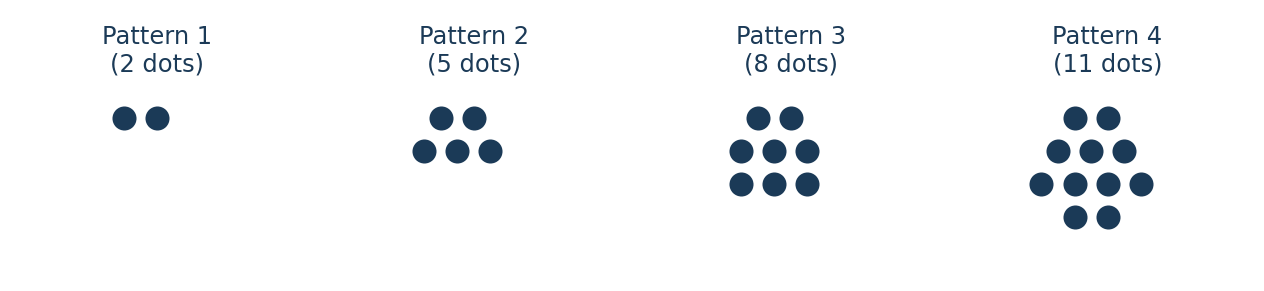
Q112. Using the sequence 2, 5, 8, 11,... (nth term 3n−1), find the 15th term.
Q113. Solve: x/3 + 2 = 7
Q114. Find the gradient of the line y=4x−3.
Q115. Find the y-intercept of the line y=4x−3.
Q116. Solve: 2(x+3)=3(x−1)
Q117. Simplify: 4x² × 3x
Q118. Solve the simultaneous equations: 3x+y=14, x−y=2
Q119. Solve the simultaneous equations: 2x+3y=16, x+y=7
Q120. Expand: (x+3)(x+5)
Q121. Expand: (x−2)(x+7)
Q122. Factorise: x²+7x+10
Q123. Factorise: x²−9
Q124. Solve: x²=49
Q125. Find the nth term of the sequence: 7, 4, 1, −2, ...
Q126. Using the sequence with nth term 10−3n, find which term equals −20.
Q127. Make x the subject: y=3x+4
Q128. Simplify: (2x³)²
Q129. Simplify: 12x4/4x²
Q130. Solve the inequality: 2x+3<11
Q131. Solve the inequality: 5−x≥2
Q132. Find the equation of a line with gradient 3 passing through (0,−2).
Q133. A line has equation y=2x+5. State its gradient and y-intercept.
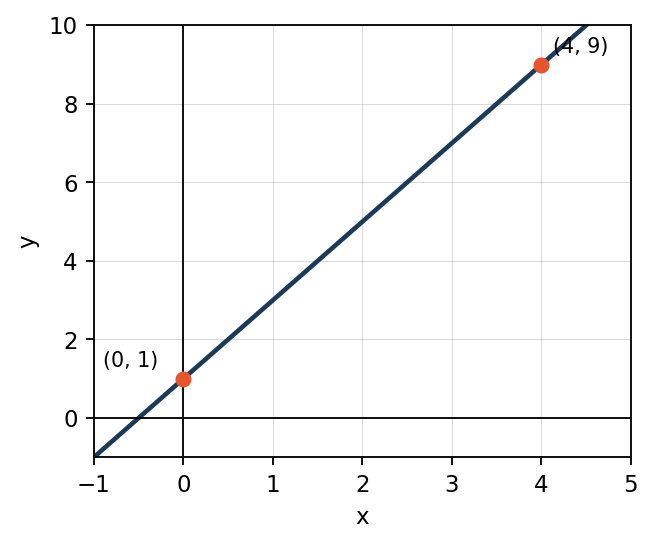
Q134. The graph shows a straight line passing through (0,1) and (4,9). Find (a) the gradient (b) the equation of the line.
Q135. Solve by factorising: x²+6x+8=0
Q136. Solve by factorising: x²−3x−10=0
Q137. Solve by factorising: x²−8x+16=0
Q138. Solve by factorising: 2x²+5x−3=0
Q139. Expand: (x+4)²
Q140. Expand: (2x−3)²
Q141. Find the nth term of the sequence: 4, 9, 14, 19, ...
Q142. Solve the simultaneous equations: y=x+1, y=x²−5
Q143. Make y the subject: 2x+3y=12
Q144. Simplify: (3x²y)(2xy³)
Q145. Solve the inequality and represent your answer using inequality notation: 3x−2≤10
Q146. The curve y=(x−2)(x+4) crosses the axes. State its roots and its y-intercept.
Q147. Factorise fully: 3x²+12x
Q148. Factorise fully: 4x²−25
Q149. Simplify fully: (x²−9)/(x+3)
Q150. Solve x²+2x−1=0 using the quadratic formula, giving your answers to 2 decimal places.
Q151. A geometric sequence has first term 3 and common ratio 2: 3, 6, 12, 24, ... Find the 6th term.
Q152. Solve by factorising: 3x²+11x+6=0
Q153. Solve x²−4x−1=0 using the quadratic formula, giving your answers to 2 decimal places.
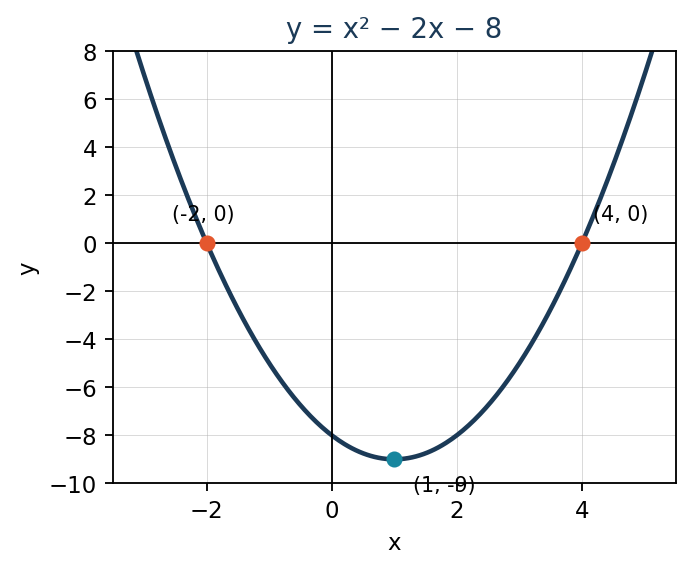
Q154. For the graph y=x²−2x−8: find the coordinates where it crosses the x-axis and the coordinates of the turning point.
Q155. Solve the inequality: x²<16
Q156. Solve the inequality: x²≥25
Q157. Solve the simultaneous equations: y=2x−1, y=x²−4x+7
Q158. Find the nth term of the quadratic sequence: 2, 7, 14, 23, 34, ...
Q159. Write as a single fraction: (2x−1)/x + 3
Q160. Write as a single fraction: 1/(x+1) + 1/(x−1)
Q161. Make x the subject: y = (2x+1)/(x−3)
Q162. Factorise fully: x³−4x
Q163. Simplify fully: (x²+5x+6)/(x+2)
Q164. Solve: 2x+1=16
Q165. Solve: 32x=81
Q166. f(x) = 2x+3. Find f(5).
Q167. A geometric sequence has first term 5 and common ratio 3. Find an expression for the nth term, and use it to find the 5th term.
Q168. Write x²+8x+3 in the form (x+a)²+b.
Q169. Solve x²−6x+2=0 by completing the square, giving exact answers.
Q170. Solve: 1/(x+2) + 2/(x−3) = 1
Q171. Given f(x)=x²−1 and g(x)=2x+3, find fg(x).
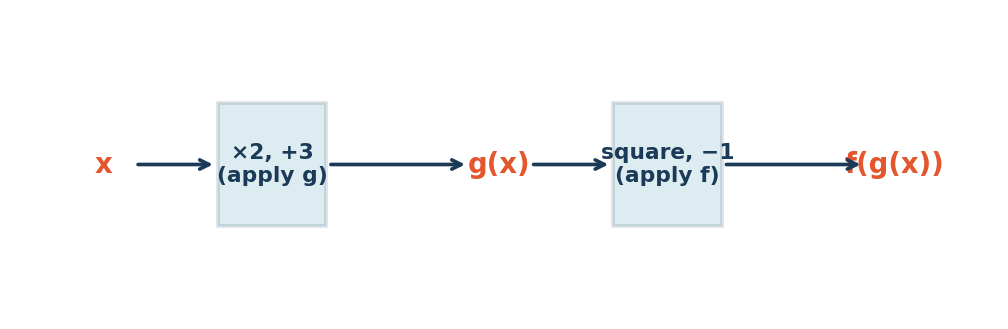
Q172. Given f(x)=x²−1 and g(x)=2x+3, find gf(x).
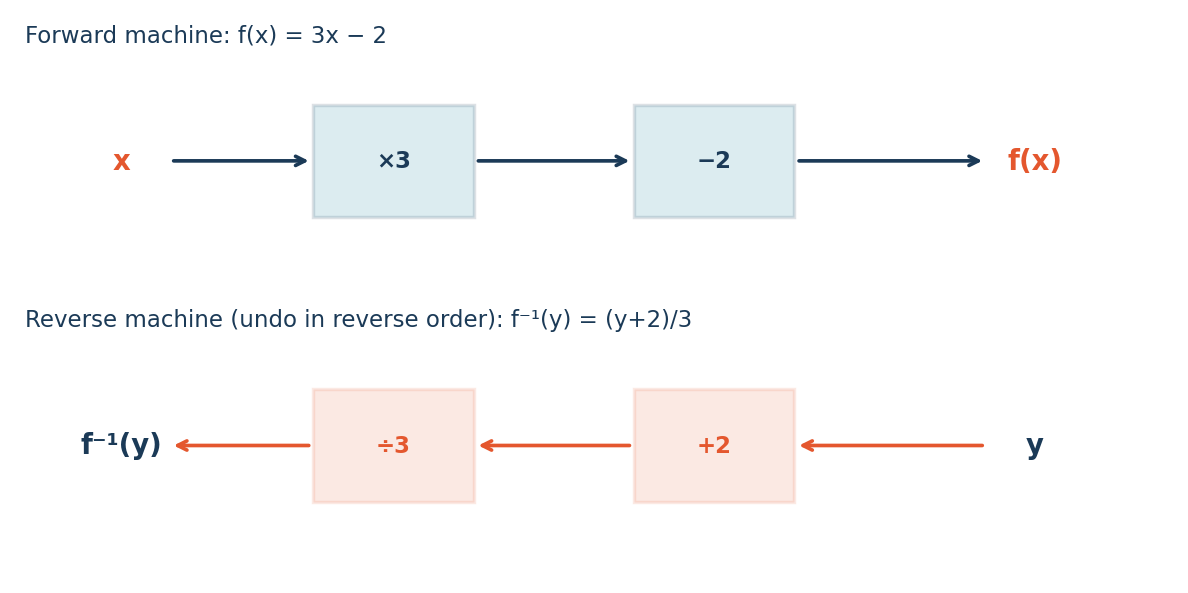
Q173. Given f(x)=3x−2, find f−1(x).
Q174. The curve y=f(x) is transformed to y=f(x)+4. Describe the transformation.
Q175. The curve y=f(x) is transformed to y=f(x−2). Describe the transformation.
Q176. Find the nth term of the quadratic sequence: 6, 11, 18, 27, 38, ...
Q177. The iteration x_(n+1) = √(3x_n+1) is used with x_0=2. Find x_1 and x_2, to 3 decimal places.
Q178. Simplify fully: (x²−4)/(x²+x−6)
Q179. Solve x²+3x−2=0 using the quadratic formula, giving your answers to 2 decimal places.
Q180. Solve the simultaneous equations: x²+y²=25, y=x+1
Q181. Factorise fully: 2x²−x−6
Q182. Write as a single fraction: 3/(x−1) − 2/(x+1)
Q183. A sequence is defined by a_(n+1)=2a_n−3, with a_1=5. Find a_2 and a_3.
Q184. Solve: 2/(x−1) − 3/(x+2) = 1
Q185. Find the nth term of the quadratic sequence: 1, 6, 15, 28, 45, ...
Q186. Given f(x) = (x+1)/(x−2), find f−1(x).
Q187. Given f(x)=x²+2 and g(x)=x−3, solve fg(x)=11.
Q188. The iteration x_(n+1) = √(2x_n+3) is used with x_0=2. Find x_3, to 3 decimal places.
Q189. The graph of y=f(x) passes through (3,7). State a point on the graph of y=f(x)−2.
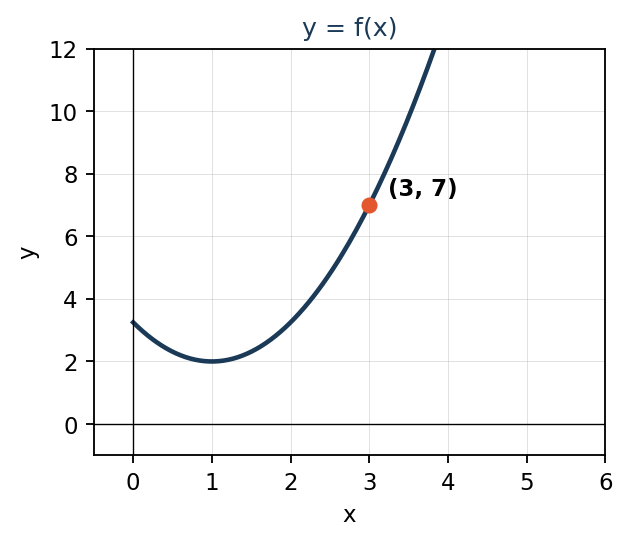
Q190. The graph of y=f(x) passes through (3,7). State a point on the graph of y=f(x+1).
Q191. The graph of y=f(x) passes through (3,7). State a point on the graph of y=2f(x).
Q192. Solve x²−5x+2=0, giving your answer in surd form.
Q193. Prove algebraically that the sum of two consecutive odd numbers is always even.
Q194. Solve: (x+1)/(x−1) = (x−2)/(x+3)
Q195. Solve the simultaneous equations: y=x²−2x, y=3x−4
Q196. Prove algebraically that (n+1)²−n² is always odd for positive integers n.
Q197. Solve: x4−5x²+4=0
Q198. Simplify fully: (2x²−8)/(x²−4x+4)
Q199. Solve the simultaneous equations: x²+y²=13, x+y=5
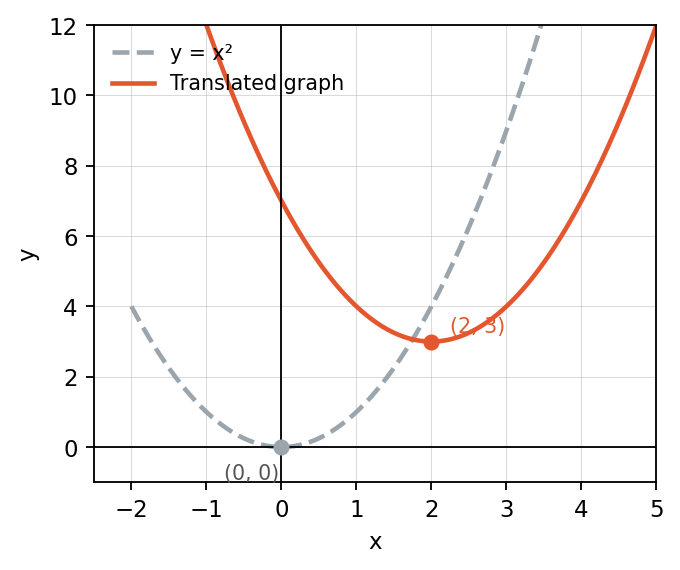
Q200. The graph shows y=x² (dashed) and a translation of it (solid). Write down the equation of the translated graph.
Q201. Share £200 in the ratio 3:2. Find the larger share.
Q202. Simplify the ratio 15:25.
Q203. Simplify the ratio 24:36.
Q204. A recipe needs flour and sugar in the ratio 5:2. If 10kg of flour is used, how much sugar is needed?
Q205. Find 20% of 150.
Q206. Find 60% of 45.
Q207. Increase 80 by 10%.
Q208. Decrease 120 by 15%.
Q209. A car travels 150 miles in 3 hours. Find its average speed.
Q210. Convert 2.5 hours into minutes.
Q211. A map has scale 1:50,000. A distance on the map is 4cm. Find the real distance in km.
Q212. Share £84 between two people in the ratio 4:3. Find each share.
Q213. Write the ratio 8:12 in its simplest form.
Q214. 3 pens cost £2.40. Find the cost of 5 pens.
Q215. A car uses 6 litres of petrol to travel 84km. How far can it travel on 10 litres?
Q216. Find 45% of 80.
Q217. Share 60 sweets in the ratio 1:2:3. Find the largest share.
Q218. Share £360 in the ratio 2:3:4. Find the middle share.
Q219. A photo measuring 10cm by 15cm is enlarged by scale factor 3/2. Find the new dimensions.
Q220. Find the original price if, after a 20% discount, an item costs £48.
Q221. Find the original price if, after a 15% increase, a price becomes £69.
Q222. Two numbers are in the ratio 5:7 and their sum is 96. Find the two numbers.
Q223. A train travels 240km in 3 hours. Find its speed in km/h.
Q224. A recipe for 6 people uses 300g of rice. How much rice is needed for 15 people?
Q225. Convert 0.75 hours to minutes.
Q226. A car uses fuel at a rate of 8km per litre. How many litres are needed for a 200km journey?
Q227. £500 is invested for 1 year at 4% simple interest. Find the interest earned.
Q228. Find 3/8 of £96.
Q229. Divide £150 in the ratio 1:2:2.
Q230. A map scale is 1:25,000. Find the real distance, in km, represented by 6cm on the map.
Q231. Two lengths are in the ratio 3:5. If the shorter is 21cm, find the longer.
Q232. A rectangle has length:width ratio 4:3 and length 20cm. Find its width.
Q233. Simplify the ratio 0.4:1.6.
Q234. Find the percentage increase from 40 to 52.
Q235. x and y are in direct proportion. When x=5, y=20. Find y when x=8.
Q236. A car travels at constant speed, covering 180km in 2 hours 30 minutes. Find its speed in km/h.
Q237. A journey takes 4 hours at 60mph. How long would it take at 80mph?
Q238. 5 workers can build a wall in 12 days. How many days would 3 workers take?
Q239. Convert a speed of 15 m/s to km/h.
Q240. Convert a speed of 72 km/h to m/s.
Q241. Density = mass ÷ volume. Find the density of an object with mass 60g and volume 15cm³.
Q242. Find the mass of an object with density 2.5g/cm³ and volume 40cm³.
Q243. A car depreciates from £15,000 to £12,000 in one year. Find the percentage decrease.
Q244. Find the compound interest on £2000 at 5% per annum for 2 years.
Q245. Two similar triangles have a scale factor of 3. If the area of the smaller is 8cm², find the area of the larger.
Q246. Two similar shapes have a length ratio of 2:5. Find the ratio of their areas.
Q247. A recipe for 8 people needs 3 eggs. How many eggs (to the nearest whole number) are needed for 20 people?
Q248. Pressure = Force ÷ Area. Find the pressure exerted by a force of 240N over an area of 4m².
Q249. y is directly proportional to x. When x=6, y=15. Find x when y=25.
Q250. A photo is enlarged by a scale factor of 1.5. If the original width is 8cm, find the new width.
Q251. Two similar cylinders have volumes in the ratio 8:125. Find the ratio of their heights.
Q252. y is inversely proportional to x. When x=3, y=20. Find y when x=12.
Q253. p is inversely proportional to q². When q=2, p=9. Find p when q=3.
Q254. The cost, C, of a journey is directly proportional to the distance, d. If C=£15 when d=50 miles, find C when d=80 miles.
Q255. Two similar solids have volumes 64cm³ and 216cm³. Find the ratio of their surface areas.
Q256. A map has scale 1:20,000. Two towns are 8.5cm apart on the map. Find the real distance in km.
Q257. Find the compound interest on £3000 at 3.5% per annum for 3 years, to the nearest penny.
Q258. A car depreciates by 18% each year. Find its value after 2 years if it started at £22,000.
Q259. y=kx³. When x=2, y=40. Find y when x=5.
Q260. A recipe requires flour, butter, and sugar in the ratio 6:3:2. If 180g of flour is used, find the total mass of all three ingredients.
Q261. a is inversely proportional to b, and a=8 when b=5. Find b when a=20.
Q262. After a 12% decrease, a value is 396. Find the original value.
Q263. Two similar containers have surface areas in the ratio 9:25. Find the ratio of their volumes.
Q264. A speed camera measures a car covering 40m in 1.6 seconds. Find its speed in km/h.
Q265. £1200 is invested at 6% compound interest. Find its value after 4 years, to the nearest pound.
Q266. y varies directly as the square root of x. When x=16, y=8. Find y when x=25.
Q267. Two similar shapes have a volume ratio of 27:64. Find the ratio of a pair of corresponding lengths.
Q268. p is directly proportional to q³. When q=2, p=40. Find p when q=5.
Q269. y is inversely proportional to x². When x=4, y=3. Find y when x=2.
Q270. A quantity decays exponentially, decreasing by 8% each year from an initial value of £5000. Find its value after 5 years, to the nearest pound.
Q271. Two similar cones have heights in ratio 2:3. The smaller has volume 32cm³. Find the volume of the larger.
Q272. Find the original amount if, after two successive 10% decreases, the amount is £324.
Q273. A car's value depreciates by 20% in the first year and 15% in each subsequent year. Find its value after 3 years if it started at £20,000.
Q274. y=kx², and y=48 when x=4. Find x when y=75.
Q275. A sphere and a cone are mathematically similar. Their surface areas are in the ratio 4:9. Find the ratio of their volumes.
Q276. £8000 is invested at compound interest. After 3 years, it has grown to £9261. Find the annual interest rate.
Q277. A radioactive isotope has a half-life of 3 years. Starting with 400g, find the mass remaining after 12 years.
Q278. Two similar prisms have volumes 27cm³ and 125cm³. Find the ratio of their surface areas.
Q279. y is directly proportional to x². Given y=18 when x=3, find x when y=200.
Q280. A car's value V after t years is V=15,000×(0.85)^t. Find the value after 5 years, to the nearest pound.
Q281. a³ is directly proportional to b, and a=2 when b=40. Find a when b=135.
Q282. A quantity increases by 5% per year. Write an expression, in terms of n, for the value after n years if the initial value is £P.
Q283. Two similar solids made of the same material have masses in the ratio 8:27. Find the ratio of their surface areas.
Q284. p varies inversely as the cube of q. When q=2, p=10. Find q when p=1.25.
Q285. Two similar solids have volumes in the ratio 125:512. Find the ratio of their surface areas.
Q286. A population grows exponentially at 4% per year. Find, to the nearest whole number, the population after 10 years if it starts at 12,000.
Q287. A sum invested at compound interest of r% per annum increases by a factor of 1.3382 (to 4 d.p.) after 5 years. Find r, to 1 decimal place.
Q288. A car's value falls from £25,000 to £14,762.50 in 3 years, decreasing by the same percentage each year. Find the annual percentage decrease, to 1 decimal place.
Q289. y²=kx. Given y=6 when x=3, find y when x=12 (where y>0).
Q290. A radioactive substance decays exponentially with a half-life of 5 years. Find the percentage remaining after 8 years, to 1 decimal place.
Q291. Prove algebraically that if a is directly proportional to b, and b is directly proportional to c, then a is directly proportional to c.
Q292. Two similar cylinders have radii in the ratio 3:4. Find the ratio of (a) their curved surface areas (b) their volumes.
Q293. Q is inversely proportional to the square root of t. When t=4, Q=10. Find Q when t=25.
Q294. The value of an investment increases by x% each year. After 2 years, its value has increased by 21%. Find x.
Q295. A cone of height 12cm is cut by a plane parallel to its base, 1/3 of the way up from the apex (so the small similar cone has height 4cm). Find the ratio of the volume of the small cone to the volume of the remaining frustum.
Q296. p is proportional to q³ and inversely proportional to r. p=20 when q=2 and r=4. Find p when q=3 and r=9.
Q297. Two similar shapes have areas in the ratio 16:81. A length on the smaller shape is 8cm. Find the corresponding length on the larger shape.
Q298. A bacteria population is modelled as P=P0 × 2^(t/20), where t is in minutes. Find, to the nearest minute, how long it takes for the population to triple.
Q299. Find the original value if, after a 12% increase followed by a 12% decrease (applied successively), the result is £4878.72.
Q300. Prove that if x is inversely proportional to y, and y is inversely proportional to z, then x is directly proportional to z.
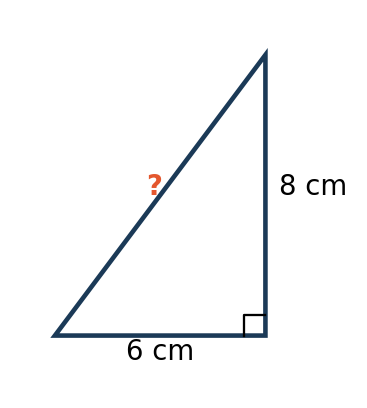
Q301. Find the missing side of a right-angled triangle with legs 6cm and 8cm.
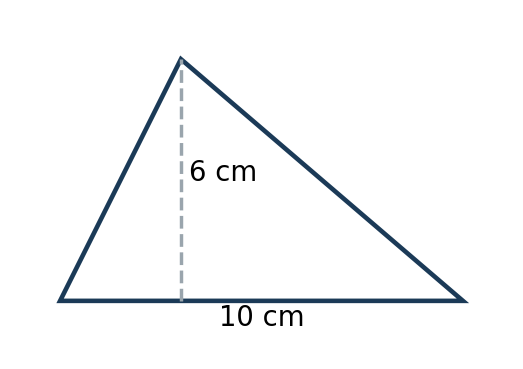
Q302. Find the area of a triangle with base 10cm and height 6cm.
Q303. Find the sum of the interior angles of a quadrilateral.
Q304. Find the circumference of a circle with radius 7cm, using π=3.14, to 1 decimal place.
Q305. Find the area of a circle with radius 5cm, using π=3.14, to 1 decimal place.
Q306. Find the area of a rectangle 8cm by 5cm.
Q307. Find the perimeter of a rectangle 8cm by 5cm.
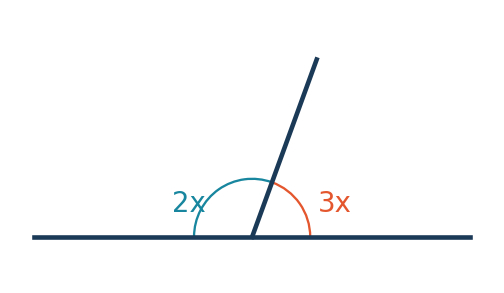
Q308. Two angles on a straight line are 3x and 2x. Find x.
Q309. Find the volume of a cuboid 4cm × 3cm × 2cm.
Q310. A triangle has angles 50° and 65°. Find the third angle.
Q311. Reflect the point (3,2) in the x-axis.
Q312. Translate the point (1,4) by the vector (3,−2).
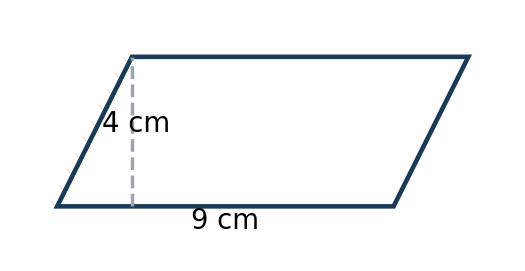
Q313. Find the area of a parallelogram with base 9cm and height 4cm.
Q314. Rotate the point (2,0) by 90° clockwise about the origin.
Q315. Find the size of one interior angle of a regular hexagon.
Q316. Find the surface area of a cube with side length 4cm.
Q317. Enlarge the point (2,3) by scale factor 2, centre the origin.
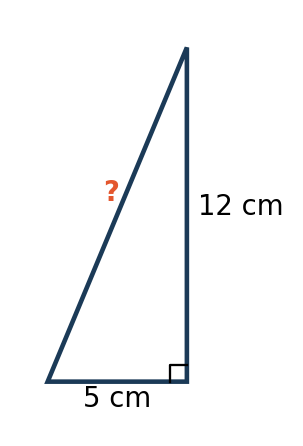
Q318. Find the hypotenuse of a right-angled triangle with legs 5cm and 12cm.
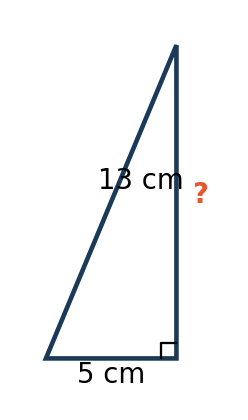
Q319. A right-angled triangle has hypotenuse 13cm and one leg 5cm. Find the other leg.
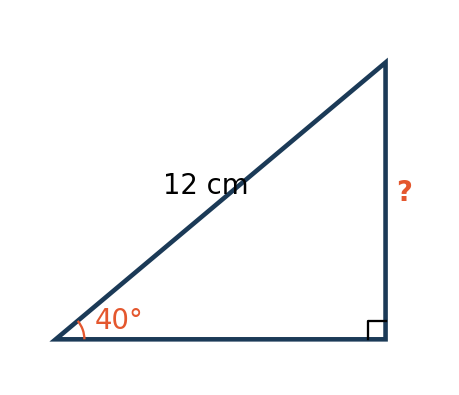
Q320. In a right-angled triangle, one angle is 40° and the hypotenuse is 12cm. Find the side opposite this angle, to 1 decimal place.
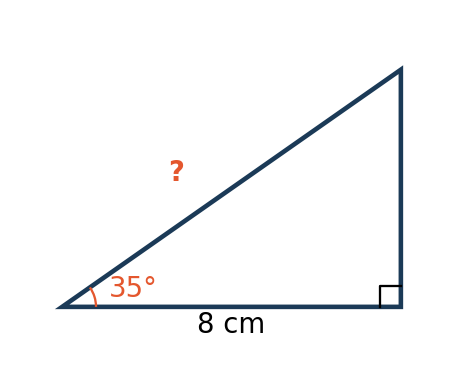
Q321. In a right-angled triangle, one angle is 35° and the adjacent side is 8cm. Find the hypotenuse, to 1 decimal place.
Q322. Find the volume of a cuboid 5cm × 4cm × 3cm.
Q323. Find the surface area of a cuboid 5cm × 4cm × 3cm.
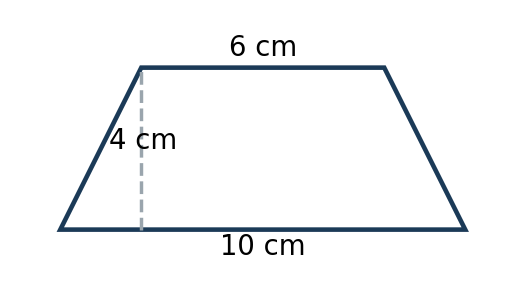
Q324. Find the area of a trapezium with parallel sides 6cm and 10cm and height 4cm.
Q325. Find the volume of a cylinder with radius 3cm and height 10cm, to 1 decimal place.
Q326. A triangle has angles 65° and 48°. Find the third angle.
Q327. Find the area of a circle with diameter 10cm, to 1 decimal place.
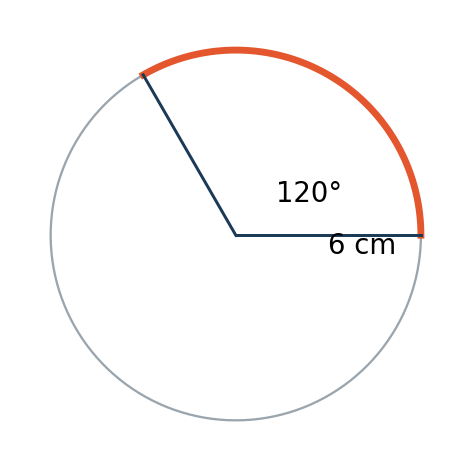
Q328. Find the length of an arc: radius 6cm, angle 120°, to 1 decimal place.
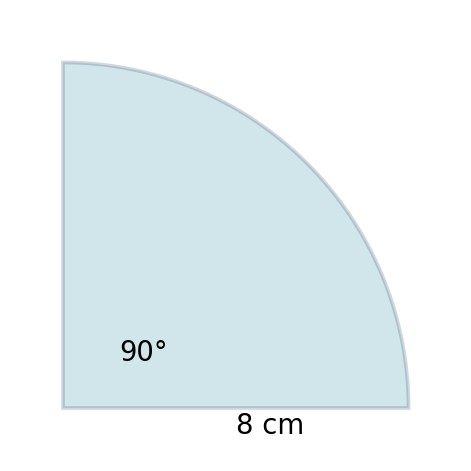
Q329. Find the area of a sector: radius 8cm, angle 90°, to 1 decimal place.
Q330. Reflect the point (−2,5) in the y-axis.
Q331. Find the volume of a triangular prism with cross-sectional area 15cm² and length 8cm.
Q332. Describe fully the single transformation that maps triangle A to triangle B, given B is the image of A reflected in the line y=x.
Q333. Point A is due north of point B. Find the bearing of B from A.
Q334. Two angles in a triangle are equal and the third is 40°. Find the two equal angles.
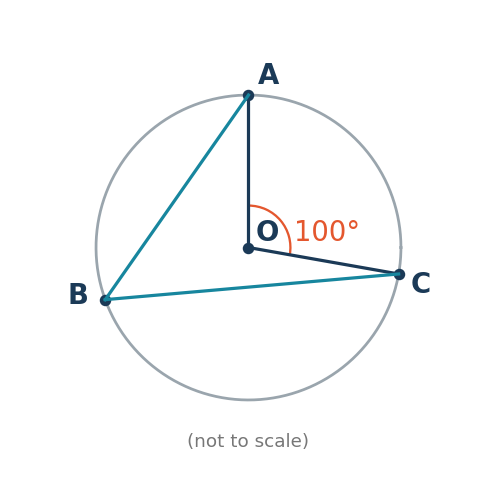
Q335. Points A, B, C lie on a circle. Angle AOC at the centre O is 100°. Find angle ABC at the circumference.
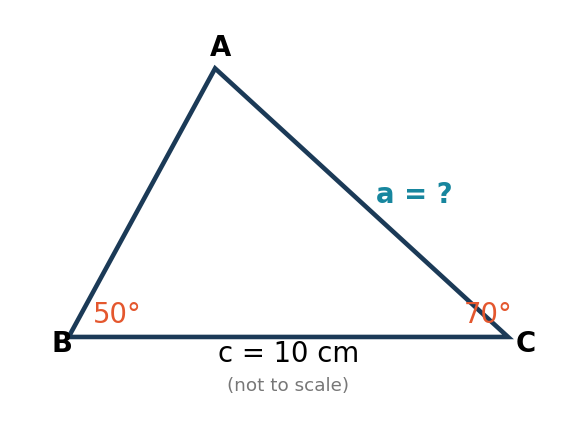
Q336. In triangle ABC, angle A=50°, angle C=70°, side c=10cm (opposite C). Find side a (opposite A), to 1 decimal place.
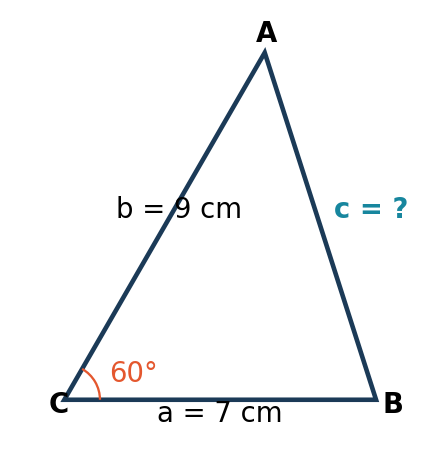
Q337. In triangle ABC, a=7cm, b=9cm, angle C=60°. Find side c using the cosine rule, to 1 decimal place.
Q338. Two similar shapes have a scale factor of 4. The smaller has area 10cm². Find the area of the larger.
Q339. Find the arc length: radius 6cm, angle 120°, giving your answer in terms of π.
Q340. Find the sector area: radius 8cm, angle 90°, giving your answer in terms of π.
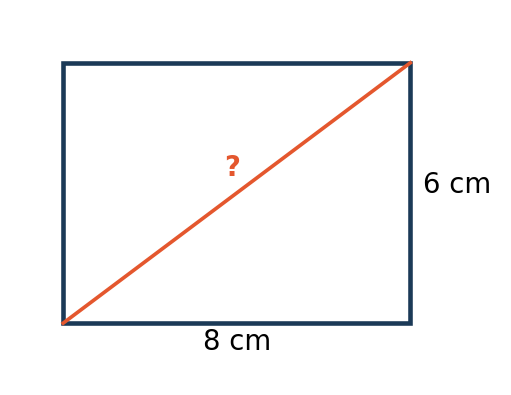
Q341. Find the length of the diagonal of a rectangle 6cm by 8cm.
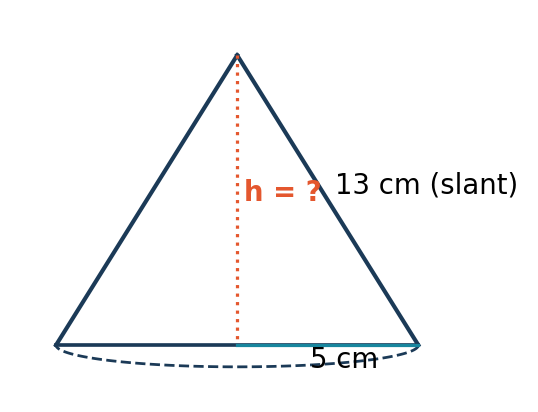
Q342. A cone has radius 5cm and slant height 13cm. Find its perpendicular height.
Q343. Find the volume of a pyramid with base area 24cm² and height 9cm.
Q344. Two similar solids have a length ratio of 3:7. Find the ratio of their volumes.
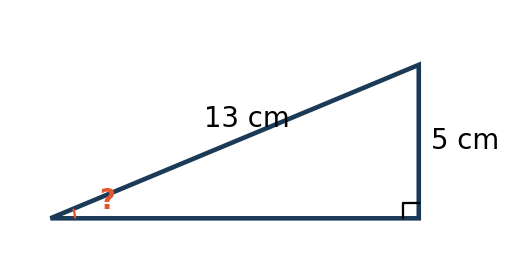
Q345. In a right-angled triangle, the opposite side is 5cm and the hypotenuse is 13cm. Find the angle, to 1 decimal place.
Q346. State the equation of a circle with centre (0,0) and radius 5.
Q347. Find the midpoint of (2,3) and (8,11).
Q348. Find the distance between (1,2) and (4,6).
Q349. Describe the locus of points equidistant from two fixed points A and B.
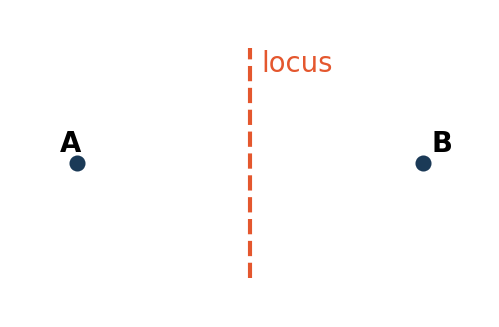
Q350. Find the interior angle sum of a regular nonagon (9 sides).
Q351. A triangle is inscribed in a semicircle (diameter as one side). One of the other angles is 35°. Find the third angle.
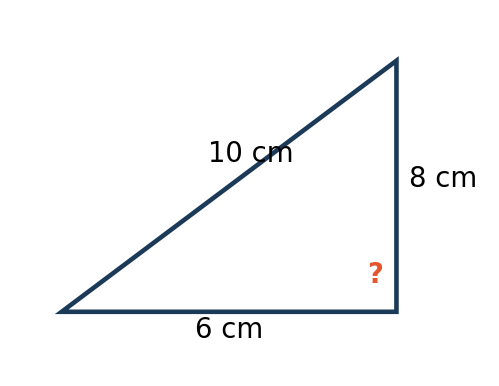
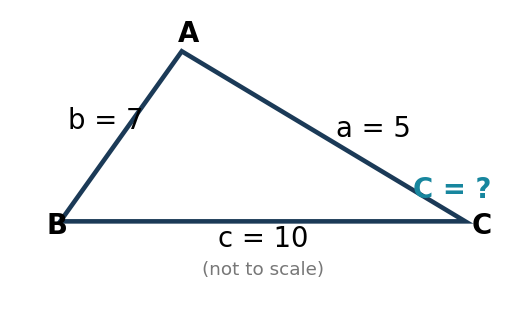
Q352. Use the cosine rule to show that a triangle with sides 6, 8, 10 is right-angled (find the angle opposite the side of length 10).
Q353. An arc has length 15.7cm on a circle of radius 10cm. Find the angle subtended at the centre, to the nearest degree.
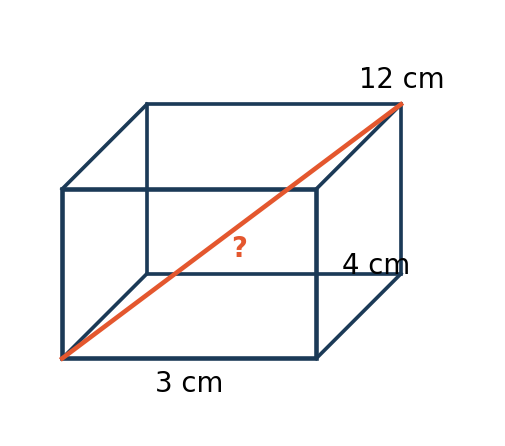
Q354. A cuboid has dimensions 3cm × 4cm × 12cm. Find the length of the space diagonal.
Q355. Find the volume of a cone with radius 6cm and height 10cm, to 1 decimal place.
Q356. Find the volume of a sphere with radius 9cm, to the nearest whole number.
Q357. Find the surface area of a sphere with radius 7cm, to the nearest whole number.
Q358. A ship sails on a bearing of 065°, then turns onto a bearing of 155°. Find the angle turned through.
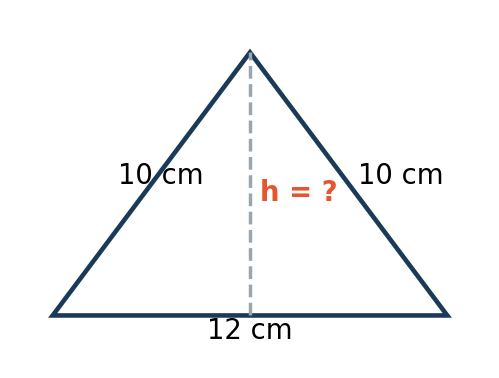
Q359. An isosceles triangle has equal sides 10cm and base 12cm. Find its perpendicular height.
Q360. Two similar cones have surface areas in the ratio 9:16. Find the ratio of their heights.
Q361. The angle at the centre of a circle for a given arc is 76°. Find the angle at the circumference subtended by the same arc.
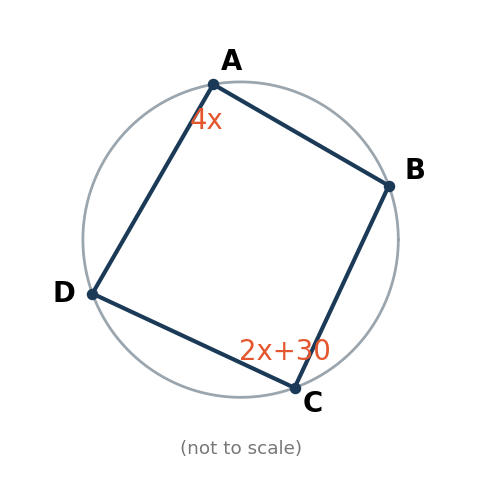
Q362. A cyclic quadrilateral has opposite angles 4x and 2x+30. Find x.
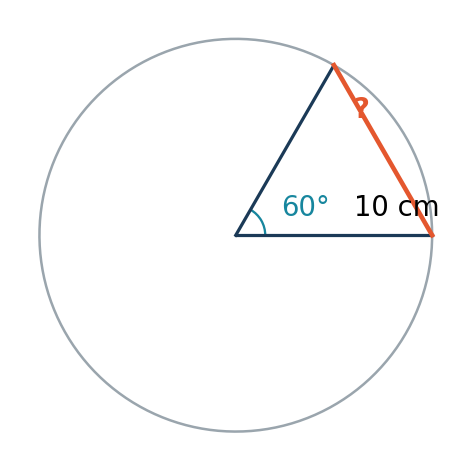
Q363. A circle has radius 10cm. A chord subtends an angle of 60° at the centre. Find the length of the chord.
Q364. A cone has curved surface area 220cm² and slant height 14cm (A=πrl). Find the radius, to 1 decimal place.
Q365. A frustum is formed by removing a cone of radius 3cm and height 6cm from a similar cone of radius 6cm and height 12cm. Find the volume of the frustum, to 1 decimal place.
Q366. A(1,1), B(5,1), C(5,4) form a right triangle. Find the length of the hypotenuse AC.
Q367. A regular polygon has an exterior angle of 24°. Find the number of sides.
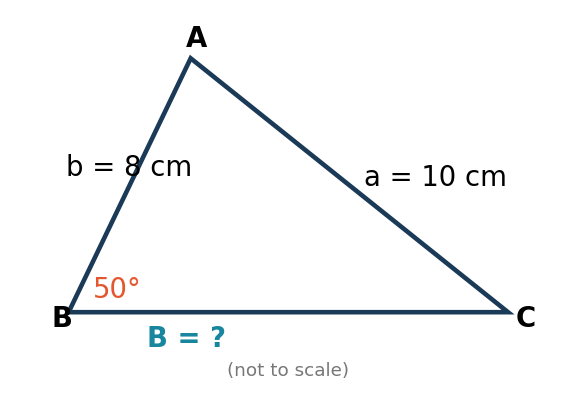
Q368. In triangle ABC, a=10, angle A=50°, b=8. Use the sine rule to find angle B, to 1 decimal place.
Q369. In triangle ABC, a=5, b=7, c=10. Use the cosine rule to find angle C (opposite c), to 1 decimal place.
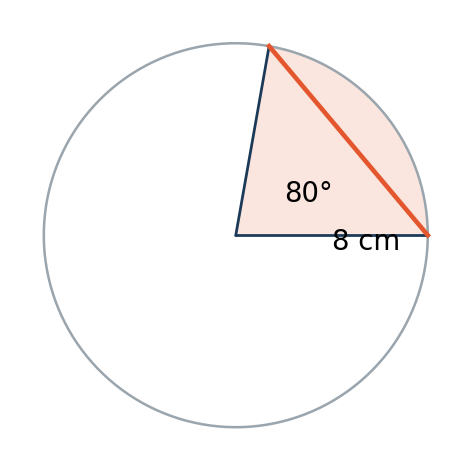
Q370. Find the area of a segment of a circle: radius 8cm, angle 80°, to 1 decimal place.
Q371. Two similar pyramids have volumes 64cm³ and 729cm³. Find the ratio of their surface areas.
Q372. A cone has base radius 5cm and vertical height 12cm. Find its curved surface area in terms of π.
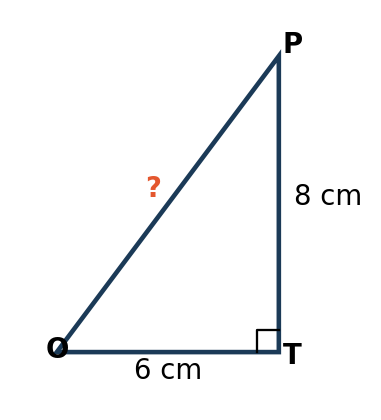
Q373. PT is a tangent to a circle at T with centre O. OT=6cm and PT=8cm. Find OP.
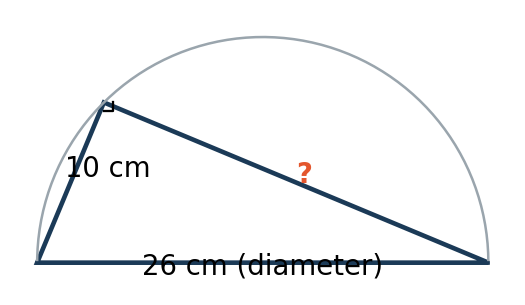
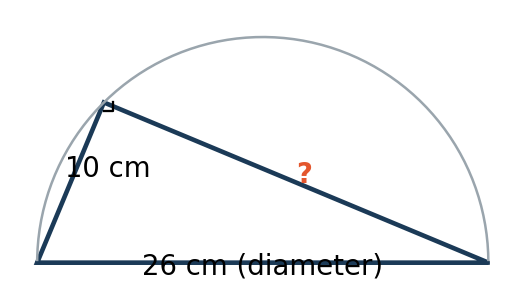
Q374. A triangle is inscribed in a semicircle with diameter 26cm and one other side 10cm. Find the third side.
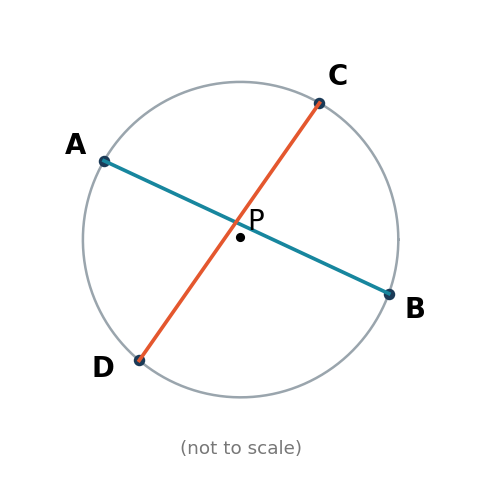
Q375. Chords AB and CD intersect at P inside a circle. AP=4, PB=9, CP=6. Find PD.
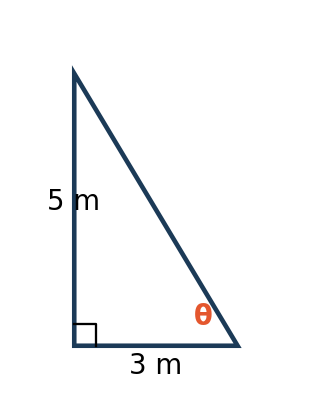
Q376. A vertical pole of height 5m casts a shadow of 3m. Find the angle of elevation of the sun, to 1 decimal place.
Q377. Find the volume of a frustum formed by removing a cone of radius 3cm and height 4cm from a similar cone of radius 9cm and height 12cm, to 1 decimal place.
Q378. A cyclic quadrilateral ABCD has angle A=3x−10 and angle C=x+50. Find x.
Q379. In triangle ABC, angle A=112°, angle B=35°, side a=20cm. Find side b, to 1 decimal place.
Q380. Find the total surface area of a hemisphere with radius 6cm, in terms of π.
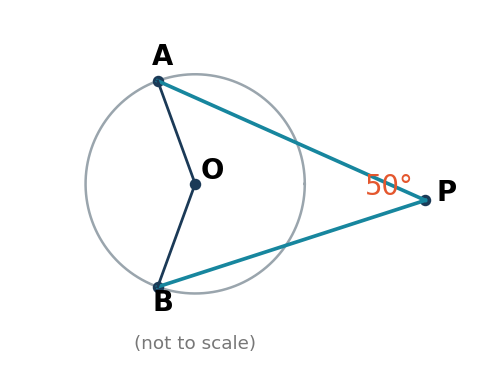
Q381. Two tangents from external point P touch a circle (centre O) at A and B. Angle APB=50°. Find angle AOB.
Q382. Find the length of AB, given A(−3,2) and B(5,−4).
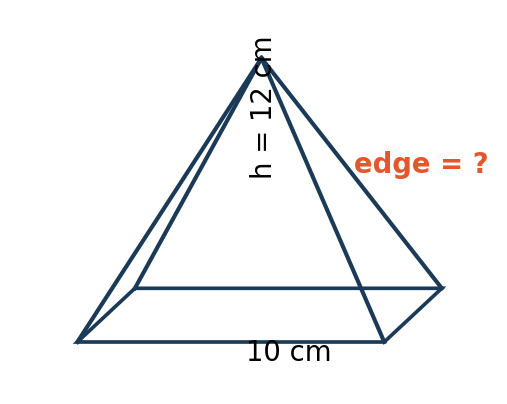
Q383. A right pyramid has a square base of side 10cm and height 12cm. Find the length of a sloping edge, to 1 decimal place.
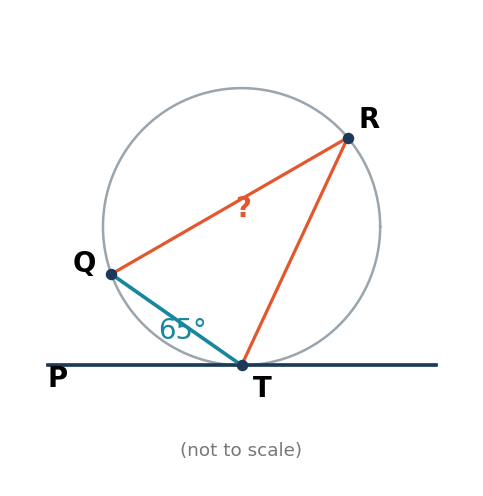
Q384. A tangent-chord angle is 65°. Using the alternate segment theorem, find the angle in the alternate segment.
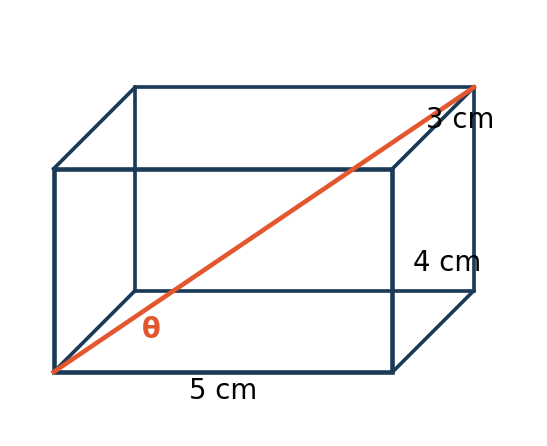
Q385. A cuboid has dimensions 5cm, 4cm and 3cm. Find the angle the space diagonal makes with the base, to 1 decimal place.
Q386. Find the area of triangle ABC given a=7, b=9, angle C=60°, using Area = 1/2 ab sinC, in exact surd form.
Q387. State the condition used to prove two triangles congruent when you know two sides and the included angle are equal in each.
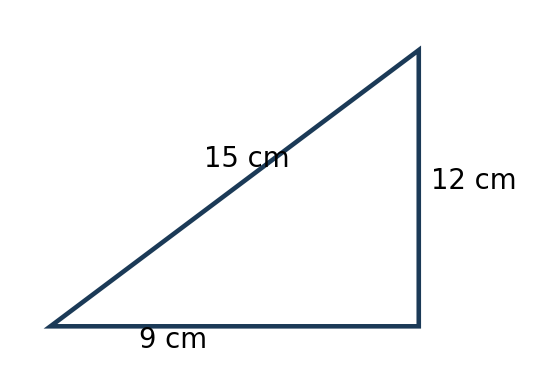
Q388. A triangle has sides 9cm, 12cm, 15cm. Show that it is right-angled, then find its area.
Q389. Find the volume of a frustum of a cone: r1=4cm, r2=10cm, height 9cm, using V=1/3 πh(r1²+r1r2+r2²), in terms of π.
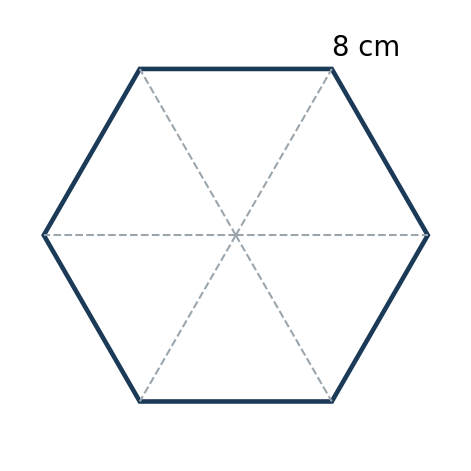
Q390. A regular hexagon has side length 8cm. Find its area, using the fact that it is made of 6 equilateral triangles, in exact surd form.
Q391. Given vectors a=(3,1) and b=(−1,4), find |a+b|, to 2 decimal places.
Q392. State the reasoning (congruence condition) used to prove that the perpendicular from the centre of a circle to a chord bisects the chord.
Q393. A triangle has sides in the ratio 3:4:5 and perimeter 36cm. Find its area.
Q394. Find the exact value of sin60°cos30° − sin30°cos60°, using exact surd values.
Q395. Two similar cones have slant heights 6cm and 15cm. The smaller has curved surface area 30π cm². Find the curved surface area of the larger.
Q396. Find angle θ such that cosθ=−0.5, for 0°≤θ≤360°.
Q397. In triangle ABC, angle A=30°, a=5, b=8. Use the sine rule to find the two possible values of angle B, to 1 decimal place.
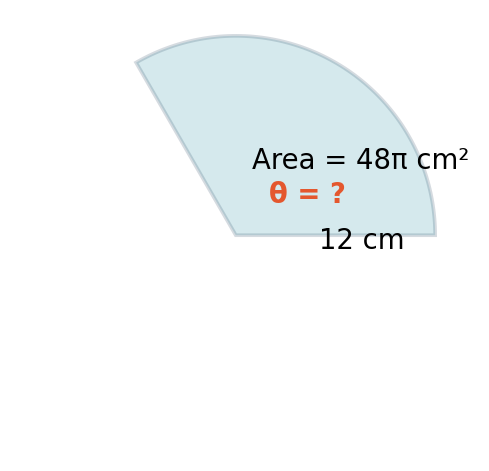
Q398. A sector of a circle has radius 12cm and area 48π cm². Find the angle of the sector.
Q399. Find the equation of a circle with centre (2,−3) and radius 5.
Q400. A circle has radius 5cm and centre O. An external point P is 13cm from O. Find the length of the tangent from P to the circle.
Q401. Find the mean of: 3, 5, 7, 9, 6.
Q402. Find the median of: 12, 7, 15, 9, 11.
Q403. Find the mode of: 4, 7, 4, 9, 4, 2.
Q404. Find the range of: 15, 8, 22, 3, 17.
Q405. A bag has 4 red, 3 blue, 3 green counters. Find P(red).
Q406. A fair die is rolled. Find P(even number).
Q407. A spinner has sections numbered 1-8. Find P(number greater than 5).
Q408. Two fair coins are flipped. List all outcomes and find P(two heads).
Q409. Find the mean of: 10, 12, 14, 16, 18.
Q410. In a survey, 15 people preferred tea and 25 preferred coffee. Find the probability a randomly chosen person prefers coffee.
Q411. Find the median of: 3, 8, 5, 9, 2, 7.
Q412. A bag has 10 balls, 6 of which are red. Find P(not red).
Q413. Find the range of: 45, 60, 38, 72, 50.
Q414. A card is drawn from a standard deck of 52. Find P(heart).
Q415. Find the mean of: 2, 2, 2, 2, 2.
Q416. A fair 6-sided die is rolled twice. Find P(both rolls give a 6).
Q417. Find the mode of: 3,3,3,7,7,9,9,9,9.
Q418. Find the mean from the frequency table: value 1, 2, 3, 4 with frequencies 2, 5, 4, 1.
Q419. In a class of 32 students, 25 study French. Find the number of students who do NOT study French.
Q420. A bag has 5 red, 4 blue, 3 green balls. One is drawn. Find P(blue or green).
Q421. Two fair dice are rolled. Find P(sum=7).
Q422. Find the interquartile range of: 2, 4, 5, 7, 9, 12, 15, 18.
Q423. A spinner has 4 equal sections: red, blue, green, yellow. It is spun twice. Find P(same colour both times).
Q424. Find the mean from the frequency table: score 0, 1, 2 with frequencies 5, 8, 7.
Q425. A survey of 50 people found 30 like chocolate, 25 like vanilla, and 15 like both. Find how many like neither.
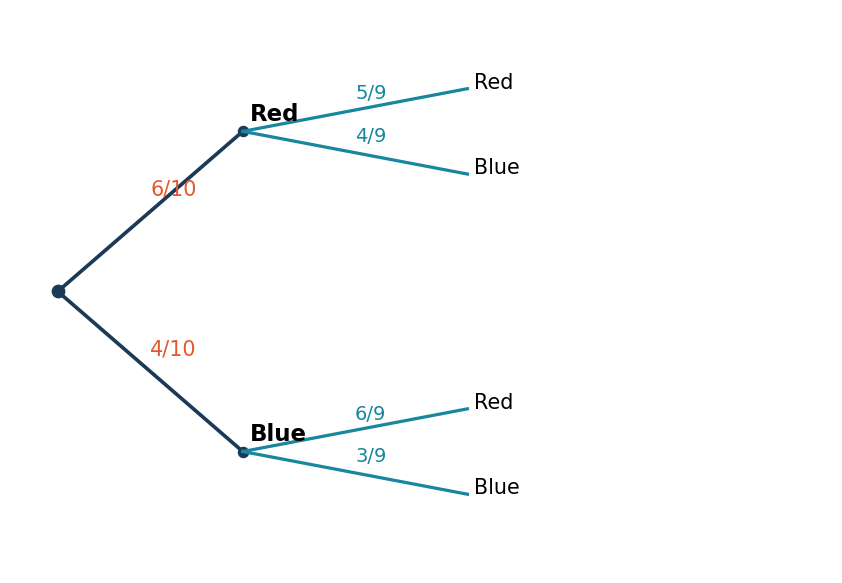
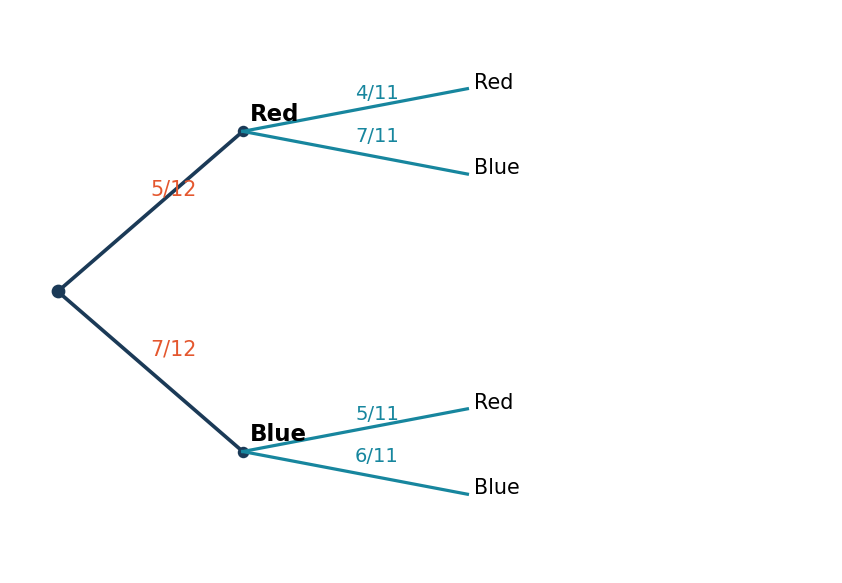
Q426. A bag has 6 red and 4 blue counters. One is removed and not replaced, then a second is drawn. Find P(both blue).
Q427. Find the estimated mean of grouped data: class 0-10 (freq 3), 10-20 (freq 5), 20-30 (freq 2).
Q428. Find P(not rolling a 3) on a fair die.
Q429. A box has 3 red and 5 blue pens. Two are picked without replacement. Find P(first red, second blue).
Q430. Find the interquartile range of: 1, 3, 5, 7, 9, 11, 13.
Q431. 60% of people are right-handed and the rest are left-handed. In a sample of 40 people, how many are left-handed?
Q432. A fair coin is flipped 3 times. Find P(exactly 2 heads).
Q433. The total of 8 numbers is 96. Find their mean.
Q434. Two mutually exclusive events A and B have P(A)=0.3 and P(B)=0.25. Find P(A or B).
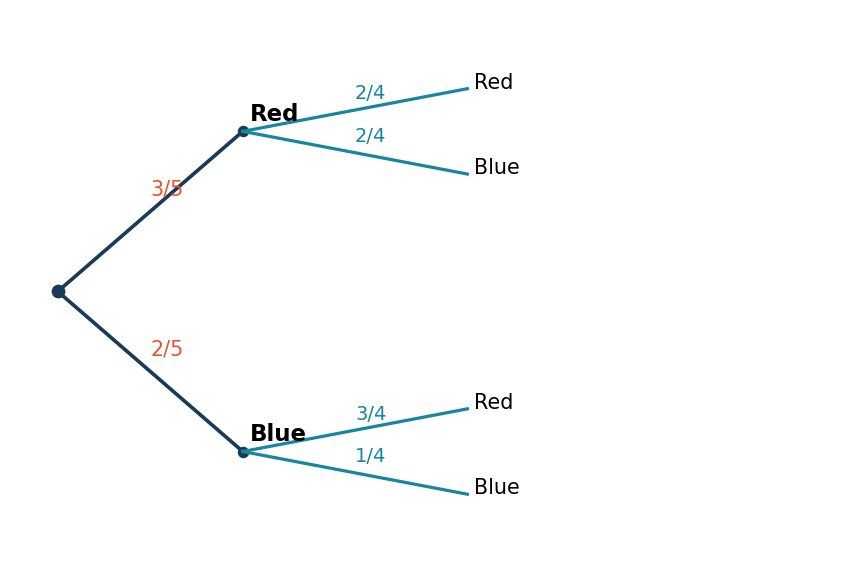
Q435. A bag has 3 red and 2 blue counters. Two are drawn without replacement. Find P(both the same colour).
Q436. A spinner has P(win)=0.3. It is spun twice. Find P(win exactly once).
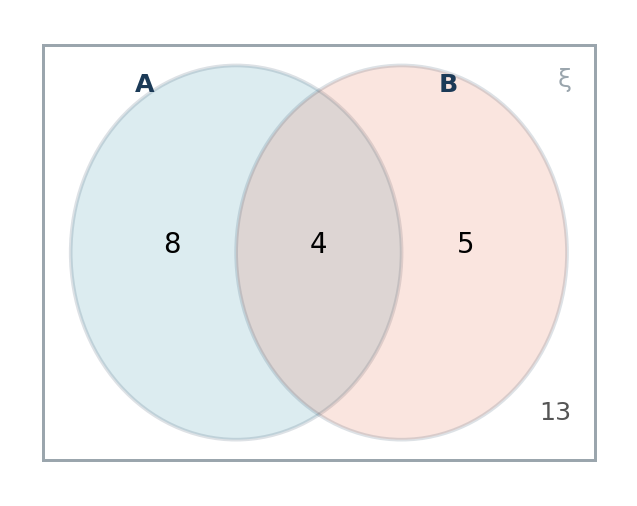
Q437. In a class of 30, 18 study French, 15 study Spanish, and 6 study both. Find P(studies neither).
Q438. Estimate the median from a grouped frequency table: 0-10 (freq 4), 10-20 (freq 10), 20-30 (freq 6), total 20.
Q439. Estimate the mean of the grouped data: 0-10 (mid 5, freq 4), 10-20 (mid 15, freq 10), 20-30 (mid 25, freq 6).
Q440. A Venn diagram shows |A|=12, |B|=9, |A∩B|=4, in a universal set of 30. Find P(A only).
Q441. Two fair dice are rolled. Find P(sum is a multiple of 3).
Q442. A bag has 4 red and x blue counters. If P(red)=2/5, find x.
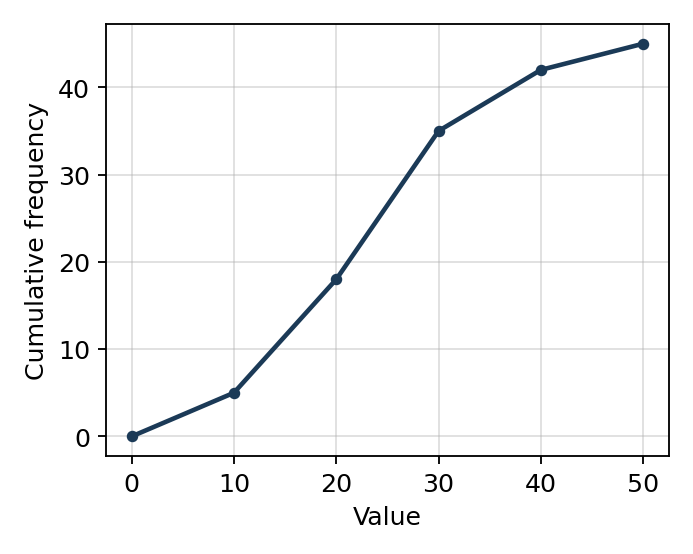
Q443. A cumulative frequency table gives: ≤10: 5, ≤20: 18, ≤30: 35, ≤40: 42, ≤50: 45. Find how many values lie between 20 and 30.
Q444. A biased coin has P(heads)=0.6. It is flipped twice. Find P(at least one head).
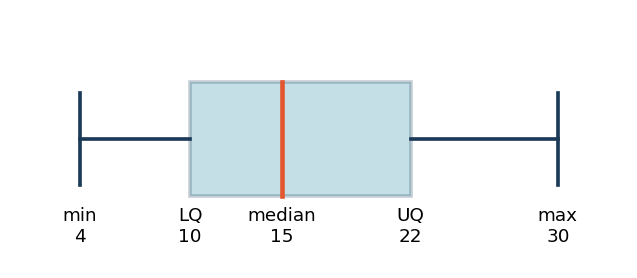
Q445. A box plot has min=4, LQ=10, median=15, UQ=22, max=30. Find the interquartile range.
Q446. A card is drawn from a standard deck. Find P(king or heart).
Q447. In a group of 25 students, P(left-handed)=0.2. Find how many students are left-handed.
Q448. Two spinners: Spinner A has P(red)=0.5; Spinner B has P(red)=0.4. Both are spun. Find P(both red).
Q449. Using the spinners from the previous question, find P(neither red).
Q450. A sample of 40 items has mean 25. Find the total sum of all items.
Q451. P(A)=0.4, and A, B are independent with P(A and B)=0.12. Find P(B).
Q452. P(A)=0.5, P(B)=0.3, P(A and B)=0.15. Show that A and B are independent.
Q453. A bag has 5 red and 7 blue balls. Two are drawn without replacement. Find P(different colours).
Q454. A cumulative frequency graph gives LQ=18 and UQ=41. Find the interquartile range.
Q455. A survey of 200 people: 120 own a car, 90 own a bike, 50 own both. Find P(owns exactly one of the two).
Q456. Estimate the mean of grouped data: 10-20 (mid 15, freq 8), 20-30 (mid 25, freq 12), 30-40 (mid 35, freq 10), to 2 decimal places.
Q457. A biased die has P(6)=0.3, and the other five outcomes are equally likely. Find P(1).
Q458. Two independent events: P(A)=0.6, P(B)=0.5. Find P(exactly one of A, B occurs).
Q459. Find P(drawing 2 aces in a row) from a standard deck, without replacement.
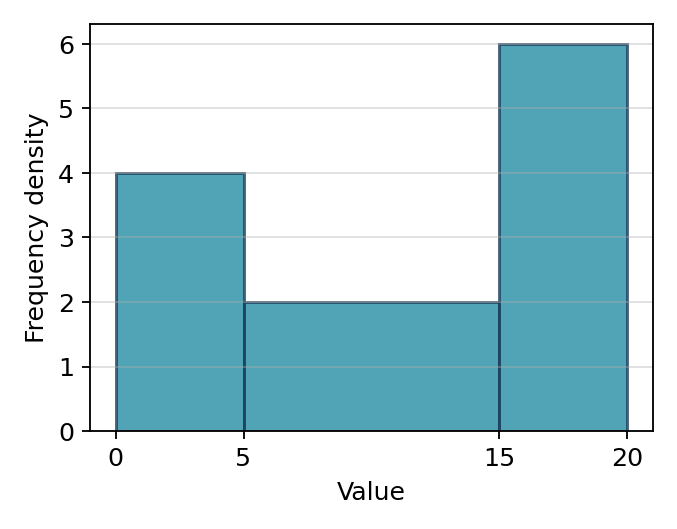
Q460. A histogram has bars: 0-5 (height 4), 5-15 (height 2), 15-20 (height 6). Find the total frequency.
Q461. 10 values have mean 20. An 11th value of 35 is added. Find the new mean, to 2 decimal places.
Q462. A fair die is rolled 3 times. Find P(at least one 6).
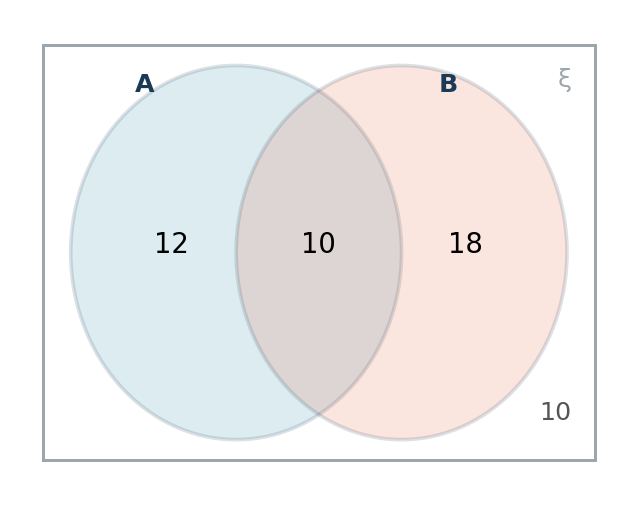
Q463. |ξ|=50, |A|=22, |B|=28, |A∩B|=10. Find P(A' ∩ B').
Q464. Two dice are rolled. Find P(the product of the scores is even).
Q465. A bag of 20 balls has 8 red. Two are drawn without replacement. Find P(exactly one red).
Q466. Events A and B are mutually exclusive with P(A)=0.35. Find P(A').
Q467. A spinner has P(green)=0.25 each spin. Find P(green at least once in 2 spins).
Q468. P(A)=0.4, P(B)=0.5, P(A∪B)=0.7. Find P(A∩B).
Q469. A bag has 6 red and 4 blue balls. Three are drawn without replacement. Find P(all three red).
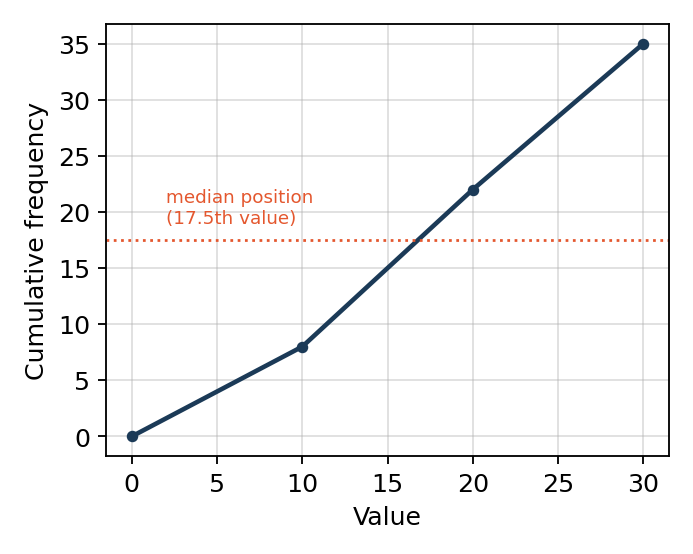
Q470. A grouped frequency table has cumulative frequencies: 0-10: 8, 10-20: 22, 20-30: 35 (total). State which class contains the median.
Q471. A histogram class 20-50 has frequency density 0.8. Find its frequency.
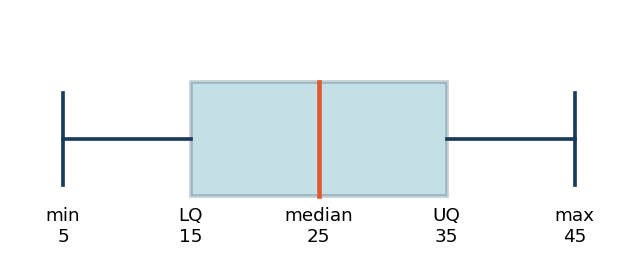
Q472. A box plot has Q1=15, Q3=35. An outlier is beyond 1.5×IQR from Q3. Find the upper outlier boundary.
Q473. Two independent events A, B: P(A)=x, P(B)=x+0.2, and P(A and B)=0.15. Find x.
Q474. P(likes tea)=0.6, P(likes coffee)=0.5, P(likes both)=0.3. Find P(likes neither).
Q475. Two fair dice are rolled. Find P(the difference between the scores is 2).
Q476. A bag has n red balls and 8 blue balls. If P(red)=3/7, find n.
Q477. A test has mean 65 with 30 students. 5 more students with mean 80 are added. Find the new overall mean, to 1 decimal place.
Q478. P(A∩B)=0.12 and P(B)=0.3. Find P(A|B).
Q479. P(A)=0.5 and P(A|B)=0.5. State, with a reason, whether A and B are independent.
Q480. A bag of 15 balls has 9 red. Three are drawn without replacement. Find P(first two red, third blue).
Q481. A cumulative frequency curve shows 60 out of 80 values are below 45. Find how many values are above 45.
Q482. P(A)=0.45, P(B)=0.35, A and B are mutually exclusive. Find P((A∪B)').
Q483. Two independent trials each have P(success)=0.7. Find P(exactly 1 success in 2 trials).
Q484. A bag has 5 red, 3 blue, 2 green balls. Two are drawn without replacement. Find P(different colours).
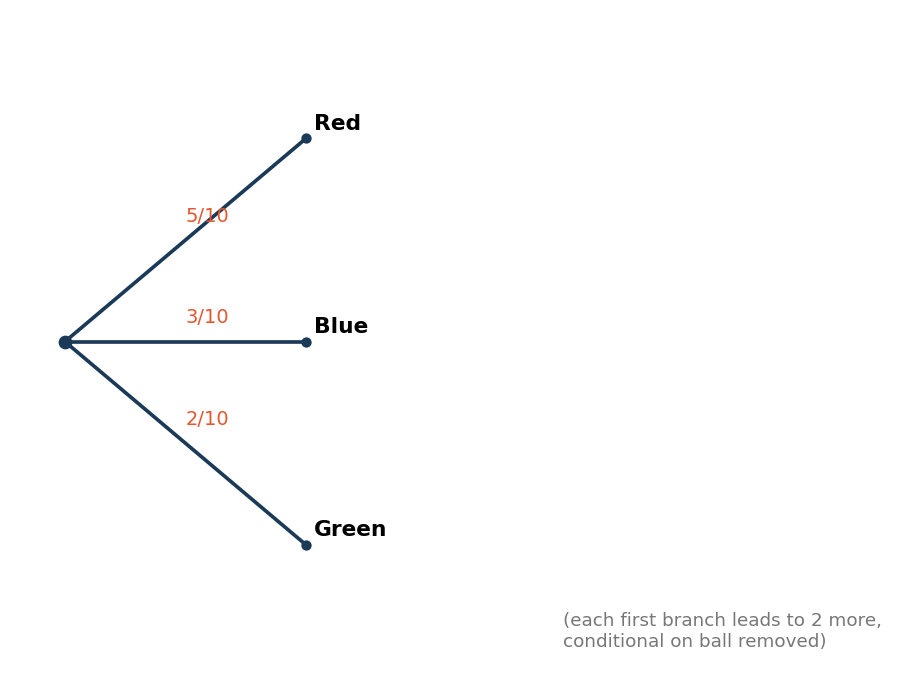
Q485. P(A)=0.3, P(B)=0.4, A and B are independent. Find P(A∪B).
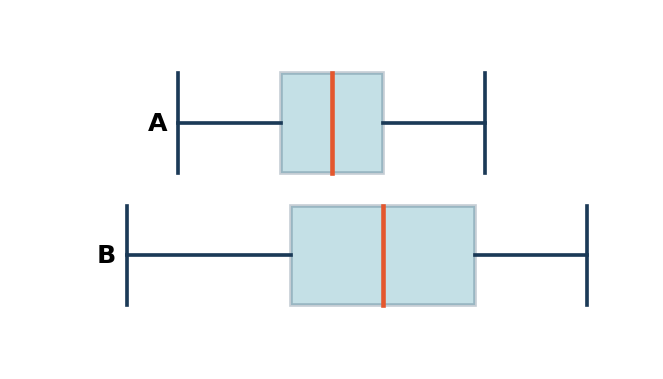
Q486. Data set A has median 40, IQR 10; data set B has median 45, IQR 18. State, with a reason, which is more consistent.
Q487. P(A)=0.6, P(B'|A)=0.25. Find P(A∩B).
Q488. A bag of 12 balls has 5 red. Three are drawn without replacement. Find P(exactly 2 red).
Q489. A fair coin is flipped 3 times. Find P(at least 2 heads).
Q490. Two independent events: P(A)=0.5, P(A∪B)=0.75. Find P(B).
Q491. The probability a component is faulty is 0.02. In a batch of 3 (independent), find P(none are faulty), to 4 decimal places.
Q492. Prove that for two independent events, P(A|B)=P(A).
Q493. P(reads fiction)=0.7, P(reads non-fiction)=0.5, P(reads both)=0.4. Find P(fiction only).
Q494. Two dice are rolled. Find P(sum is prime).
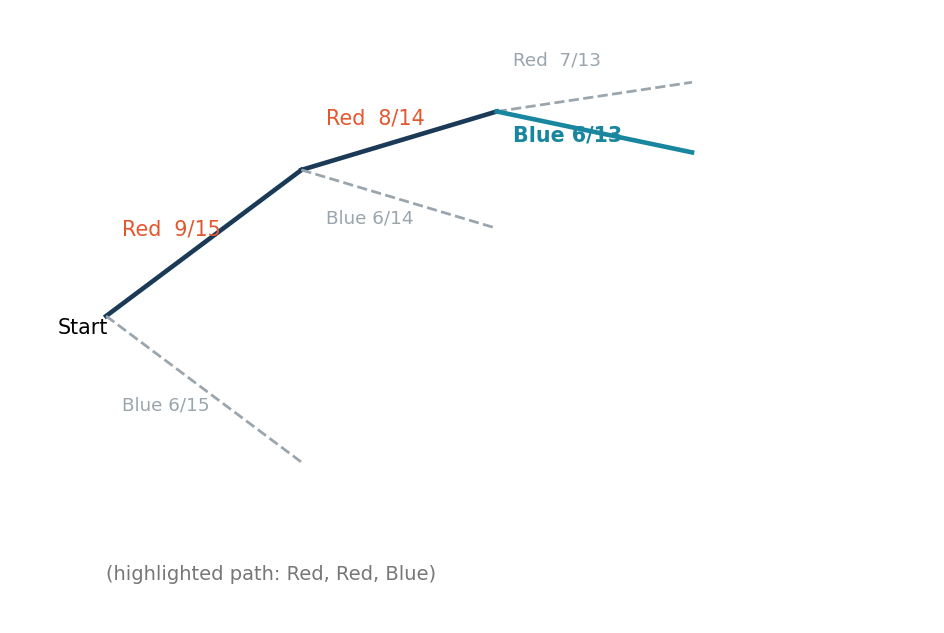
Q495. A bag has 4 red and 6 blue balls. Balls are drawn one at a time, without replacement, until a red is drawn. Find P(first red on the 2nd draw).
Q496. A and B are independent, P(A)=0.25, P(A∪B)=0.4. Find P(B).
Q497. A quality test has P(pass)=0.9 for each independent unit. Find P(exactly 3 pass out of 4).
Q498. P(A)=0.6, P(B)=0.7, A and B are independent. Find P(neither occurs).
Q499. Explain, using a Venn diagram argument, why P(A∪B)=P(A)+P(B)-P(A∩B).
Q500. A biased coin has P(heads)=p. It is flipped twice, and P(two heads)=0.36. Find p.
These are original questions written in the style of recent papers, not reproductions of any real exam paper. Individual grade labels are indicative, based on typical question-targeting and examiner reports — not an official Pearson document.
I can put together a timed practice paper and mark it with you, mirroring the real exam conditions.
You might also like the full Topics by Grade guide.