Higher Non-Calculator — Paper 1H
Original EzyMatics practice bank covering exact-value working, standard form, surds, algebraic manipulation and full geometry & probability coverage — every question written to be solved without a calculator.
🔢 Number
💡Core idea
Use common denominators for addition or subtraction; invert the second fraction when dividing.
📐Essential rules and method
Rules:
- Use a common denominator for addition/subtraction
- Multiply numerators and denominators
- Divide by multiplying by the reciprocal
Method:
- Convert mixed numbers
- Find the LCM denominator
- Calculate
- Cancel common factors
- Convert to the requested form
✏️Worked example — mark-scheme method
- Identify the method. Use common denominators for addition or subtraction; invert the second fraction when dividing.
- Apply the method and show the mathematical evidence. \(2\frac{3}{5}+1\frac{7}{10}\): convert to \(\frac{13}{5}+\frac{17}{10}=\frac{26}{10}+\frac{17}{10}=\frac{43}{10}=4\frac{3}{10}\).
- Check and present the answer. Simplify before multiplying and convert mixed numbers to improper fractions first. Check that every value has been used, signs and units are correct, and the final answer is in the form requested by the question.
⚡Exam hack
Simplify before multiplying and convert mixed numbers to improper fractions first.
Questions (8)
- G6–7 1. Work out \(2\dfrac{3}{5} + 1\dfrac{7}{10}\), giving your answer as a mixed number in its simplest form. [3]
- G6–7 2. Work out \(3\dfrac{1}{4} \div 2\dfrac{3}{8}\), giving your answer as a mixed number in its simplest form. [3]
- G6–7 3. Work out \(5\dfrac{1}{3} - 2\dfrac{5}{6}\), giving your answer as a mixed number in its simplest form. [3]
- G6–7 4. Work out \(\dfrac{2}{3}\) of \(5\dfrac{1}{4}\). [2]
- G6–7 5. Work out \(4\dfrac{2}{7} + 3\dfrac{5}{14}\), giving your answer as a mixed number in its simplest form. [3]
- G6–7 6. Work out \(\dfrac{7}{8} - \dfrac{1}{3} + \dfrac{1}{4}\), giving your answer as a fraction in its simplest form. [3]
- G6–7 7. A jug holds \(2\dfrac{1}{2}\) litres. Sam pours out \(\dfrac{3}{5}\) of the jug. Work out how many litres are left. [3]
- G6–7 8. Work out \(3\dfrac{3}{5} \times 1\dfrac{1}{4}\), giving your answer as a mixed number in its simplest form. [3]
💡Core idea
A percentage multiplier is \(1\pm\frac{r}{100}\); reverse percentages divide by the multiplier.
📐Essential rules and method
Rules:
- Increase multiplier \(=1+r/100\)
- Decrease multiplier \(=1-r/100\)
- Reverse percentage \(=\) final amount \(\div\) multiplier
Method:
- Identify the original base
- Write the multiplier
- Calculate
- Check whether the answer should be larger or smaller
✏️Worked example — mark-scheme method
- Identify the method. A percentage multiplier is \(1\pm\frac{r}{100}\); reverse percentages divide by the multiplier.
- Apply the method and show the mathematical evidence. A price is reduced by 20% to £60. Since £60 represents \(100\%-20\%=80\%\) of the original, the original price is \(60\div0.8=£75\).
- Check and present the answer. Successive changes use successive multipliers; never add the rates unless the base stays unchanged. Check that every value has been used, signs and units are correct, and the final answer is in the form requested by the question.
⚡Exam hack
Successive changes use successive multipliers; never add the rates unless the base stays unchanged.
Questions (10)
- G6–7 1. A laptop is reduced by 15% in a sale to a price of £510. Work out the original price of the laptop. [3]
- G6–7 2. Bilal invests £2400. After one year, 4% interest is added. After the second year, a further 5% interest is added to the new total. Work out the total value of the investment after two years. [3]
- G6–7 3. Work out 35% of 260. [2]
- G6–7 4. In a survey, 156 out of 400 people preferred tea. Work out this as a percentage. [2]
- G6–7 5. A car’s value depreciates by 12% each year. If it is worth £18\,000 now, work out its value after 2 years. [3]
- G6–7 6. Increase 84 by 35%. [2]
- G6–7 7. A shop reduces all prices by 20% in a sale, then by a further 10% in a clearance event. A coat originally costs £90. Work out its final clearance price. [3]
- G6–7 8. Express 45 as a percentage of 180. [2]
- G6–7 9. Sara’s salary increases from £24\,000 to £27\,600. Work out the percentage increase. [3]
- G6–7 10. A meal costs £68 before a 12.5% service charge is added. Work out the total cost including the service charge. [2]
💡Core idea
Round values to convenient numbers, calculate, and state that the result is an estimate.
📐Essential rules and method
Rules:
- Decimal places count digits after the point
- Significant figures begin at the first non-zero digit
Method:
- Round each value consistently
- Calculate with the rounded values
- Use \(\approx\)
- Compare the size with the original expression
✏️Worked example — mark-scheme method
- Identify the method. Round values to convenient numbers, calculate, and state that the result is an estimate.
- Apply the method and show the mathematical evidence. \(19.8\times5.1\div0.48\): round each value to 1 s.f. to get \(20\times5\div0.5\), then simplify \(100\div0.5=200\), so the estimate is \(\approx200\).
- Check and present the answer. Round every value to one significant figure unless the question suggests a better choice. Check that every value has been used, signs and units are correct, and the final answer is in the form requested by the question.
⚡Exam hack
Round every value to one significant figure unless the question suggests a better choice.
Questions (6)
- G6–7 1. Work out an estimate for \(\dfrac{19.8 \times 5.1}{0.48}\). You must show clearly how you get your estimate. [3]
- G6–7 2. A journey of 396 miles is driven at an average speed of 58 mph. Work out an estimate for the time taken, giving your answer in hours and minutes. [3]
- G6–7 3. Round 68\,247 to 2 significant figures. [1]
- G6–7 4. Work out an estimate for \(\sqrt{48.7 \times 9.3}\). [2]
- G6–7 5. A rectangular field measures 38.6 m by 21.4 m. Work out an estimate for its area. [2]
- G8–9 6. Work out an estimate for \(\dfrac{312 + 489}{29.6}\). [3]
💡Core idea
For the same base, add powers when multiplying and subtract when dividing; standard form is \(a\times10^n\) with \(1\le a<10\).
📐Essential rules and method
Rules:
- \(a^m a^n=a^{m+n}\), \(a^m/a^n=a^{m-n}\), \((a^m)^n=a^{mn}\), \(a^0=1\), \(a^{-n}=1/a^n\)
- Standard form has \(1\leq a<10\)
Method:
- Apply one index law at a time
- Calculate coefficients separately
- Normalise the final coefficient
✏️Worked example — mark-scheme method
- Identify the method. For the same base, add powers when multiplying and subtract when dividing; standard form is \(a\times10^n\) with \(1\le a<10\).
- Apply the method and show the mathematical evidence. \(x^5\div x^2=x^{5-2}=x^3\). Separately, \((4.2\times10^6)\) already has \(1\le4.2<10\), so it is already in standard form, equal to \(4\,200\,000\).
- Check and present the answer. Normalise the final coefficient into the interval \([1,10)\) after every standard-form calculation. Check that every value has been used, signs and units are correct, and the final answer is in the form requested by the question.
⚡Exam hack
Normalise the final coefficient into the interval \([1,10)\) after every standard-form calculation.
Questions (16)
- G8–9 1. (a) Write \(4.7 \times 10^{-3}\) as an ordinary number. [1]\ (b) Work out \((5 \times 10^6) \times (8 \times 10^{-2})\), giving your answer in standard form. [2]
- G6–7 2. (a) Write down the value of \(5^0\). [1]\ (b) Find the value of \(4^{-3/2}\). [2]
- G6–7 3. Simplify \(x^5 \times x^{-2}\). [1]
- G6–7 4. Simplify \((y^3)^4\). [1]
- G6–7 5. Work out \(2^{-3}\). [1]
- G6–7 6. Work out \(100^{1/2}\). [1]
- G6–7 7. Write 5\,600\,000 in standard form. [1]
- G6–7 8. Write \(3.2 \times 10^{-5}\) as an ordinary number. [1]
- G6–7 9. Work out \((3\times10^4) + (2\times10^3)\), giving your answer in standard form. [2]
- G6–7 10. Work out \((7.2\times10^8) \div (4\times10^3)\), giving your answer in standard form. [2]
- G6–7 11. Simplify \((2x^3)^2 \times 3x\). [2]
- G6–7 12. Find the value of \(9^{3/2}\). [2]
- G6–7 13. Find the value of \(\left(\dfrac{1}{4}\right)^{-2}\). [2]
- G6–7 14. Simplify \(a^7 \div a^{-3}\). [1]
- G6–7 15. Work out \(5^0 + 5^{-1}\). [2]
- G8–9 16. The population of a country is \(4.7 \times 10^7\). The population of a city within it is \(2.3\times10^6\). Work out the population of the country outside the city, giving your answer in standard form. [3]
💡Core idea
Simplify square roots using square factors and rationalise denominators when required.
📐Essential rules and method
Rules:
- \(\sqrt{ab}=\sqrt a\sqrt b\)
- Only like surds combine
- Use a conjugate to rationalise a binomial denominator
Method:
- Extract the largest square factor
- Simplify
- Combine like terms
- Check that no square factor remains inside a root
✏️Worked example — mark-scheme method
- Identify the method. Simplify square roots using square factors and rationalise denominators when required.
- Apply the method and show the mathematical evidence. \(\sqrt{75}+\sqrt{27}\): write \(\sqrt{75}=\sqrt{25\times3}=5\sqrt3\) and \(\sqrt{27}=\sqrt{9\times3}=3\sqrt3\), so the sum is \(5\sqrt3+3\sqrt3=8\sqrt3\).
- Check and present the answer. Look for the largest square factor; use the conjugate for denominators such as \(a+\sqrt b\). Check that every value has been used, signs and units are correct, and the final answer is in the form requested by the question.
⚡Exam hack
Look for the largest square factor; use the conjugate for denominators such as \(a+\sqrt b\).
Questions (7)
- G6–7 1. Simplify \(\sqrt{75} + \sqrt{27}\), giving your answer in the form \(a\sqrt{3}\) where \(a\) is an integer. [2]
- G8–9 2. Rationalise the denominator of \(\dfrac{6}{\sqrt{2}}\), giving your answer in its simplest form. [2]
- G6–7 3. Simplify \(\sqrt{50}\). [1]
- G6–7 4. Simplify \((3+\sqrt{2})(3-\sqrt{2})\). [2]
- G6–7 5. Expand and simplify \((2+\sqrt{3})^2\). [3]
- G6–7 6. Simplify \(\sqrt{18} \times \sqrt{2}\). [1]
- G8–9 7. Rationalise the denominator of \(\dfrac{10}{3-\sqrt{7}}\). [3]
💡Core idea
Use algebra to shift repeating digits, subtract, and solve for the original decimal.
📐Essential rules and method
Rules:
- Multiply by \(10^n\) where \(n\) is the recurring block length
- Use a second shift when non-recurring digits occur first
Method:
- Define \(x\)
- Align the recurring digits
- Subtract the equations
- Solve for \(x\)
- Simplify the fraction
✏️Worked example — mark-scheme method
- Identify the method. Use algebra to shift repeating digits, subtract, and solve for the original decimal.
- Apply the method and show the mathematical evidence. Let \(x=0.4\dot5\dot5\ldots\) Since one digit recurs, \(10x=4.5\dot5\) and \(100x=45.5\dot5\); subtracting, \(90x=41\), so \(x=\frac{41}{90}\).
- Check and present the answer. Multiply by \(10^k\), where \(k\) is the number of recurring digits. Check that every value has been used, signs and units are correct, and the final answer is in the form requested by the question.
⚡Exam hack
Multiply by \(10^k\), where \(k\) is the number of recurring digits.
Questions (4)
- G8–9 1. Prove algebraically that \(0.4\dot{5}\) (i.e. \(0.4555\ldots\)) can be written as \(\dfrac{41}{90}\). [3]
- G6–7 2. Express \(0.\dot{2}\dot{7}\) (i.e. \(0.272727\ldots\)) as a fraction in its simplest form. [3]
- G6–7 3. Express \(0.1\dot{8}\) (i.e. \(0.1888\ldots\)) as a fraction in its simplest form. [3]
- G6–7 4. Express \(0.0\dot{6}\) (i.e. \(0.0666\ldots\)) as a fraction in its simplest form. [3]
💡Core idea
Prime factorisation supports HCF, LCM and problems involving perfect squares or cubes.
📐Essential rules and method
Rules:
- HCF uses the smallest shared prime powers
- LCM uses the greatest powers present
- Square numbers have even prime powers
Method:
- Prime-factorise each number
- Compare powers systematically
- Rebuild the required number
✏️Worked example — mark-scheme method
- Identify the method. Prime factorisation supports HCF, LCM and problems involving perfect squares or cubes.
- Apply the method and show the mathematical evidence. \(72=2^3\times3^2\) and \(60=2^2\times3\times5\). HCF takes the smaller shared powers: \(2^2\times3=12\). LCM takes the largest powers present: \(2^3\times3^2\times5=360\).
- Check and present the answer. For HCF take the smaller shared powers; for LCM take the largest powers present. Check that every value has been used, signs and units are correct, and the final answer is in the form requested by the question.
⚡Exam hack
For HCF take the smaller shared powers; for LCM take the largest powers present.
Questions (5)
- G6–7 1. Write 360 as a product of its prime factors. [2]
- G6–7 2. Find the lowest common multiple (LCM) of 42 and 63. [2]
- G6–7 3. Find the lowest common multiple of 8, 12 and 20. [2]
- G6–7 4. Express 84 as a product of its prime factors. [2]
- G6–7 5. Two numbers have a highest common factor of 6 and a lowest common multiple of 180. One of the numbers is 36. Find the other number. [3]
💡Core idea
Use place value, written methods and number facts accurately without relying on a calculator.
📐Essential rules and method
Rules:
- Preserve place value and follow BIDMAS
- Division and multiplication can be scaled by powers of ten
Method:
- Estimate first
- Use a written method
- Restore the decimal point
- Check the result against the estimate
✏️Worked example — mark-scheme method
- Identify the method. Use place value, written methods and number facts accurately without relying on a calculator.
- Apply the method and show the mathematical evidence. \(4.6\times3.8\): ignore the decimal points to get \(46\times38=1748\); since \(4.6\) and \(3.8\) together have 2 decimal places, divide by \(100\): \(1748\div100=17.48\).
- Check and present the answer. Estimate first so misplaced decimal points are easy to spot. Check that every value has been used, signs and units are correct, and the final answer is in the form requested by the question.
⚡Exam hack
Estimate first so misplaced decimal points are easy to spot.
Questions (5)
- G6–7 1. Work out \(4.6 \times 3.8\) [2]
- G6–7 2. Work out \(245.7 \div 2.1\) [2]
- G6–7 3. Work out \(512 \div 16\) [2]
- G6–7 4. Work out \(7.35 + 12.6 - 3.08\) [2]
- G6–7 5. Work out \(3.6 \times 2.05\) [2]
💡Core idea
Use the product rule for successive choices and adjust when repetition is forbidden.
📐Essential rules and method
Rules:
- Add mutually exclusive alternatives
- Multiply successive choices
- Reduce later choices when repetition is forbidden
Method:
- Draw slots or a tree
- Write the number of choices at each stage
- Multiply and adjust restrictions
✏️Worked example — mark-scheme method
- Identify the method. Use the product rule for successive choices and adjust when repetition is forbidden.
- Apply the method and show the mathematical evidence. A meal deal has 5 sandwich choices, 3 drink choices and 2 snack choices, with one from each category. The number of different meal deals is \(5\times3\times2=30\).
- Check and present the answer. Write the number of choices at each stage before multiplying. Check that every value has been used, signs and units are correct, and the final answer is in the form requested by the question.
⚡Exam hack
Write the number of choices at each stage before multiplying.
Questions (4)
- G6–7 1. (a) A restaurant menu has 4 starters, 6 main courses and 3 desserts. How many different three-course meals (one of each) are possible? [1]\ (b) A padlock has 3 dials, each numbered 0–9. How many different codes are possible if all three digits must be different? [2]
- G6–7 2. A school offers 5 science clubs and 4 sports clubs. A student chooses one club of each type. Work out the number of possible choices. [1]
- G6–7 3. How many different three-letter arrangements can be made using A, B, C, D and E without repetition? [2]
- G6–7 4. A code consists of two different letters followed by one digit. There are 6 available letters and 10 digits. Work out the number of possible codes. [2]
📐 Algebra
💡Core idea
Represent general integers algebraically, simplify, and finish with a statement that proves the claim.
📐Essential rules and method
Rules:
- Consecutive integers are \(n,n+1,\ldots\)
- Even integers are \(2n\)
- Odd integers are \(2n+1\)
Method:
- Represent a general case
- Simplify exactly
- Factor into the required form
- Finish with a sentence linking the algebra to the claim
✏️Worked example — mark-scheme method
- Identify the method. Represent general integers algebraically, simplify, and finish with a statement that proves the claim.
- Apply the method and show the mathematical evidence. Prove the sum of three consecutive integers is a multiple of 3. Let the integers be \(n,\,n+1,\,n+2\). Sum \(=n+(n+1)+(n+2)=3n+3=3(n+1)\), which is a multiple of 3 since \(n+1\) is an integer.
- Check and present the answer. Do not test examples only; use \(n\) so the argument covers every valid integer. Check that every value has been used, signs and units are correct, and the final answer is in the form requested by the question.
⚡Exam hack
Do not test examples only; use \(n\) so the argument covers every valid integer.
Questions (4)
- G8–9 1. Prove algebraically that the sum of any three consecutive integers is always a multiple of 3. [3]
- G8–9 2. Prove that \((2n+1)^2 - (2n-1)^2\) is always a multiple of 8, for any positive integer \(n\). [3]
- G8–9 3. Prove that the difference between the squares of any two consecutive even numbers is always a multiple of 4. [3]
- G8–9 4. Prove algebraically that \((n+2)^2 - n^2\) is always even, for any integer \(n\). [3]
💡Core idea
Expanding removes brackets; factorising reverses the process by finding common factors or quadratic pairs.
📐Essential rules and method
Rules:
- Multiply every term in one bracket by every term in the other
- Factorising reverses expansion
- Take out the HCF first
Method:
- Expand systematically or find a product/sum pair
- Collect like terms
- Expand the factorised answer to check it
✏️Worked example — mark-scheme method
- Identify the method. Expanding removes brackets; factorising reverses the process by finding common factors or quadratic pairs.
- Apply the method and show the mathematical evidence. Factorise \(x^2+7x+12\): find two numbers that multiply to 12 and add to 7, namely 3 and 4, so \(x^2+7x+12=(x+3)(x+4)\). Check by expanding: \((x+3)(x+4)=x^2+4x+3x+12=x^2+7x+12\). ✓
- Check and present the answer. Always take out the highest common factor before trying any other pattern. Check that every value has been used, signs and units are correct, and the final answer is in the form requested by the question.
⚡Exam hack
Always take out the highest common factor before trying any other pattern.
Questions (12)
- G6–7 1. Expand and simplify \((2x-3)(x+4)(x-1)\). [3]
- G6–7 2. Expand and simplify \((3x-2)^2-(x+5)(2x-1)\). [3]
- G6–7 3. Expand and simplify \((x-4)(x+1)(2x+3)\). [3]
- G6–7 4. Factorise fully \(3x^2 - 12\). [2]
- G6–7 5. Factorise \(x^2 + 7x + 12\). [2]
- G6–7 6. Factorise \(x^2-11x+24\). [2]
- G6–7 7. Factorise \(6x^2+x-2\). [2]
- G6–7 8. Factorise \(8x^2-2x-3\). [2]
- G6–7 9. Factorise fully \(5x^3-45x\). [3]
- G6–7 10. Factorise fully \(4a^2-25b^2\). [2]
- G6–7 11. Factorise fully \(ap+bp-aq-bq\). [3]
- G8–9 12. Hence, or otherwise, solve \(6x^2+x-2=0\). [3]
💡Core idea
Factorise fully, state excluded values where relevant, and use common denominators for addition.
📐Essential rules and method
Rules:
- Cancel factors only, never terms
- Excluded values come from the original denominator
- Addition needs a common denominator
Method:
- Factorise fully
- State restrictions
- Cancel common factors
- Combine numerators
- Simplify again
✏️Worked example — mark-scheme method
- Identify the method. Factorise fully, state excluded values where relevant, and use common denominators for addition.
- Apply the method and show the mathematical evidence. Simplify \(\dfrac{x^2-9}{x^2+5x+6}\): factorise top and bottom, \(\dfrac{(x-3)(x+3)}{(x+2)(x+3)}\), then cancel the common factor \((x+3)\) to leave \(\dfrac{x-3}{x+2}\), valid for \(x\ne-2,-3\).
- Check and present the answer. Cancellation works with factors, never with separate terms joined by addition. Check that every value has been used, signs and units are correct, and the final answer is in the form requested by the question.
⚡Exam hack
Cancellation works with factors, never with separate terms joined by addition.
Questions (6)
- G6–7 1. Simplify fully \(\dfrac{x^2 - 9}{2x^2 + 5x - 3}\). [3]
- G6–7 2. Write \(\dfrac{3}{x+2} + \dfrac{2}{x-1}\) as a single fraction in its simplest form. [3]
- G6–7 3. Simplify fully \(\dfrac{4x^2-9}{2x^2+x-3}\). [3]
- G6–7 4. Write \(\dfrac{5}{x-3} - \dfrac{2}{x+1}\) as a single fraction in its simplest form. [3]
- G6–7 5. Simplify fully \(\dfrac{x^2+5x+6}{x^2-4}\). [3]
- G8–9 6. Solve \(\dfrac{3}{x} + \dfrac{2}{x+2} = 1\). [4]
💡Core idea
Know the shapes, periods and key values of sine, cosine and tangent graphs.
📐Essential rules and method
Rules:
- Sine and cosine have period \(360^\circ\)
- Tangent has period \(180^\circ\) with asymptotes at \(90^\circ+180^\circ n\)
Method:
- Mark key angles and values
- Include asymptotes
- Apply transformations
- Draw a smooth periodic curve
✏️Worked example — mark-scheme method
- Identify the method. Know the shapes, periods and key values of sine, cosine and tangent graphs.
- Apply the method and show the mathematical evidence. To sketch \(y=\sin x\) for \(0^\circ\le x\le360^\circ\): plot key points \((0^\circ,0)\), \((90^\circ,1)\), \((180^\circ,0)\), \((270^\circ,-1)\), \((360^\circ,0)\), then join with a smooth periodic curve.
- Check and present the answer. Mark key points and asymptotes before drawing a smooth curve. Check that every value has been used, signs and units are correct, and the final answer is in the form requested by the question.
⚡Exam hack
Mark key points and asymptotes before drawing a smooth curve.
Questions (4)
- G6–7 1. Sketch the graph of \(y = \cos x^{\circ}\) for \(0 \leqslant x \leqslant 360\), marking the coordinates of any points where the graph meets the axes. [3]
- G6–7 2. Using the graph of \(y = \sin x^{\circ}\), write down all solutions of \(\sin x^{\circ} = -0.5\) for \(-180 \leqslant x \leqslant 180\). [2]
- G6–7 3. Write down the period of the graph of \(y = \tan x^{\circ}\). [1]
- G6–7 4. Write down the coordinates of the maximum point of \(y = 3\sin x^{\circ}\) for \(0 \leqslant x \leqslant 360\). [2]
💡Core idea
Use \(y=mx+c\), where \(m\) is gradient and \(c\) is the \(y\)-intercept.
📐Essential rules and method
Rules:
- \(m=(y_2-y_1)/(x_2-x_1)\) and \(y=mx+c\)
- Parallel gradients match
- Perpendicular gradients satisfy \(m_1m_2=-1\)
Method:
- Find the gradient
- Substitute one point to find \(c\)
- Write the equation
- Verify the second point
✏️Worked example — mark-scheme method
- Identify the method. Use \(y=mx+c\), where \(m\) is gradient and \(c\) is the \(y\)-intercept.
- Apply the method and show the mathematical evidence. Find the equation through \((2,5)\) and \((6,13)\): gradient \(m=\dfrac{13-5}{6-2}=\dfrac{8}{4}=2\). Substitute \((2,5)\) into \(y=2x+c\): \(5=4+c\), so \(c=1\), giving \(y=2x+1\).
- Check and present the answer. Parallel lines have equal gradients; perpendicular gradients multiply to \(-1\). Check that every value has been used, signs and units are correct, and the final answer is in the form requested by the question.
⚡Exam hack
Parallel lines have equal gradients; perpendicular gradients multiply to \(-1\).
Questions (5)
- G6–7 1. Find the equation of the straight line that passes through the points \((2,5)\) and \((6,13)\). [3]
- G6–7 2. The line \(L_1\) has equation \(y = 2x - 3\). The line \(L_2\) is perpendicular to \(L_1\) and passes through \((4,1)\). Find the equation of \(L_2\). [3]
- G6–7 3. Find the gradient of the line joining \((-2,7)\) and \((4,-5)\). [2]
- G6–7 4. A line has equation \(2x + 3y = 12\). Find the coordinates of the points where the line crosses the axes. [2]
- G6–7 5. The line \(L\) passes through \((1,4)\) and is parallel to \(y = 3x - 2\). Find the equation of \(L\). [2]
💡Core idea
Solve like an equation, but reverse the inequality when multiplying or dividing by a negative number.
📐Essential rules and method
Rules:
- Perform the same operation on both sides
- Reverse the inequality when multiplying or dividing by a negative
Method:
- Simplify
- Isolate the variable
- Record any sign reversal
- Represent the solution correctly on a line or graph
✏️Worked example — mark-scheme method
- Identify the method. Solve like an equation, but reverse the inequality when multiplying or dividing by a negative number.
- Apply the method and show the mathematical evidence. Solve \(-2x<6\): divide both sides by \(-2\), remembering to reverse the inequality, to get \(x>-3\). Represent on a number line with an open circle at \(-3\) and an arrow to the right.
- Check and present the answer. Use an open circle for \(<\) or \(>\) and a filled circle for \(\le\) or \(\ge\). Check that every value has been used, signs and units are correct, and the final answer is in the form requested by the question.
⚡Exam hack
Use an open circle for \(<\) or \(>\) and a filled circle for \(\le\) or \(\ge\).
Questions (4)
- G6–7 1. Solve \(3x - 5 \leqslant 16\), illustrating your answer on a number line. [2]
- G6–7 2. Find the set of integer values of \(n\) that satisfy \(-3 < 2n + 1 \leqslant 9\). [3]
- G6–7 3. Solve the inequality \(2(x-3) > x+1\). [2]
- G6–7 4. On a number line, show the solution set of \(-2 \leqslant x < 4\). [2]
💡Core idea
Substitute carefully using brackets, or rearrange by applying inverse operations to both sides.
📐Essential rules and method
Rules:
- Substitution needs brackets around negative values
- Rearrangement uses inverse operations on both sides
Method:
- Identify the subject
- Clear fractions
- Collect subject terms
- Factorise if necessary
- Divide to isolate it
✏️Worked example — mark-scheme method
- Identify the method. Substitute carefully using brackets, or rearrange by applying inverse operations to both sides.
- Apply the method and show the mathematical evidence. Make \(r\) the subject of \(A=\pi r^2\): divide both sides by \(\pi\) to get \(\dfrac{A}{\pi}=r^2\), then square-root both sides: \(r=\sqrt{\dfrac{A}{\pi}}\) (taking the positive root, since \(r\) is a length).
- Check and present the answer. When the required variable appears twice, collect its terms and factorise it out. Check that every value has been used, signs and units are correct, and the final answer is in the form requested by the question.
⚡Exam hack
When the required variable appears twice, collect its terms and factorise it out.
Questions (3)
- G8–9 1. Make \(x\) the subject of the formula \(y = \dfrac{3x+2}{x-5}\). [4]
- G6–7 2. Given that \(v^2 = u^2 + 2as\), find the value of \(a\) when \(v=20\), \(u=8\) and \(s=18\). [2]
- G6–7 3. Make \(r\) the subject of the formula \(A = \pi r^2\). [2]
💡Core idea
Find values satisfying both equations using elimination, substitution or graphical intersection.
📐Essential rules and method
Rules:
- A solution satisfies both equations
- Elimination requires equal coefficients
- Substitution replaces one variable consistently
Method:
- Match coefficients
- Add/subtract
- Solve one variable
- Substitute back
- Check both equations
✏️Worked example — mark-scheme method
- Identify the method. Find values satisfying both equations using elimination, substitution or graphical intersection.
- Apply the method and show the mathematical evidence. Solve \(x+y=7\) and \(x-y=1\): adding the equations eliminates \(y\), giving \(2x=8\), so \(x=4\). Substitute into the first equation: \(4+y=7\), so \(y=3\). Check: \(4-3=1\). ✓
- Check and present the answer. Choose elimination when coefficients can be matched easily; substitute back into the simpler equation. Check that every value has been used, signs and units are correct, and the final answer is in the form requested by the question.
⚡Exam hack
Choose elimination when coefficients can be matched easily; substitute back into the simpler equation.
Questions (5)
- G8–9 1. Solve the simultaneous equations \(3x + 2y = 16\) and \(5x - y = 11\). [3]
- G8–9 2. Solve the simultaneous equations \(y = x^2 - 2x\) and \(y = x + 4\). [4]
- G8–9 3. Solve the simultaneous equations \(x+y=9\) and \(x^2+y^2=53\). [4]
- G8–9 4. Solve the simultaneous equations \(2x-y=5\) and \(3x+2y=18\). [3]
- G8–9 5. Solve the simultaneous equations \(y=2x+1\) and \(y=x^2-4x+7\). [4]
💡Core idea
A quadratic graph is a parabola; roots, intercept and turning point describe its key features.
📐Essential rules and method
Rules:
- Roots occur where \(y=0\)
- The \(y\)-intercept occurs at \(x=0\)
- The axis of symmetry passes through the turning point
Method:
- Find intercepts
- Locate the turning point or symmetry
- Plot sufficient points
- Draw a smooth parabola
✏️Worked example — mark-scheme method
- Identify the method. A quadratic graph is a parabola; roots, intercept and turning point describe its key features.
- Apply the method and show the mathematical evidence. For \(y=(x-2)^2-5\): the turning point is \((2,-5)\) directly from completed-square form. The \(y\)-intercept is at \(x=0\): \(y=(0-2)^2-5=4-5=-1\), giving \((0,-1)\).
- Check and present the answer. Use symmetry: the turning point lies midway between two roots. Check that every value has been used, signs and units are correct, and the final answer is in the form requested by the question.
⚡Exam hack
Use symmetry: the turning point lies midway between two roots.
Questions (4)
- G8–9 1. For \(y = x^2 - 2x - 3\), find the coordinates of the turning point by completing the square. [3]
- G6–7 2. Sketch the graph of \(y = -(x-1)(x+3)\), marking clearly the coordinates of the points where the curve crosses the axes. [3]
- G6–7 3. Find the roots of \(y = x^2 - 5x + 6\) by factorising. [2]
- G6–7 4. State the equation of the line of symmetry of \(y = x^2 + 6x + 5\). [2]
💡Core idea
Changes outside \(f(x)\) move a graph vertically; changes inside move it horizontally in the opposite direction.
📐Essential rules and method
Rules:
- \(f(x)+a\) moves up
- \(f(x-a)\) moves right
- \(af(x)\) stretches vertically
- \(f(ax)\) changes horizontal scale
Method:
- Track key points
- Apply the inside change to \(x\) and outside change to \(y\)
- Redraw with unchanged features noted
✏️Worked example — mark-scheme method
- Identify the method. Changes outside \(f(x)\) move a graph vertically; changes inside move it horizontally in the opposite direction.
- Apply the method and show the mathematical evidence. Given \(y=f(x)\) passes through \((3,2)\): on \(y=f(x)+3\) this point becomes \((3,5)\) (shift up 3); on \(y=f(x-3)\) it becomes \((6,2)\) (shift right 3, \(x\)-value only).
- Check and present the answer. Track one distinctive point before trying to redraw the whole graph. Check that every value has been used, signs and units are correct, and the final answer is in the form requested by the question.
⚡Exam hack
Track one distinctive point before trying to redraw the whole graph.
Questions (1)
- G6–7 1. The graph of \(y=f(x)\) has a minimum point at \((3,-2)\). Write down the coordinates of the minimum point of \(y = f(x) + 5\). [1]
💡Core idea
Treat a function as a machine; composition applies one function and then another, while an inverse reverses it.
📐Essential rules and method
Rules:
- Composition is read right-to-left
- An inverse undoes the original function
- \(f^{-1}\) is not \(1/f\)
Method:
- Substitute with brackets
- Simplify
- For an inverse set \(y=f(x)\)
- Rearrange for \(x\)
- Swap notation
✏️Worked example — mark-scheme method
- Identify the method. Treat a function as a machine; composition applies one function and then another, while an inverse reverses it.
- Apply the method and show the mathematical evidence. \(f(x)=2x+1\), \(g(x)=x^2\). Find \(fg(3)\): work right to left, first \(g(3)=3^2=9\), then \(f(9)=2(9)+1=19\), so \(fg(3)=19\).
- Check and present the answer. Read composition from right to left and use brackets around the substituted expression. Check that every value has been used, signs and units are correct, and the final answer is in the form requested by the question.
⚡Exam hack
Read composition from right to left and use brackets around the substituted expression.
Questions (6)
- G6–7 1. \(f(x) = 2x-5\) and \(g(x) = x^2+1\). Find \(fg(3)\). [2]
- G6–7 2. \(f(x) = \dfrac{x+4}{3}\). Find \(f^{-1}(x)\). [2]
- G6–7 3. \(f(x) = 5-2x\). Find \(f^{-1}(x)\). [2]
- G6–7 4. \(g(x) = x^2-3\), \(h(x)=2x+1\). Find \(gh(2)\). [2]
- G6–7 5. \(f(x) = \dfrac{2x+1}{3}\). Solve \(f(x) = 7\). [2]
- G6–7 6. \(f(x)=x^2+1\), \(g(x)=3x-2\). Find \(fg(x)\) in its simplest form. [3]
💡Core idea
Solve by factorising, completing the square or using the quadratic formula.
📐Essential rules and method
Rules:
- First write \(ax^2+bx+c=0\)
- Zero-product gives each factor equal to zero
- Formula \(x=(-b\pm\sqrt{b^2-4ac})/(2a)\)
Method:
- Choose factorising
- Completing the square or formula
- Find both roots
- Substitute to check
✏️Worked example — mark-scheme method
- Identify the method. Solve by factorising, completing the square or using the quadratic formula.
- Apply the method and show the mathematical evidence. Solve \(x^2+3x-10=0\): find factors of \(-10\) that sum to 3, namely 5 and \(-2\), so \((x+5)(x-2)=0\). Then \(x+5=0\) or \(x-2=0\), giving \(x=-5\) or \(x=2\).
- Check and present the answer. Set the equation equal to zero before choosing a method. Check that every value has been used, signs and units are correct, and the final answer is in the form requested by the question.
⚡Exam hack
Set the equation equal to zero before choosing a method.
Questions (3)
- G6–7 1. Solve \(x^2 + 3x - 10 = 0\) [3]
- G6–7 2. Solve \(x^2 - 4x - 1 = 0\), giving your answers in the form \(a \pm \sqrt{b}\). [3]
- G6–7 3. Solve \(3x^2 + 5x - 2 = 0\). [3]
💡Core idea
Identify constant first differences for linear sequences and constant second differences for quadratic sequences.
📐Essential rules and method
Rules:
- Linear sequences have constant first difference
- Quadratic sequences have constant second difference
- Geometric sequences use a constant ratio
Method:
- Build a difference table
- Select the rule form
- Determine coefficients
- Verify several terms
✏️Worked example — mark-scheme method
- Identify the method. Identify constant first differences for linear sequences and constant second differences for quadratic sequences.
- Apply the method and show the mathematical evidence. For \(5,9,13,17,\ldots\): the first difference is constant at 4, so the \(n\)th term has the form \(4n+c\). Since the 1st term is 5, \(4(1)+c=5\), so \(c=1\): \(n\)th term \(=4n+1\).
- Check and present the answer. Substitute \(n=1\) into your rule to check the first term immediately. Check that every value has been used, signs and units are correct, and the final answer is in the form requested by the question.
⚡Exam hack
Substitute \(n=1\) into your rule to check the first term immediately.
Questions (5)
- G8–9 1. The \(n\)th term of a sequence is \(3n^2 - 2\). (a) Find the 5th term. [1] (b) Show that 100 is not a term of this sequence. [2]
- G6–7 2. The first three terms of a geometric sequence are 4, 12, 36. Find the 6th term. [2]
- G6–7 3. Find the \(n\)th term of the sequence \(7, 11, 15, 19, \ldots\) [2]
- G6–7 4. The \(n\)th term of a sequence is \(n^2 + 2n\). Find the first term of the sequence that is greater than 50. [2]
- G6–7 5. A sequence is defined by \(a_{n+1} = 2a_n - 3\), with \(a_1 = 4\). Find \(a_3\). [2]
💡Core idea
Recognise graphs from their symmetry, intercepts, end behaviour and special features.
📐Essential rules and method
Rules:
- Identify graphs using symmetry, intercepts, asymptotes, turning points and end behaviour
Method:
- Name the function family
- Test key coordinates
- Inspect the leading term
- Eliminate shapes with incompatible features
✏️Worked example — mark-scheme method
- Identify the method. Recognise graphs from their symmetry, intercepts, end behaviour and special features.
- Apply the method and show the mathematical evidence. To identify \(y=x^3-4x\): it passes through the origin (constant term 0), and as a cubic with positive leading coefficient it rises left-to-right through its turning points, matching an S-shaped curve.
- Check and present the answer. Make a tiny table of values if two possible shapes seem similar. Check that every value has been used, signs and units are correct, and the final answer is in the form requested by the question.
⚡Exam hack
Make a tiny table of values if two possible shapes seem similar.
Questions (2)
- G6–7 1. Sketch the graphs of \(y=x^2\) and \(y=x^3\) on the same axes, labelling each curve clearly. [3]
- G6–7 2. Explain how the graph of \(y = -\dfrac{1}{x}\) differs from the graph of \(y = \dfrac{1}{x}\). [2]
💡Core idea
Define the unknown, translate each relationship into algebra, solve, and interpret the result.
📐Essential rules and method
Rules:
- Every expression must represent the stated quantity and use consistent units
Method:
- Define the variable
- Translate each relationship
- Form the equation
- Solve
- Reject invalid roots
- Answer in context
✏️Worked example — mark-scheme method
- Identify the method. Define the unknown, translate each relationship into algebra, solve, and interpret the result.
- Apply the method and show the mathematical evidence. A rectangle has width \(x\) and length \(2x+3\); its perimeter is 30. Form the equation: \(2x+2(2x+3)=30\), so \(2x+4x+6=30\), giving \(6x=24\) and \(x=4\).
- Check and present the answer. Write what \(x\) represents before forming the equation. Check that every value has been used, signs and units are correct, and the final answer is in the form requested by the question.
⚡Exam hack
Write what \(x\) represents before forming the equation.
Questions (2)
- G8–9 1. The perimeter of a rectangle is 54 cm. The length is 3 cm more than twice the width. Find the dimensions of the rectangle. [4]
- G6–7 2. Three angles of a triangle are \(x^{\circ}\), \((2x-10)^{\circ}\) and \((x+40)^{\circ}\). Find the size of the smallest angle. [3]
💡Core idea
On distance–time graphs gradient is speed; on speed–time graphs area is distance and gradient is acceleration.
📐Essential rules and method
Rules:
- Distance–time gradient is speed
- Speed–time gradient is acceleration
- Area under a speed–time graph is distance
Method:
- Identify gradient or area
- Split compound regions
- Calculate with units
- Interpret horizontal or negative sections
✏️Worked example — mark-scheme method
- Identify the method. On distance–time graphs gradient is speed; on speed–time graphs area is distance and gradient is acceleration.
- Apply the method and show the mathematical evidence. A speed-time graph shows constant speed 12 m/s for 5 s. The distance travelled is the area under the graph: a rectangle of area \(12\times5=60\) m.
- Check and present the answer. Split an area into rectangles and triangles and include units. Check that every value has been used, signs and units are correct, and the final answer is in the form requested by the question.
⚡Exam hack
Split an area into rectangles and triangles and include units.
Questions (3)
-
G8–9
1.
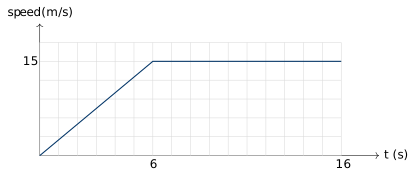
A car accelerates from rest to \(15\) m/s in 6 seconds, then travels at a constant \(15\) m/s for a further 10 seconds. Using a speed–time graph, work out the total distance travelled. [4]
- G6–7 2. Explain what is represented by the gradient of a distance–time graph. [1]
- G6–7 3. A ball is thrown upwards. Its height, \(h\) metres, after \(t\) seconds is given by \(h = 20t - 5t^2\). By sketching a graph of \(h\) against \(t\), find how long the ball is in the air for before it lands. [3]
💡Core idea
Cubic graphs may have up to three real roots and usually have opposite end directions.
📐Essential rules and method
Rules:
- A cubic can have one, two or three distinct real roots
- A repeated factor touches rather than crosses the axis
Method:
- Factorise
- Find intercepts
- Use multiplicity and leading-term end behaviour
- Sketch smoothly
✏️Worked example — mark-scheme method
- Identify the method. Cubic graphs may have up to three real roots and usually have opposite end directions.
- Apply the method and show the mathematical evidence. For \(y=x^3-4x\): factorise to \(y=x(x^2-4)=x(x-2)(x+2)\), so the graph crosses the \(x\)-axis at \(x=-2,0,2\). The positive leading coefficient means it falls then rises overall.
- Check and present the answer. Factorise first to obtain intercepts, then use the leading term for end behaviour. Check that every value has been used, signs and units are correct, and the final answer is in the form requested by the question.
⚡Exam hack
Factorise first to obtain intercepts, then use the leading term for end behaviour.
Questions (1)
-
G8–9
1.
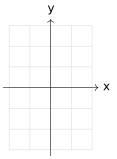
(a) Complete a table of values and sketch the graph of \(y = x^3 - 3x\) for values of \(x\) from \(-2\) to \(2\). [4]\ (b) Using your graph, find estimates for the solutions of \(x^3 - 3x = 1\). [2]
⚖️ Ratio & Proportion
💡Core idea
Simplify ratios, use total parts to share quantities, and keep corresponding terms in the same order.
📐Essential rules and method
Rules:
- Equivalent ratios multiply/divide every part equally
- A share uses amount \(\div\) total parts
Method:
- Align quantities
- Simplify or total the parts
- Find one part
- Scale
- Check shares sum to the original
✏️Worked example — mark-scheme method
- Identify the method. Simplify ratios, use total parts to share quantities, and keep corresponding terms in the same order.
- Apply the method and show the mathematical evidence. Share £60 in the ratio \(2:3\): total parts \(=2+3=5\), so one part \(=60\div5=£12\). The shares are \(2\times12=£24\) and \(3\times12=£36\), which sum to £60. ✓
- Check and present the answer. Add the ratio parts before finding the value of one part. Check that every value has been used, signs and units are correct, and the final answer is in the form requested by the question.
⚡Exam hack
Add the ratio parts before finding the value of one part.
Questions (12)
- G8–9 1. A charity shares a donation of £3600 between three projects in the ratio \(2:3:7\). Work out the amount given to each project. [3]
- G8–9 2. The ratio of cats to dogs at a rescue centre is \(5:8\). There are 12 more dogs than cats. Work out the total number of animals at the centre. [3]
- G6–7 3. Divide £450 in the ratio \(3:2\). [2]
- G8–9 4. A recipe uses flour, sugar and butter in the ratio \(5:3:2\). If 750\,g of flour is used, find the amounts of sugar and butter needed. [3]
- G6–7 5. The ratio of boys to girls in a school is \(4:5\). There are 180 girls. Work out how many boys there are. [2]
- G8–9 6. A map has a scale of \(1:25\,000\). Two towns are 8.4 cm apart on the map. Work out the real distance between the towns, in km. [3]
- G8–9 7. £600 is shared between Amy, Ben and Cara in the ratio \(2:3:5\). Work out how much more Cara receives than Amy. [3]
- G6–7 8. A solution is made from water and juice in the ratio \(7:1\). Work out how much water is needed to make 2 litres of solution. [2]
- G8–9 9. The ratio of red to blue to green marbles in a bag is \(2:5:3\). There are 45 marbles in total. Work out the number of green marbles. [3]
- G8–9 10. A photo measuring 15 cm by 10 cm is enlarged so that the ratio of old width to new width is \(3:7\). Work out the dimensions of the new photo. [3]
- G6–7 11. Paint is mixed in the ratio blue:white \(=3:8\) to make grey paint. Work out how much blue paint is needed to make 33 litres of grey paint. [2]
- G8–9 12. The ratio \(a:b\) is \(2:3\) and the ratio \(b:c\) is \(4:5\). Find \(a:b:c\). [3]
💡Core idea
Direct proportion uses \(y=kx^n\); inverse proportion uses \(y=k/x^n\).
📐Essential rules and method
Rules:
- Direct: \(y=kx^n\)
- Inverse: \(y=k/x^n\)
- The constant \(k\) does not change
Method:
- Translate the proportion
- Substitute a known pair to find \(k\)
- Write the full formula
- Use it for the unknown
✏️Worked example — mark-scheme method
- Identify the method. Direct proportion uses \(y=kx^n\); inverse proportion uses \(y=k/x^n\).
- Apply the method and show the mathematical evidence. \(y\propto x^2\) and \(y=20\) when \(x=2\): substitute to find \(k\), \(20=k(2)^2=4k\), so \(k=5\), giving the formula \(y=5x^2\). This formula can now be used for any value of \(x\).
- Check and present the answer. Use the given pair first to find \(k\) before answering the actual question. Check that every value has been used, signs and units are correct, and the final answer is in the form requested by the question.
⚡Exam hack
Use the given pair first to find \(k\) before answering the actual question.
Questions (8)
- G8–9 1. \(y\) is directly proportional to \(x^2\). When \(x=4\), \(y=48\). Find the value of \(y\) when \(x=7\). [3]
- G8–9 2. \(p\) is inversely proportional to \(q\). When \(q=5\), \(p=12\). Find the value of \(p\) when \(q=15\). [3]
- G6–7 3. \(y\) is directly proportional to \(x\). When \(x=6\), \(y=15\). Find \(y\) when \(x=10\). [2]
- G6–7 4. The cost, \(C\), of a taxi journey is directly proportional to the distance, \(d\), travelled. A journey of 8 miles costs £14. Find the cost of a 20-mile journey. [2]
- G6–7 5. It takes 6 workers 15 hours to complete a task. Assuming all workers work at the same rate, how long would it take 10 workers to complete the same task? [3]
- G8–9 6. \(p\) is inversely proportional to the square of \(q\). When \(q=2\), \(p=20\). Find \(p\) when \(q=5\). [3]
- G8–9 7. The time, \(T\), taken to fill a tank is inversely proportional to the number of pipes, \(n\), used. With 3 pipes it takes 8 hours. Work out how long it would take with 5 pipes. [3]
- G8–9 8. \(y\) is directly proportional to \(x^3\). When \(x=2\), \(y=40\). Find the value of \(x\) when \(y=135\). [3]
💡Core idea
Use formulas such as speed \(=d/t\), density \(=m/V\) and pressure \(=F/A\) with consistent units.
📐Essential rules and method
Rules:
- Speed \(=d/t\), density \(=m/V\), pressure \(=F/A\)
- Compound units must be consistent
Method:
- Write the formula triangle or equation
- Convert units
- Substitute
- Rearrange
- Attach the correct compound unit
✏️Worked example — mark-scheme method
- Identify the method. Use formulas such as speed \(=d/t\), density \(=m/V\) and pressure \(=F/A\) with consistent units.
- Apply the method and show the mathematical evidence. A car travels 150 km in 2.5 hours. Using speed \(=\) distance \(\div\) time: speed \(=150\div2.5=60\) km/h. The units (km and hours) are consistent, so no conversion is needed.
- Check and present the answer. Write the formula and convert units before substituting. Check that every value has been used, signs and units are correct, and the final answer is in the form requested by the question.
⚡Exam hack
Write the formula and convert units before substituting.
Questions (6)
- G6–7 1. A metal block has a mass of 540 g and a volume of \(60\text{ cm}^3\). Work out its density. [2]
- G6–7 2. A force of 250 N acts on an area of \(0.5\text{ m}^2\). Work out the pressure. [2]
- G6–7 3. A car travels 180 miles in 3 hours. Work out its average speed. [2]
- G6–7 4. A block of wood has volume \(250\text{ cm}^3\) and density \(0.8\) g/cm\(^3\). Work out its mass. [2]
- G8–9 5. A cyclist travels at an average speed of 24 km/h for 45 minutes. Work out the distance travelled. [3]
- G6–7 6. A gas exerts a pressure of 150\,000 Pa on an area of \(0.02\text{ m}^2\). Work out the force exerted. [2]
• Geometry & Measures
💡Core idea
Choose the correct area, surface-area or volume formula and keep units squared or cubed.
📐Essential rules and method
Rules:
- Area uses square units, volume cubic units
- Prism volume \(=\) cross-sectional area \(\times\) length
- Circle measures use \(\pi\)
Method:
- Mark dimensions
- Choose the correct formula
- Split composite shapes
- Retain exact values until the end
- Round with units
✏️Worked example — mark-scheme method
- Identify the method. Choose the correct area, surface-area or volume formula and keep units squared or cubed.
- Apply the method and show the mathematical evidence. A cylinder has radius 3 cm and height 5 cm. Using \(V=\pi r^2h\): \(V=\pi\times3^2\times5=\pi\times9\times5=45\pi\approx141\) cm\(^3\) (3 s.f.).
- Check and present the answer. For compound shapes, sketch the pieces and mark whether you add or subtract them. Check that every value has been used, signs and units are correct, and the final answer is in the form requested by the question.
⚡Exam hack
For compound shapes, sketch the pieces and mark whether you add or subtract them.
Questions (21)
-
G8–9
1.
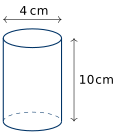
A cylinder has radius 4 cm and height 10 cm. Work out its volume in terms of \(\pi\). [3]
-
G8–9
2.
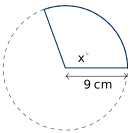
The area of a sector of a circle with radius 9 cm is \(27\pi\text{ cm}^2\). Work out the angle of the sector. [3]
(Diagrams not accurately drawn.)
- G6–7 3. A cuboid has dimensions \(5\text{ cm} \times 4\text{ cm} \times 3\text{ cm}\). Work out its volume. [2]
- G6–7 4. A cuboid has dimensions \(5\text{ cm} \times 4\text{ cm} \times 3\text{ cm}\). Work out its total surface area. [3]
- G6–7 5. A cone has radius 3 cm and slant height 5 cm. Work out its curved surface area in terms of \(\pi\). [2]
- G6–7 6. A sphere has radius 6 cm. Work out its volume in terms of \(\pi\). [2]
- G6–7 7. A triangular prism has a cross-sectional area of \(18\text{ cm}^2\) and length 12 cm. Work out its volume. [2]
- G8–9 8. The area of a circle is \(154\text{ cm}^2\) (take \(\pi \approx \tfrac{22}{7}\)). Find its radius. [3]
- G6–7 9. A sector of a circle has radius 10 cm and angle \(72^{\circ}\). Work out its area in terms of \(\pi\). [2]
- G6–7 10. A sector of a circle has radius 6 cm and angle \(150^{\circ}\). Work out the arc length in terms of \(\pi\). [2]
- G8–9 11. A composite shape is made from a rectangle 8 cm by 5 cm with a semicircle of diameter 5 cm attached to one side. Work out the total area of the shape. [4]
- G8–9 12. A cylinder has volume \(300\pi\text{ cm}^3\) and height 12 cm. Work out its radius. [3]
- G6–7 13. A cuboid-shaped tank measures 40 cm by 25 cm by 30 cm. Work out how many litres of water it can hold when full (\(1\) litre \(=1000\text{ cm}^3\)). [3]
- G8–9 14. A hemisphere has radius 5 cm. Work out its total surface area in terms of \(\pi\). [3]
- G6–7 15. Two similar solids have surface areas \(50\text{ cm}^2\) and \(200\text{ cm}^2\). The volume of the smaller solid is \(40\text{ cm}^3\). Find the volume of the larger solid. [3]
- G6–7 16. A regular hexagon has a perimeter of 42 cm. Work out the length of one side. [1]
- G6–7 17. Find the perimeter of a right-angled triangle with legs 9 cm and 12 cm. [3]
- G6–7 18. A cone has base radius 4 cm and height 9 cm. Work out its volume in terms of \(\pi\). [2]
- G6–7 19. A pyramid has a rectangular base \(6\text{ cm} \times 4\text{ cm}\) and height 9 cm. Work out its volume. [2]
- G6–7 20. Find the area of a trapezium with parallel sides 8 cm and 14 cm and height 5 cm. [2]
- G6–7 21. A circle has circumference 44 cm. Work out its area, giving your answer to 3 significant figures. [3]
💡Core idea
Use coordinate formulas for gradient, midpoint and distance, then connect them to line properties.
📐Essential rules and method
Rules:
- Midpoint is the mean of coordinates
- Distance follows Pythagoras
- Gradient is change in \(y\) over change in \(x\)
Method:
- Label ordered coordinate pairs
- Substitute carefully
- Simplify exactly
- Check signs/quadrants
✏️Worked example — mark-scheme method
- Identify the method. Use coordinate formulas for gradient, midpoint and distance, then connect them to line properties.
- Apply the method and show the mathematical evidence. Find the midpoint of \((2,3)\) and \((8,11)\): average the \(x\)-coordinates, \(\dfrac{2+8}{2}=5\), and the \(y\)-coordinates, \(\dfrac{3+11}{2}=7\), giving the midpoint \((5,7)\).
- Check and present the answer. Subtract coordinates in the same order when finding gradient. Check that every value has been used, signs and units are correct, and the final answer is in the form requested by the question.
⚡Exam hack
Subtract coordinates in the same order when finding gradient.
Questions (6)
- G6–7 1. Find the midpoint of the line segment joining \((-3,5)\) and \((7,-1)\). [2]
- G6–7 2. Find the length of the line segment joining \(A(1,2)\) and \(B(4,6)\). [2]
- G6–7 3. Find the gradient of the line joining \((-2,1)\) and \((4,13)\). [2]
- G6–7 4. Find the equation of the straight line that passes through \((2,-1)\) and \((6,7)\), giving your answer in the form \(y = mx + c\). [3]
- G6–7 5. Line \(L_1\) has equation \(y = 3x - 2\). Line \(L_2\) is perpendicular to \(L_1\) and passes through \((6,1)\). Find the equation of \(L_2\). [3]
- G8–9 6. \(A\) is the point \((0,4)\) and \(B\) is the point \((8,0)\). Find the equation of the perpendicular bisector of \(AB\). [4]
💡Core idea
Describe transformations fully: translation vector, reflection line, rotation centre/angle/direction, or enlargement centre/scale factor.
📐Essential rules and method
Rules:
- State transformation type and all defining data: vector, centre/angle/direction, mirror line, or centre/scale factor
Method:
- Transform key vertices
- Count from the centre or line
- Preserve orientation where appropriate
- Label the image
✏️Worked example — mark-scheme method
- Identify the method. Describe transformations fully: translation vector, reflection line, rotation centre/angle/direction, or enlargement centre/scale factor.
- Apply the method and show the mathematical evidence. Translate a point \((4,1)\) by the vector \(\binom{3}{-2}\): add the vector components to the coordinates, \((4+3,\,1+(-2))=(7,-1)\), so the image point is \((7,-1)\).
- Check and present the answer. One missing detail can lose the mark, so use the full transformation vocabulary. Check that every value has been used, signs and units are correct, and the final answer is in the form requested by the question.
⚡Exam hack
One missing detail can lose the mark, so use the full transformation vocabulary.
Questions (5)
-
G6–7
1.
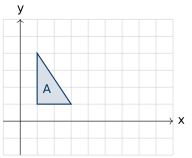
Triangle \(A\) has vertices \((1,1)\), \((3,1)\), \((1,4)\). It is translated by the vector \(\begin{pmatrix}4\\-2\end{pmatrix}\) to give triangle \(B\). Write down the coordinates of the vertices of triangle \(B\). [2]
- G6–7 2. Describe fully the single transformation that is equivalent to a reflection in the line \(y=x\) followed by a reflection in the \(x\)-axis. [3]
- G6–7 3. Reflect the point \((4,-3)\) in the line \(y=x\). Write down the coordinates of the image. [2]
- G6–7 4. A shape is enlarged by scale factor 3 with centre \((0,0)\). A point on the original shape is at \((2,1)\). Find the coordinates of the image point. [2]
- G6–7 5. Triangle \(P\) is rotated \(90^{\circ}\) anticlockwise about the origin to form triangle \(Q\). A vertex of \(P\) is at \((3,1)\). Find the coordinates of the corresponding vertex of \(Q\). [2]
💡Core idea
Recognise the relevant theorem, calculate the angle, and give the theorem as the reason.
📐Essential rules and method
Rules:
- Centre angle is twice circumference angle
- Same-segment angles match
- Cyclic opposite angles total \(180^\circ\)
- Radius is perpendicular to tangent
Method:
- Mark known radii and angles
- Name each theorem used
- Form an angle equation
- Solve in a logical chain
✏️Worked example — mark-scheme method
- Identify the method. Recognise the relevant theorem, calculate the angle, and give the theorem as the reason.
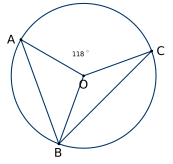
- Apply the method and show the mathematical evidence. \(A\), \(B\), \(C\) lie on a circle centre \(O\); angle \(AOC=118^\circ\) (at the centre). Since the angle at the centre is twice the angle at the circumference on the same arc, angle \(ABC=118^\circ\div2=59^\circ\).
- Check and present the answer. Mark equal radii to expose isosceles triangles before using a theorem. Check that every value has been used, signs and units are correct, and the final answer is in the form requested by the question.
⚡Exam hack
Mark equal radii to expose isosceles triangles before using a theorem.
Questions (5)
-
G6–7
1.
\(A\), \(B\), \(C\) are points on a circle with centre \(O\). Angle \(AOC = 118^{\circ}\). Work out the size of angle \(ABC\), giving a reason for your answer. [2]
-
G8–9
2.
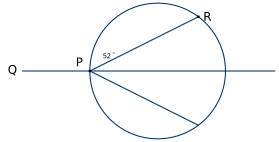
\(PQ\) is a tangent to a circle at point \(P\). The angle between the tangent \(PQ\) and the chord \(PR\) is \(52^{\circ}\). Work out the angle in the alternate segment, giving a reason for your answer. [2]
(Diagrams not accurately drawn.)
- G8–9 3. \(A\), \(B\), \(C\), \(D\) lie on a circle, forming a cyclic quadrilateral \(ABCD\). Angle \(A = 105^{\circ}\). Work out angle \(C\), giving a reason for your answer. [2]
- G8–9 4. \(PA\) and \(PB\) are tangents to a circle from an external point \(P\). Angle \(APB = 50^{\circ}\). Work out angle \(PAB\), giving a reason for your answer. [3]
- G6–7 5. \(A\), \(B\), \(C\) are points on a circle such that \(AB\) is a diameter. Write down the size of angle \(ACB\), giving a reason for your answer. [1]
💡Core idea
Use Pythagoras in right triangles, SOHCAHTOA for right-triangle ratios, and sine/cosine rules for non-right triangles.
📐Essential rules and method
Rules:
- Right triangles use SOHCAHTOA
- Non-right triangles use sine rule, cosine rule or \(\frac12ab\sin C\)
Method:
- Label opposite/adjacent/hypotenuse
- Choose a formula from known data
- Substitute before rearranging
- Check calculator degree mode
✏️Worked example — mark-scheme method
- Identify the method. Use Pythagoras in right triangles, SOHCAHTOA for right-triangle ratios, and sine/cosine rules for non-right triangles.
- Apply the method and show the mathematical evidence. A right triangle has opposite side 6 and hypotenuse 10. Using \(\sin\theta=\dfrac{\text{opp}}{\text{hyp}}\): \(\sin\theta=\dfrac{6}{10}=0.6\), so \(\theta=\sin^{-1}(0.6)\approx36.9^\circ\) (3 s.f.).
- Check and present the answer. Label opposite, adjacent and hypotenuse relative to the angle before choosing a ratio. Check that every value has been used, signs and units are correct, and the final answer is in the form requested by the question.
⚡Exam hack
Label opposite, adjacent and hypotenuse relative to the angle before choosing a ratio.
Questions (5)
-
G6–7
1.
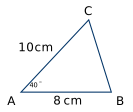
In triangle \(ABC\), angle \(A = 40^{\circ}\), \(AB = 8\) cm, \(AC = 10\) cm. Work out the area of the triangle. [3]
-
G6–7
2.
In triangle \(PQR\), \(PQ = 7\) cm, \(QR = 9\) cm, angle \(PQR = 65^{\circ}\). Work out the length of \(PR\). [3]
(Diagrams not accurately drawn.)
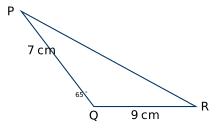
- G6–7 3. In triangle \(ABC\), angle \(A=90^{\circ}\), angle \(B=35^{\circ}\), \(AB=6\) cm. Work out the length of \(BC\). [3]
- G6–7 4. In a right-angled triangle, the side opposite an angle \(\theta\) is 7 cm and the side adjacent to \(\theta\) is 9 cm. Find the size of \(\theta\). [2]
- G8–9 5. In triangle \(XYZ\), \(XY=11\) cm, \(XZ=9\) cm, \(YZ=14\) cm. Use the cosine rule to work out the size of angle \(X\). [3]
💡Core idea
Similar shapes have equal corresponding angles and proportional lengths; areas scale by \(k^2\) and volumes by \(k^3\).
📐Essential rules and method
Rules:
- Similar lengths scale by \(k\), areas by \(k^2\), volumes by \(k^3\)
- Congruent shapes have scale factor 1
Method:
- Match corresponding sides
- Find the linear scale factor
- Apply the correct power
- Preserve the direction of enlargement
✏️Worked example — mark-scheme method
- Identify the method. Similar shapes have equal corresponding angles and proportional lengths; areas scale by \(k^2\) and volumes by \(k^3\).
- Apply the method and show the mathematical evidence. Two similar shapes have a linear scale factor of 3. Since area scales by (linear factor)\(^2\), the area scale factor is \(3^2=9\): a shape of area 5 cm\(^2\) maps to an image of area \(5\times9=45\) cm\(^2\).
- Check and present the answer. Write the linear scale factor first, then square or cube it only when needed. Check that every value has been used, signs and units are correct, and the final answer is in the form requested by the question.
⚡Exam hack
Write the linear scale factor first, then square or cube it only when needed.
Questions (5)
-
G6–7
1.
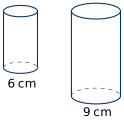
Two similar cylinders have heights 6 cm and 9 cm. The volume of the smaller cylinder is \(96\text{ cm}^3\). Work out the volume of the larger cylinder. [3]
-
G8–9
2.
Prove that triangle \(ABC\) is congruent to triangle \(DEF\), given that \(AB=DE\), \(BC=EF\) and angle \(B\) = angle \(E\). [2]
(Diagrams not accurately drawn.)
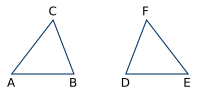
- G6–7 3. Triangle \(ABC\) is similar to triangle \(PQR\). \(AB=6\) cm, \(PQ=15\) cm. Given that \(BC=8\) cm, find \(QR\). [2]
- G8–9 4. Two similar triangles have areas \(18\text{ cm}^2\) and \(50\text{ cm}^2\). Find the ratio of their corresponding sides. [3]
- G8–9 5. State which condition (SSS, SAS, ASA or RHS) proves two triangles congruent if they share two equal sides and the included angle. [1]
💡Core idea
Describe directed movement using vector addition and scalar multiples; use alternate routes to form equations.
📐Essential rules and method
Rules:
- A route vector is the sum of directed segments
- Reversing a vector changes its sign
- Parallel vectors are scalar multiples
Method:
- Choose a common start/end route
- Express each segment in base vectors
- Simplify coefficients
- State the geometric conclusion
✏️Worked example — mark-scheme method
- Identify the method. Describe directed movement using vector addition and scalar multiples; use alternate routes to form equations.
- Apply the method and show the mathematical evidence. \(OABC\) is a parallelogram, \(\overrightarrow{OA}=\mathbf{a}\), \(\overrightarrow{OC}=\mathbf{c}\). Since \(\overrightarrow{AB}=\overrightarrow{OC}=\mathbf{c}\) (opposite sides equal), \(\overrightarrow{OB}=\overrightarrow{OA}+\overrightarrow{AB}=\mathbf{a}+\mathbf{c}\).
- Check and present the answer. Start every route at the named first point and follow arrow directions. Check that every value has been used, signs and units are correct, and the final answer is in the form requested by the question.
⚡Exam hack
Start every route at the named first point and follow arrow directions.
Questions (4)
-
G6–7
1.
\(OABC\) is a parallelogram with \(\overrightarrow{OA} = \mathbf{a}\) and \(\overrightarrow{OC} = \mathbf{c}\). \(M\) is the midpoint of \(AB\). Find, in terms of \(\mathbf{a}\) and \(\mathbf{c}\), the vector \(\overrightarrow{OM}\). [2]
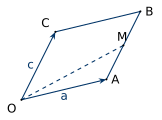
- G6–7 2. Given \(\mathbf{a} = \begin{pmatrix}3\\-2\end{pmatrix}\) and \(\mathbf{b} = \begin{pmatrix}-1\\5\end{pmatrix}\), find \(2\mathbf{a} - 3\mathbf{b}\). [2]
- G6–7 3. Given that \(\mathbf{a} = \begin{pmatrix}2\\5\end{pmatrix}\) and \(\mathbf{b} = \begin{pmatrix}-3\\1\end{pmatrix}\), find \(|\mathbf{a}+\mathbf{b}|\). [3]
- G6–7 4. \(OABC\) is a parallelogram with \(\overrightarrow{OA} = \mathbf{p}\) and \(\overrightarrow{OC} = \mathbf{q}\). Find, in terms of \(\mathbf{p}\) and \(\mathbf{q}\), the vector \(\overrightarrow{CB}\). [2]
💡Core idea
Bearings are measured clockwise from north and written using three digits.
📐Essential rules and method
Rules:
- Bearings are measured clockwise from north and written with three figures
- Alternate/corresponding north-line angles are useful
Method:
- Draw north lines
- Mark the clockwise bearing
- Find internal angles
- Use scale drawing
- Sine rule or cosine rule as appropriate
✏️Worked example — mark-scheme method
- Identify the method. Bearings are measured clockwise from north and written using three digits.
- Apply the method and show the mathematical evidence. A ship sails from a port on a bearing of \(048^\circ\) for 60 km, then on a bearing of \(155^\circ\) for 40 km. Draw a north line at each turning point, mark the given bearings as clockwise angles from north, and use the interior angle between legs to find the final bearing from the port.
- Check and present the answer. Draw a north line at every relevant point and use parallel-line angle facts. Check that every value has been used, signs and units are correct, and the final answer is in the form requested by the question.
⚡Exam hack
Draw a north line at every relevant point and use parallel-line angle facts.
Questions (4)
-
G6–7
1.
The bearing of \(B\) from \(A\) is \(065^{\circ}\). Work out the bearing of \(A\) from \(B\). [2]

- G6–7 2. A ship sails from port \(P\) on a bearing of \(120^{\circ}\) to point \(Q\). Work out the bearing of \(P\) from \(Q\). [2]
- G8–9 3. Point \(C\) is due east of point \(D\). Point \(E\) is on a bearing of \(030^{\circ}\) from \(D\), and angle \(CDE = 60^{\circ}\). Work out the bearing of \(E\) from \(C\), giving a reason at each stage. [3]
- G6–7 4. A lighthouse \(L\) is on a bearing of \(210^{\circ}\) from a harbour \(H\). Work out the bearing of \(H\) from \(L\). [2]
💡Core idea
Plans show the view from above; elevations show front or side views with hidden depth removed.
📐Essential rules and method
Rules:
- A plan is viewed from above
- Front/side elevations preserve width or height but not depth
Method:
- Identify the viewing direction
- Project visible edges to a grid
- Use exact dimensions
- Include hidden structure only when required
✏️Worked example — mark-scheme method
- Identify the method. Plans show the view from above; elevations show front or side views with hidden depth removed.
- Apply the method and show the mathematical evidence. A \(3\times2\times1\) cuboid is viewed from above (plan) and from the front (front elevation). The plan shows the \(3\times2\) face; the front elevation shows the \(3\times1\) face, since depth is not visible from the front.
- Check and present the answer. Count grid units and identify the viewing direction before drawing. Check that every value has been used, signs and units are correct, and the final answer is in the form requested by the question.
⚡Exam hack
Count grid units and identify the viewing direction before drawing.
Questions (3)
-
G6–7
1.
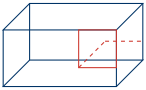
A solid is made from a cuboid measuring \(6\text{ cm} \times 4\text{ cm} \times 3\text{ cm}\) with a cube of side 2 cm removed from one corner. Sketch the front elevation of the solid. [3]
(Diagram not accurately drawn: the red notch shows the \(2\)\,cm cube removed from the corner.)
-
G6–7
2.
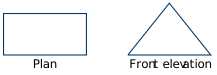
The diagram shows the plan view and front elevation of a prism. Sketch the side elevation of the prism, labelling any lengths that can be determined from the given views. [3]
- G6–7 3. A solid triangular prism has length 7 cm; its cross-section is a right-angled triangle with base 4 cm and height 3 cm. Sketch, on separate grids, the plan view and the front elevation of the prism, marking all lengths. [3]
💡Core idea
Use angle facts, parallel-line rules and polygon sums: interior sum \(=(n-2)180^\circ\).
📐Essential rules and method
Rules:
- Triangle sum \(180^\circ\)
- Quadrilateral sum \(360^\circ\)
- Polygon interior sum \((n-2)180^\circ\)
- Exterior angles total \(360^\circ\)
Method:
- Mark equal/parallel-angle facts
- Select the relevant total
- Form an equation
- Verify the angle is plausible
✏️Worked example — mark-scheme method
- Identify the method. Use angle facts, parallel-line rules and polygon sums: interior sum \(=(n-2)180^\circ\).
- Apply the method and show the mathematical evidence. A regular hexagon has 6 sides. Interior angle sum \(=(6-2)\times180^\circ=720^\circ\). Since all interior angles in a regular polygon are equal, each interior angle \(=720^\circ\div6=120^\circ\).
- Check and present the answer. Write angle reasons such as alternate, corresponding or co-interior, not just numbers. Check that every value has been used, signs and units are correct, and the final answer is in the form requested by the question.
⚡Exam hack
Write angle reasons such as alternate, corresponding or co-interior, not just numbers.
Questions (6)
- G6–7 1. The exterior angle of a regular polygon is \(24^{\circ}\). Work out the number of sides of the polygon. [2]
-
G6–7
2.
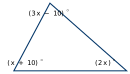
In a triangle, the interior angles are \((x+10)^{\circ}\), \((2x)^{\circ}\) and \((3x-10)^{\circ}\). Find the value of \(x\). [2]
(Diagram not accurately drawn.)
- G6–7 3. Find the sum of the interior angles of a nonagon (a 9-sided polygon). [2]
- G6–7 4. Two parallel lines are cut by a transversal. One angle formed is \(118^{\circ}\). Find the size of its co-interior angle. [1]
- G6–7 5. A regular polygon has interior angles of \(156^{\circ}\). Work out the number of sides of the polygon. [2]
- G6–7 6. The angles in a quadrilateral are \(x^{\circ}\), \((x+20)^{\circ}\), \((x+40)^{\circ}\) and \((x+60)^{\circ}\). Find the value of \(x\). [2]
💡Core idea
A circle with centre \((a,b)\) and radius \(r\) has equation \((x-a)^2+(y-b)^2=r^2\).
📐Essential rules and method
Rules:
- \((x-a)^2+(y-b)^2=r^2\) has centre \((a,b)\) and radius \(r\)
- A tangent is perpendicular to the radius
Method:
- Read centre/radius
- Test points by substitution
- Find the radius gradient
- Use the negative reciprocal
- Form the tangent equation
✏️Worked example — mark-scheme method
- Identify the method. A circle with centre \((a,b)\) and radius \(r\) has equation \((x-a)^2+(y-b)^2=r^2\).
- Apply the method and show the mathematical evidence. \(x^2+y^2=25\) compared with \((x-a)^2+(y-b)^2=r^2\): here \(a=0\), \(b=0\) and \(r^2=25\), so the centre is \((0,0)\) and the radius is \(r=\sqrt{25}=5\).
- Check and present the answer. Read the centre signs oppositely from the brackets. Check that every value has been used, signs and units are correct, and the final answer is in the form requested by the question.
⚡Exam hack
Read the centre signs oppositely from the brackets.
Questions (5)
-
G8–9
1.
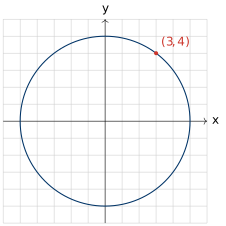
A circle has equation \(x^2+y^2=25\). Find the equation of the tangent to the circle at the point \((3,4)\). [4]
-
G8–9
2.
Find the coordinates of the points where the line \(y=x+1\) intersects the circle \(x^2+y^2=13\). [4]
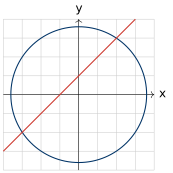
- G6–7 3. Write down the radius and the coordinates of the centre of the circle with equation \(x^2+y^2=64\). [1]
- G8–9 4. Show that the point \((5,12)\) lies on the circle \(x^2+y^2=169\). [2]
- G6–7 5. A circle has equation \((x-2)^2+(y+1)^2=25\). Write down the coordinates of its centre and its radius. [2]
💡Core idea
Find a useful right triangle inside the solid, often using Pythagoras on a face before trigonometry.
📐Essential rules and method
Rules:
- Three-dimensional problems reduce to connected right triangles
- Locate a face or space diagonal using Pythagoras first
Method:
- Sketch and label the hidden triangle
- Calculate an intermediate length
- Apply trigonometry and round only at the end
✏️Worked example — mark-scheme method
- Identify the method. Find a useful right triangle inside the solid, often using Pythagoras on a face before trigonometry.
- Apply the method and show the mathematical evidence. A cuboid has a rectangular base \(3\times4\). Its diagonal on that face, by Pythagoras, is \(\sqrt{3^2+4^2}=\sqrt{25}=5\). This length can now be used as a side of a new right triangle running up into the solid.
- Check and present the answer. Redraw the required triangle in two dimensions and label every known length. Check that every value has been used, signs and units are correct, and the final answer is in the form requested by the question.
⚡Exam hack
Redraw the required triangle in two dimensions and label every known length.
Questions (1)
-
G8–9
1.
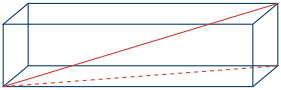
A cuboid measures \(4\text{ cm} \times 3\text{ cm} \times 12\text{ cm}\). Work out the length of the space diagonal of the cuboid, and hence find the angle it makes with the base, correct to 1 decimal place. [4]
(Diagram not accurately drawn: red lines show the space diagonal and its base projection.)
💡Core idea
Use compass-and-straightedge arcs for bisectors and loci, leaving construction marks visible.
📐Essential rules and method
Rules:
- A perpendicular bisector gives points equidistant from two points
- An angle bisector gives points equidistant from two lines
Method:
- Keep compass radius fixed for paired arcs
- Draw construction arcs clearly
- Join intersections accurately
- Shade the correct locus
✏️Worked example — mark-scheme method
- Identify the method. Use compass-and-straightedge arcs for bisectors and loci, leaving construction marks visible.
- Apply the method and show the mathematical evidence. To bisect angle \(ABC\): place the compass point at \(B\) and draw an arc crossing both arms; from each crossing point draw equal-radius arcs that intersect; join \(B\) to this intersection point — this line is the bisector.
- Check and present the answer. Do not erase arcs; they are evidence of the required construction. Check that every value has been used, signs and units are correct, and the final answer is in the form requested by the question.
⚡Exam hack
Do not erase arcs; they are evidence of the required construction.
Questions (5)
- G8–9 1. Using a ruler and compasses only, construct the perpendicular bisector of a line segment \(AB\) of length 8 cm. You must show all construction lines. [2]
-
G6–7
2.
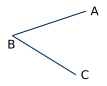
Using a ruler and compasses only, construct the bisector of angle \(ABC\) shown below. [2]
-
G6–7
3.
Using a ruler and compasses only, construct the perpendicular from point \(P\) to the line \(\ell\). [2]
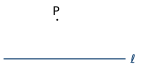
- G8–9 4. A garden is a rectangle \(PQRS\). A tree is to be planted so that it is nearer to \(PQ\) than to \(QR\), and nearer to \(P\) than to \(S\). On a copy of the rectangle, construct the boundaries of the region where the tree may be planted and shade this region. [4]
-
G8–9
5.
Using a ruler and compasses only, construct an angle of \(60^{\circ}\) at point \(A\) on the line shown. [2]

🎲 Probability
💡Core idea
Use sample spaces, trees or two-way tables; conditional probability restricts the sample to known outcomes.
📐Essential rules and method
Rules:
- Branch probabilities multiply along a route and mutually exclusive routes add
- Conditional probabilities use the reduced sample space
Method:
- Complete missing branches to total 1
- Multiply route probabilities
- Add required routes
- Interpret without replacement carefully
✏️Worked example — mark-scheme method
- Identify the method. Use sample spaces, trees or two-way tables; conditional probability restricts the sample to known outcomes.
- Apply the method and show the mathematical evidence. A bag has 5 red and 3 blue counters; two are drawn without replacement. \(P(\text{both red})=P(\text{1st red})\times P(\text{2nd red}\mid\text{1st red})=\dfrac{5}{8}\times\dfrac{4}{7}=\dfrac{20}{56}=\dfrac{5}{14}\).
- Check and present the answer. On a tree, multiply along branches and add mutually exclusive final routes. Check that every value has been used, signs and units are correct, and the final answer is in the form requested by the question.
⚡Exam hack
On a tree, multiply along branches and add mutually exclusive final routes.
Questions (13)
- G8–9 1. A bag contains 5 red counters and 3 blue counters. Two counters are taken at random without replacement. Work out the probability that both counters are the same colour. [3]
- G6–7 2. The probability that it rains on a given day is 0.3. If it rains, the probability that Sam cycles to work is 0.2; if it does not rain, the probability is 0.9. Work out the probability that Sam cycles to work on a randomly chosen day. [3]
- G6–7 3. Two fair coins are flipped. Work out the probability of getting exactly one head. [2]
- G6–7 4. A bag has 4 red and 6 green balls. One ball is drawn, replaced, then another is drawn. Find the probability that both are red. [2]
- G6–7 5. A fair die is rolled twice. Find the probability of getting a total score of 9. [3]
- G6–7 6. \(P(\text{likes maths})=0.6\), \(P(\text{likes science})=0.5\), \(P(\text{likes both})=0.3\). Find \(P(\text{likes maths or science})\). [3]
- G8–9 7. A bag contains 3 black and 4 white counters. Two counters are drawn without replacement. Find the probability that they are different colours. [3]
- G6–7 8. The probability that a train is late is 0.15. Find the probability that, of the next 2 trains, exactly one is late. [3]
- G6–7 9. A spinner has sections numbered 1–4, each equally likely. It is spun twice. Find the probability that the sum of the two scores is even. [3]
- G6–7 10. Events \(A\) and \(B\) are independent. \(P(A)=0.4\), \(P(B)=0.25\). Find \(P(A \text{ and } B)\). [2]
- G8–9 11. A box has 5 red pens and 3 blue pens. Two pens are chosen at random without replacement. Find the probability that both are the same colour. [3]
- G8–9 12. The probability it snows on a given day in December is 0.1. Find the probability it snows on at least one of the next 3 days (assume independence). [3]
- G6–7 13. In a game, the probability of winning is 0.3. A player plays the game twice. Find the probability of winning exactly once. [3]
💡Core idea
Place intersections first, then fill exclusive regions and the outside of the universal set.
📐Essential rules and method
Rules:
- Intersection means both, union means either, complement means not
- Fill the intersection first
Method:
- Place overlap values
- Complete exclusive regions
- Calculate the outside region
- Divide by the universal total for probabilities
✏️Worked example — mark-scheme method
- Identify the method. Place intersections first, then fill exclusive regions and the outside of the universal set.
- Apply the method and show the mathematical evidence. \(P(\text{maths})=0.6\), \(P(\text{science})=0.5\), \(P(\text{both})=0.3\). Using \(P(A\cup B)=P(A)+P(B)-P(A\cap B)\): \(P(\text{maths or science})=0.6+0.5-0.3=0.8\).
- Check and present the answer. “Or” means union; “and” means intersection; “not” means complement. Check that every value has been used, signs and units are correct, and the final answer is in the form requested by the question.
⚡Exam hack
“Or” means union; “and” means intersection; “not” means complement.
Questions (3)
-
G6–7
1.
In a class of 30 students, 18 study French, 15 study Spanish, and 8 study both. Draw a Venn diagram to show this information and find the number of students who study neither language. [3]
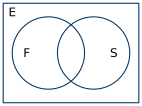
- G6–7 2. \(\mathcal{E} = \{1,2,\ldots,12\}\), \(A = \{\text{multiples of }3\}\), \(B = \{\text{multiples of }4\}\). List the elements of \(A \cap B\). [2]
- G6–7 3. In a survey of 50 people, 28 like coffee, 22 like tea, and 10 like neither. Work out the number of people who like both coffee and tea. [3]
💡Core idea
Relative frequency estimates probability from observed data and becomes more stable with more trials.
📐Essential rules and method
Rules:
- Relative frequency \(=\) observed successes/trials
- Estimated frequency \(=\) relative frequency \(\times\) future trials
Method:
- Use the largest reliable sample
- Calculate the proportion
- Scale to the new number of trials
- Describe it as an estimate
✏️Worked example — mark-scheme method
- Identify the method. Relative frequency estimates probability from observed data and becomes more stable with more trials.
- Apply the method and show the mathematical evidence. A biased dice is rolled 60 times, landing on 6 fifteen times. Relative frequency \(=15\div60=0.25\). To estimate the count in 500 rolls: \(0.25\times500=125\) sixes expected.
- Check and present the answer. Use the estimate to predict a count by multiplying by the new number of trials. Check that every value has been used, signs and units are correct, and the final answer is in the form requested by the question.
⚡Exam hack
Use the estimate to predict a count by multiplying by the new number of trials.
Questions (4)
- G6–7 1. A spinner is spun 200 times and lands on red 46 times. Work out the estimated probability that the spinner lands on red. [1]
- G6–7 2. A biased dice is rolled 60 times and lands on a six 15 times. Estimate how many times the dice would land on a six in 500 rolls. [2]
- G6–7 3. A coin is tossed 40 times, giving 26 heads. \ (a) Work out the relative frequency of heads. [1] \ (b) Explain why 40 trials may not give a reliable estimate of the coin’s true probability of landing heads. [1]
- G6–7 4. Two different samples are taken of a biased spinner landing on blue: sample 1 gives 9 blues from 20 spins; sample 2 gives 54 blues from 150 spins. Which sample gives the more reliable estimate of the probability of blue, and why? [2]
📊 Statistics
💡Core idea
Use median and quartiles for position, and range or IQR for spread; compare both centre and variability.
📐Essential rules and method
Rules:
- Mean \(=\sum x/n\)
- Range \(=\) max\(-\)min
- IQR \(=Q_3-Q_1\)
- Cumulative frequency locates medians and quartiles
Method:
- Order or accumulate data
- Identify positions
- Calculate the requested measure
- Compare centre and spread separately
✏️Worked example — mark-scheme method
- Identify the method. Use median and quartiles for position, and range or IQR for spread; compare both centre and variability.
- Apply the method and show the mathematical evidence. A data set has lower quartile \(Q_1=12\) and upper quartile \(Q_3=29\). The interquartile range is \(\mathrm{IQR}=Q_3-Q_1=29-12=17\), which measures the spread of the middle 50% of the data.
- Check and present the answer. When comparing distributions, make one statement about average and one about spread in context. Check that every value has been used, signs and units are correct, and the final answer is in the form requested by the question.
⚡Exam hack
When comparing distributions, make one statement about average and one about spread in context.
Questions (12)
- G6–7 1. Here are the ages, in years, of 9 people: \(21, 45, 32, 19, 28, 50, 33, 41, 26\). Find the median and the interquartile range of these ages. [3]
-
G6–7
2.
A box plot shows: minimum 10, lower quartile 18, median 25, upper quartile 34, maximum 48. Describe the skew of the distribution, giving a reason for your answer. [1]

- G6–7 3. Find the mean of \(12, 15, 9, 22, 18, 14\). [2]
- G6–7 4. A cumulative frequency table gives quartiles: lower quartile \(=20\), median \(=32\), upper quartile \(=48\). Find the interquartile range. [1]
- G6–7 5. The mean of 5 numbers is 14. Four of the numbers are 10, 16, 12 and 18. Find the fifth number. [2]
- G6–7 6. Box plot \(A\) has median 40 and interquartile range 15. Box plot \(B\) has median 35 and interquartile range 25. Comment on which data set is more consistent. [2]
- G6–7 7. Find the range of the data set \(3, 17, 9, 22, 5, 30\). [1]
- G6–7 8. A set of 12 exam scores has median 68 and range 34. If the highest score is 85, find the lowest score. [2]
- G6–7 9. The table shows the ages of 20 people: \(10\)–\(19\): 4, \(20\)–\(29\): 7, \(30\)–\(39\): 6, \(40\)–\(49\): 3. Find an estimate for the mean age. [3]
- G6–7 10. A box plot has median 55, lower quartile 40, upper quartile 70. Find the interquartile range and describe the skew of the distribution. [2]
- G6–7 11. The mean of 8 numbers is 25. A ninth number, 43, is added to the set. Find the new mean. [2]
- G6–7 12. Find the median and range of \(14, 8, 19, 3, 25, 11, 7\). [2]
💡Core idea
Histogram bar area represents frequency; frequency density \(=\) frequency divided by class width.
📐Essential rules and method
Rules:
- Frequency density \(=\) frequency/class width
- Histogram area represents frequency
Method:
- Calculate class widths and densities
- Draw bars with continuous boundaries
- Use area ratios to recover missing frequencies
✏️Worked example — mark-scheme method
- Identify the method. Histogram bar area represents frequency; frequency density \(=\) frequency divided by class width.
- Apply the method and show the mathematical evidence. A class of width 5 has frequency 30. Frequency density \(=\) frequency \(\div\) class width \(=30\div5=6\), so the bar for this class is drawn with height 6 on the frequency density axis.
- Check and present the answer. Never read frequency directly from height unless all class widths are equal. Check that every value has been used, signs and units are correct, and the final answer is in the form requested by the question.
⚡Exam hack
Never read frequency directly from height unless all class widths are equal.
Questions (2)
- G8–9 1. A histogram has a bar of frequency density 3.5 over the class \(10 < x \leqslant 14\). Work out the frequency for this class. [2]
- G8–9 2. Explain why frequency density, rather than frequency, is used on the vertical axis of a histogram with unequal class widths. [1]
💡Core idea
Choose scales and representations that match the data, and label axes, units and categories clearly.
📐Essential rules and method
Rules:
- Pie-chart angle \(=\) frequency/total \(\times360^\circ\)
- Frequency polygons use class midpoints
- Diagrams need labelled scales
Method:
- Identify variable type
- Choose a suitable display
- Calculate plotting values
- Label axes/units
- Avoid misleading scales
✏️Worked example — mark-scheme method
- Identify the method. Choose scales and representations that match the data, and label axes, units and categories clearly.
- Apply the method and show the mathematical evidence. A frequency table has class \(10\)–\(20\) with frequency 8. The class midpoint is \((10+20)\div2=15\), so the point \((15,8)\) is plotted on the frequency polygon and joined to adjacent midpoints with straight lines.
- Check and present the answer. Calculate every class midpoint before placing any points. Check that every value has been used, signs and units are correct, and the final answer is in the form requested by the question.
⚡Exam hack
Calculate every class midpoint before placing any points.
Questions (3)
-
G6–7
1.
The table shows the number of books read by a group of students in a month.
Number of books 0–2 3–5 6–8 9–11 Frequency 5 12 9 4
Draw a frequency polygon for this data. [3]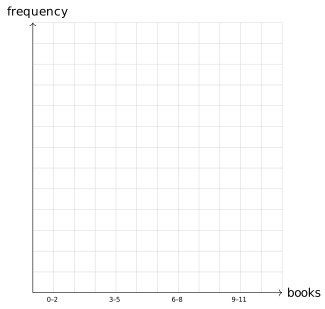
- G8–9 2. A survey of 60 students records their favourite sport: Football 24, Rugby 15, Tennis 9, Other 12. Work out the angle for each sector of a pie chart representing this data. [3]
-
G6–7
3.
The stem-and-leaf diagram below shows the ages, in years, of 13 people at a wedding.
Find (a) the median age, [1] \ (b) the interquartile range of the ages. [2]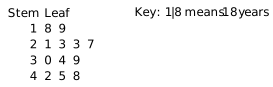
💡Core idea
Describe correlation by direction and strength; use a line of best fit only within a sensible data range.
📐Essential rules and method
Rules:
- Correlation describes association, not causation
- Interpolation is within the data range and extrapolation is outside it
Method:
- Describe direction/strength
- Draw a balanced line of best fit
- Estimate from the line
- Comment on reliability
✏️Worked example — mark-scheme method
- Identify the method. Describe correlation by direction and strength; use a line of best fit only within a sensible data range.
- Apply the method and show the mathematical evidence. A scatter graph of hours revised against test score shows points rising left to right, close to a straight line. This shows strong positive correlation: as revision time increases, test score tends to increase.
- Check and present the answer. Mention interpolation or extrapolation when judging reliability. Check that every value has been used, signs and units are correct, and the final answer is in the form requested by the question.
⚡Exam hack
Mention interpolation or extrapolation when judging reliability.
Questions (4)
- G6–7 1. A scatter graph plots hours of television watched per week against exam score. Describe what a negative correlation would mean in this context. [1]
- G8–9 2. Explain why correlation does not necessarily show that one variable causes the other. [1]
- G6–7 3. A line of best fit predicts a score of 72 for a student who studies for 8 hours. State one reason why this prediction may not be reliable. [1]
- G6–7 4. A data point lies a long way from the overall pattern. State the statistical name for this point. [1]
Higher Calculator — Papers 2H & 3H
Original EzyMatics practice bank for calculator-based problem solving: compound growth, bounds, iteration, bearings, trigonometry and multi-step applied reasoning across every Higher-tier domain.
🔢 Number
💡Core idea
Repeated percentage change uses powers of a multiplier: \(V=P(1\pm r)^n\).
📐Essential rules and method
Rules:
- Repeated change uses \(V=P(1\pm r)^n\) with \(r\) as a decimal
- Different rates require separate multipliers
Method:
- Identify initial value
- Multiplier and number of periods
- Calculate without premature rounding
- Test whole years if finding a minimum time
✏️Worked example — mark-scheme method
- Identify the method. Repeated percentage change uses powers of a multiplier: \(V=P(1\pm r)^n\).
- Apply the method and show the mathematical evidence. £500 is invested at 4% compound interest for 3 years. Using \(V=P(1+r)^n\): \(V=500\times(1.04)^3=500\times1.124864\approx£562.43\) (to the nearest penny), keeping full precision until the final step.
- Check and present the answer. For a minimum whole number of years, test neighbouring integer values after using logarithms or trial. Check that every value has been used, signs and units are correct, and the final answer is in the form requested by the question.
⚡Exam hack
For a minimum whole number of years, test neighbouring integer values after using logarithms or trial.
Questions (12)
- G6–7 1. A car worth £14\,000 depreciates at 8% per year. Find its value after 4 years, correct to the nearest £1. [3]
- G6–7 2. Sara invests £3200 at 2.5% compound interest per year. Find the value of her investment after 5 years. [3]
- G8–9 3. A house valued at £220\,000 increases in value by 3% per year for 3 years, then by 4% per year for a further 2 years. Find its value at the end of year 5. [4]
- G6–7 4. A population of bacteria grows by 15% every hour. Starting at 800, find the population after 6 hours. [3]
- G8–9 5. Bank A offers 2% compound interest for the first year and 3% for each year after. Bank B offers a flat 2.6% each year. Compare the value of £5000 invested in each account after 3 years. [4]
- G6–7 6. A laptop costs £900. Its value decreases by 20% in the first year and 12% each year after. Find its value after 3 years. [3]
- G8–9 7. £2500 is invested at \(r\%\) compound interest per year. After 3 years the investment is worth £2812.16. Find the value of \(r\). [4]
- G6–7 8. A city’s population of 50\,000 grows at 1.8% per year. Estimate the population after 10 years, to the nearest hundred. [3]
- G8–9 9. An antique bought for £600 increases in value by 5% each year. Find the smallest number of whole years after which its value first exceeds £900. [4]
- G8–9 10. Two investment accounts both start at £4000. Account A grows at 3% per year. Account B grows at 2.5% per year for the first 2 years then 4% per year after. Which account has more money after 4 years? [4]
- G6–7 11. A phone depreciates by 18% in its first year and then 9% each following year. Find its value after 3 years if it originally cost £750. [3]
- G8–9 12. A savings account pays 1.9% compound interest annually. Find the minimum number of complete years for £3000 to grow to at least £3500. [4]
💡Core idea
Write numbers as \(a\times10^n\) with \(1\le a<10\), applying index laws during calculations.
📐Essential rules and method
Rules:
- Standard form is \(a\times10^n\) with \(1\le a<10\)
- Multiply coefficients/add powers
- Divide coefficients/subtract powers
Method:
- Perform coefficient and power calculations separately
- Combine
- Normalise
- Adjust the exponent
✏️Worked example — mark-scheme method
- Identify the method. Write numbers as \(a\times10^n\) with \(1\le a<10\), applying index laws during calculations.
- Apply the method and show the mathematical evidence. \((3\times10^5)\times(2\times10^{-2})\): multiply coefficients, \(3\times2=6\); add powers, \(5+(-2)=3\); combine to get \(6\times10^3\), which is already in standard form since \(1\le6<10\).
- Check and present the answer. Enter powers with the calculator’s EXP or \(\times10^x\) key and normalise the final coefficient. Check that every value has been used, signs and units are correct, and the final answer is in the form requested by the question.
⚡Exam hack
Enter powers with the calculator’s EXP or \(\times10^x\) key and normalise the final coefficient.
Questions (10)
- G6–7 1. Write \(6.4 \times 10^7\) as an ordinary number. [1]
- G6–7 2. Write 0.000512 in standard form. [1]
- G6–7 3. Work out \((3.2\times10^5)\times(4\times10^{-2})\), giving your answer in standard form. [2]
- G6–7 4. Work out \((7.5\times10^8)\div(2.5\times10^3)\), giving your answer in standard form. [2]
- G8–9 5. The mass of a proton is approximately \(1.67\times10^{-27}\) kg. Find the total mass of \(5\times10^6\) protons, giving your answer in standard form. [3]
- G6–7 6. Work out \((2.4\times10^6)+(3.1\times10^5)\), giving your answer in standard form. [2]
- G6–7 7. Given that \((4\times10^a)\times(3\times10^b)=1.2\times10^9\), find a possible pair of integer values for \(a\) and \(b\). [3]
- G8–9 8. A number \(k\) is such that \(3.6\times10^{-8} = k \times (9\times10^{-16})\). Find the value of \(k\) in standard form. [3]
- G8–9 9. Light travels at approximately \(3\times10^8\) m/s. Find, in standard form, the distance travelled in \(2.5\times10^4\) seconds. [3]
- G8–9 10. Order the following numbers from smallest to largest: \(5.2\times10^{-3}\), \(4.9\times10^{-2}\), \(6\times10^{-4}\), \(1.1\times10^{-2}\). [2]
💡Core idea
A rounded value represents an interval; use lower or upper endpoints according to the required bound.
📐Essential rules and method
Rules:
- Rounded value \(x\) to unit \(u\) gives \(x-u/2\leq X
- Truncation uses a one-sided interval
Method:
- Write input intervals first
- Choose numerator/denominator extremes for the required bound
- Calculate
- Keep inequalities correct
✏️Worked example — mark-scheme method
- Identify the method. A rounded value represents an interval; use lower or upper endpoints according to the required bound.
- Apply the method and show the mathematical evidence. A length is given as 7.3 cm to 1 d.p. The true value lies within half a unit of the last digit: \(7.3-0.05\le x<7.3+0.05\), so \(7.25\text{ cm}\le x<7.35\text{ cm}\).
- Check and present the answer. For a quotient’s upper bound, use the largest numerator and smallest positive denominator. Check that every value has been used, signs and units are correct, and the final answer is in the form requested by the question.
⚡Exam hack
For a quotient’s upper bound, use the largest numerator and smallest positive denominator.
Questions (20)
- G8–9 1. A length is measured as 24 cm, correct to the nearest cm. Write down the error interval for the length. [1]
- G8–9 2. A number, \(x\), is rounded to 1 decimal place. The result is 7.3. Write down the error interval for \(x\). [2]
- G8–9 3. A number is truncated to 2 significant figures. The result is 5.6. Write down the error interval for the original number. [2]
- G8–9 4. A distance is given as 15.4 km, correct to 3 significant figures. Write down the error interval for the distance. [2]
- G8–9 5. A number \(w\) is rounded to the nearest 10. The result is 250. Write down the error interval for \(w\). [1]
- G8–9 6. Given that \(a=6.5\) correct to 1 decimal place and \(b=3.2\) correct to 1 decimal place, find the upper bound of \(a+b\). [2]
- G8–9 7. Given that \(p=8.6\) correct to 1 decimal place and \(q=2.3\) correct to 1 decimal place, find the upper bound of \(p \div q\). [3]
- G8–9 8. A rectangle has length 9.5 cm and width 4.2 cm, both correct to 1 decimal place. Find the upper bound for the area of the rectangle. [3]
- G8–9 9. \(v=24\) correct to the nearest whole number, \(t=5.0\) correct to 1 decimal place. Given \(a=v\div t\), find the lower bound of \(a\). [3]
- G8–9 10. A distance of 60 km, correct to the nearest km, is travelled in a time of 50 minutes, correct to the nearest minute. Find the upper bound for the average speed in km/h. [3]
- G8–9 11. \(m=3.75\) correct to 2 decimal places. Write down the error interval for \(m\). [1]
- G8–9 12. A cube has volume \(216\text{ cm}^3\), correct to the nearest whole number. Find the lower bound for the length of one side. [3]
- G8–9 13. Given that \(x=4.8\) (1 dp) and \(y=1.5\) (1 dp), find the lower bound of \(x-y\). [2]
- G8–9 14. A number \(n\) is rounded to 3 significant figures to give 2.30. Write down the error interval for \(n\). [2]
- G8–9 15. A field has area \(500\text{ m}^2\), correct to 1 significant figure. Write down the error interval for the area. [2]
- G8–9 16. \(u=15.0\) (1 dp), \(a=9.8\) (2 sf), \(s=200\) (nearest 10). Given \(v^2=u^2+2as\), find the upper bound of \(v^2\). [4]
- G8–9 17. A runner completes a race in 45.2 seconds, correct to the nearest 0.1 seconds, over a distance of 400 m, correct to the nearest metre. Find the lower bound for the average speed. [3]
- G8–9 18. Given that \(a=5.4\times10^3\) correct to 2 significant figures and \(b=3.1\times10^2\) correct to 2 significant figures, find the upper bound of \(a \times b\), giving your answer in standard form. [3]
- G8–9 19. \(h=12.5\), correct to the nearest 0.5. Write down the error interval for \(h\). [1]
- G8–9 20. A number \(k\) rounded to the nearest 100 gives 3200. Write down the error interval for \(k\). [1]
💡Core idea
Use brackets and calculator functions accurately, retaining full precision until the final rounding step.
📐Essential rules and method
Rules:
- Keep full calculator precision during working
- Round only the final answer to the stated dp or sf
Method:
- Enter brackets explicitly
- Record intermediate values when needed
- Check the display and order of operations
- Round with trailing zeros if significant
✏️Worked example — mark-scheme method
- Identify the method. Use brackets and calculator functions accurately, retaining full precision until the final rounding step.
- Apply the method and show the mathematical evidence. Evaluate \(\sqrt{4.6^2-19.3}\): enter the whole expression under the root, \(4.6^2-19.3=21.16-19.3=1.86\), so \(\sqrt{1.86}\approx1.364\), keeping full display precision before rounding the final answer.
- Check and present the answer. Write down extra display digits before rounding so method marks remain visible. Check that every value has been used, signs and units are correct, and the final answer is in the form requested by the question.
⚡Exam hack
Write down extra display digits before rounding so method marks remain visible.
Questions (6)
- G6–7 1. Use your calculator to work out \(\dfrac{5.72+3.9}{2.1-0.68}\). Write down all the figures on your calculator display. [2]
- G6–7 2. Round 3.14159 to 3 significant figures. [1]
- G6–7 3. Work out \(4.6^2 - \sqrt{19.3}\), giving your answer correct to 2 decimal places. [2]
- G6–7 4. Use your calculator to find the value of \(\dfrac{2.3\times10^4 + 5.1\times10^3}{1.9}\), giving your answer correct to 3 significant figures. [2]
- G6–7 5. Round 128\,749 to the nearest thousand. [1]
- G6–7 6. Aisha rounds 6.995 to 2 decimal places and writes 6.99. Explain what she has done wrong. [1]
💡Core idea
A percentage multiplier is \(1\pm\frac{r}{100}\); reverse percentages divide by the multiplier.
📐Essential rules and method
Rules:
- Increase multiplier \(=1+r/100\)
- Decrease multiplier \(=1-r/100\)
- Reverse percentage \(=\) final amount \(\div\) multiplier
Method:
- Identify the original base
- Write the multiplier
- Calculate
- Check whether the answer should be larger or smaller
✏️Worked example — mark-scheme method
- Identify the method. A percentage multiplier is \(1\pm\frac{r}{100}\); reverse percentages divide by the multiplier.
- Apply the method and show the mathematical evidence. A price is reduced by 20% to £60. Since £60 represents \(100\%-20\%=80\%\) of the original, the original price is \(60\div0.8=£75\).
- Check and present the answer. Successive changes use successive multipliers; never add the rates unless the base stays unchanged. Check that every value has been used, signs and units are correct, and the final answer is in the form requested by the question.
⚡Exam hack
Successive changes use successive multipliers; never add the rates unless the base stays unchanged.
Questions (9)
- G6–7 1. A jacket costs £64 before VAT. VAT is charged at 20%. Work out the total cost including VAT. [2]
- G6–7 2. In a sale, a television’s price is reduced from £550 to £429. Work out the percentage reduction. [2]
- G6–7 3. A company’s profits rose from £120\,000 to £138\,000. Work out the percentage increase. [2]
- G6–7 4. Rehana invests £4000 for 1 year at 3.2% simple interest. Work out the total interest earned. [2]
- G6–7 5. A meal costs £45.60 including a 12% service charge. Work out the cost of the meal before the service charge. [3]
- G6–7 6. A shop increases all prices by 5% and then reduces the new prices by 5% in a later sale. Explain why the final prices are not the same as the original prices. [2]
- G6–7 7. Of 240 students, 35% study French. Of these, 60% are girls. Work out the number of girls studying French. [3]
- G6–7 8. A salary of £32\,000 increases by 4% then by a further 3% the following year. Work out the salary after both increases. [3]
- G8–9 9. A washing machine is reduced by 30% to £294 in a sale. Work out the original price. [3]
💡Core idea
Use algebra to shift repeating digits, subtract, and solve for the original decimal.
📐Essential rules and method
Rules:
- Multiply by \(10^n\) where \(n\) is the recurring block length
- Use a second shift when non-recurring digits occur first
Method:
- Define \(x\)
- Align the recurring digits
- Subtract the equations
- Solve for \(x\)
- Simplify the fraction
✏️Worked example — mark-scheme method
- Identify the method. Use algebra to shift repeating digits, subtract, and solve for the original decimal.
- Apply the method and show the mathematical evidence. Let \(x=0.4\dot5\dot5\ldots\) Since one digit recurs, \(10x=4.5\dot5\) and \(100x=45.5\dot5\); subtracting, \(90x=41\), so \(x=\frac{41}{90}\).
- Check and present the answer. Multiply by \(10^k\), where \(k\) is the number of recurring digits. Check that every value has been used, signs and units are correct, and the final answer is in the form requested by the question.
⚡Exam hack
Multiply by \(10^k\), where \(k\) is the number of recurring digits.
Questions (5)
- G8–9 1. Prove algebraically that \(0.4\dot{5}\) (i.e. \(0.4555\ldots\)) can be written as \(\dfrac{41}{90}\). [3]
- G6–7 2. Express \(0.1\dot{6}\) as a fraction in its simplest form. [3]
- G8–9 3. Prove algebraically that \(0.\dot{2}3\dot{7}\) can be written as \(\dfrac{79}{333}\). [3]
- G6–7 4. Express \(0.0\dot{4}\dot{5}\) as a fraction in its simplest form. [3]
- G8–9 5. Prove algebraically that \(0.3\dot{1}\dot{8}\) can be written as \(\dfrac{7}{22}\). [3]
💡Core idea
Prime factorisation supports HCF, LCM and problems involving perfect squares or cubes.
📐Essential rules and method
Rules:
- HCF uses the smallest shared prime powers
- LCM uses the greatest powers present
- Square numbers have even prime powers
Method:
- Prime-factorise each number
- Compare powers systematically
- Rebuild the required number
✏️Worked example — mark-scheme method
- Identify the method. Prime factorisation supports HCF, LCM and problems involving perfect squares or cubes.
- Apply the method and show the mathematical evidence. \(72=2^3\times3^2\) and \(60=2^2\times3\times5\). HCF takes the smaller shared powers: \(2^2\times3=12\). LCM takes the largest powers present: \(2^3\times3^2\times5=360\).
- Check and present the answer. For HCF take the smaller shared powers; for LCM take the largest powers present. Check that every value has been used, signs and units are correct, and the final answer is in the form requested by the question.
⚡Exam hack
For HCF take the smaller shared powers; for LCM take the largest powers present.
Questions (8)
- G6–7 1. Write 504 as a product of its prime factors. [2]
- G6–7 2. Find the highest common factor (HCF) of 90 and 126. [2]
- G6–7 3. Find the lowest common multiple (LCM) of 18, 24 and 30. [2]
- G6–7 4. \(A=2^3\times3^2\times5\), \(B=2\times3^3\times7\). Find the highest common factor of \(A\) and \(B\). [2]
- G6–7 5. \(A=2^2\times3^4\times5\), \(B=2^3\times3^2\times5^2\times7\). Find the lowest common multiple of \(A\) and \(B\). [2]
- G6–7 6. Two bells ring every 18 and 24 minutes respectively. If they ring together at 09:00, find the next time they ring together. [2]
- G6–7 7. Find the smallest number that is both a multiple of 15 and a multiple of 20. [1]
- G6–7 8. Given that \(2520 = 2^3\times3^2\times5\times7\), find the smallest positive integer \(k\) such that \(2520k\) is a perfect square. [3]
💡Core idea
Simplify square roots using square factors and rationalise denominators when required.
📐Essential rules and method
Rules:
- \(\sqrt{ab}=\sqrt a\sqrt b\)
- Only like surds combine
- Use a conjugate to rationalise a binomial denominator
Method:
- Extract the largest square factor
- Simplify
- Combine like terms
- Check that no square factor remains inside a root
✏️Worked example — mark-scheme method
- Identify the method. Simplify square roots using square factors and rationalise denominators when required.
- Apply the method and show the mathematical evidence. \(\sqrt{75}+\sqrt{27}\): write \(\sqrt{75}=\sqrt{25\times3}=5\sqrt3\) and \(\sqrt{27}=\sqrt{9\times3}=3\sqrt3\), so the sum is \(5\sqrt3+3\sqrt3=8\sqrt3\).
- Check and present the answer. Look for the largest square factor; use the conjugate for denominators such as \(a+\sqrt b\). Check that every value has been used, signs and units are correct, and the final answer is in the form requested by the question.
⚡Exam hack
Look for the largest square factor; use the conjugate for denominators such as \(a+\sqrt b\).
Questions (1)
- G8–9 1. Rationalise the denominator of \(\dfrac{5}{\sqrt{7}-2}\), giving your answer in its simplest form. [3]
📐 Algebra
💡Core idea
Use \(y=mx+c\), where \(m\) is gradient and \(c\) is the \(y\)-intercept.
📐Essential rules and method
Rules:
- \(m=(y_2-y_1)/(x_2-x_1)\) and \(y=mx+c\)
- Parallel gradients match
- Perpendicular gradients satisfy \(m_1m_2=-1\)
Method:
- Find the gradient
- Substitute one point to find \(c\)
- Write the equation
- Verify the second point
✏️Worked example — mark-scheme method
- Identify the method. Use \(y=mx+c\), where \(m\) is gradient and \(c\) is the \(y\)-intercept.
- Apply the method and show the mathematical evidence. Find the equation through \((2,5)\) and \((6,13)\): gradient \(m=\dfrac{13-5}{6-2}=\dfrac{8}{4}=2\). Substitute \((2,5)\) into \(y=2x+c\): \(5=4+c\), so \(c=1\), giving \(y=2x+1\).
- Check and present the answer. Parallel lines have equal gradients; perpendicular gradients multiply to \(-1\). Check that every value has been used, signs and units are correct, and the final answer is in the form requested by the question.
⚡Exam hack
Parallel lines have equal gradients; perpendicular gradients multiply to \(-1\).
Questions (9)
- G6–7 1. Find the equation of the line through \((3,7)\) and \((9,19)\). [3]
- G6–7 2. Find the equation of the line perpendicular to \(y=3x-1\) that passes through \((6,2)\). [3]
- G6–7 3. \(A\) is \((2,5)\) and \(B\) is \((10,17)\). Find the coordinates of the midpoint of \(AB\). [2]
- G6–7 4. A line has equation \(4x+2y=10\). Find its gradient and \(y\)-intercept. [2]
- G6–7 5. The points \(P(-4,3)\), \(Q(2,15)\) and \(R(k,21)\) lie on a straight line. Find the value of \(k\). [3]
- G8–9 6. Show that the lines \(2y=6x+4\) and \(y=3x-7\) are parallel. [2]
- G6–7 7. Find the equation of the line passing through \((0,-3)\) that is parallel to \(5x-2y=8\). [3]
- G6–7 8. A line \(L\) has gradient \(-2\) and passes through \((5,-1)\). Find the coordinates of the point where \(L\) crosses the \(y\)-axis. [2]
- G6–7 9. Points \(A(-2,-1)\) and \(B(4,b)\) lie on a line with gradient 1.5. Find the value of \(b\). [2]
💡Core idea
Use coordinate formulas for gradient, midpoint and distance, then connect them to line properties.
📐Essential rules and method
Rules:
- Midpoint is the mean of coordinates
- Distance follows Pythagoras
- Gradient is change in \(y\) over change in \(x\)
Method:
- Label ordered coordinate pairs
- Substitute carefully
- Simplify exactly
- Check signs/quadrants
✏️Worked example — mark-scheme method
- Identify the method. Use coordinate formulas for gradient, midpoint and distance, then connect them to line properties.
- Apply the method and show the mathematical evidence. Find the midpoint of \((2,3)\) and \((8,11)\): average the \(x\)-coordinates, \(\dfrac{2+8}{2}=5\), and the \(y\)-coordinates, \(\dfrac{3+11}{2}=7\), giving the midpoint \((5,7)\).
- Check and present the answer. Subtract coordinates in the same order when finding gradient. Check that every value has been used, signs and units are correct, and the final answer is in the form requested by the question.
⚡Exam hack
Subtract coordinates in the same order when finding gradient.
Questions (5)
- G6–7 1. Find the distance between the points \(A(2,3)\) and \(B(9,27)\), giving your answer to 3 significant figures. [2]
- G8–9 2. A ferry travels in a straight line from a port at \((0,0)\) to an island at \((14.6, 8.3)\), where coordinates are in km. Work out the direct distance from the port to the island, giving your answer to 1 decimal place. [3]
- G8–9 3. Triangle \(ABC\) has vertices \(A(1,1)\), \(B(7,1)\) and \(C(4,9)\). Work out the perimeter of the triangle, giving your answer to 3 significant figures. [4]
- G8–9 4. A circle has centre \((3,4)\) and passes through the point \((11,10)\). Work out the radius of the circle, giving your answer to 3 significant figures. [3]
- G8–9 5. Points \(P(-2,5)\) and \(Q(6,-1)\) are the endpoints of a diameter of a circle. Work out the area of the circle, giving your answer to 1 decimal place. [4]
💡Core idea
Factorise fully, state excluded values where relevant, and use common denominators for addition.
📐Essential rules and method
Rules:
- Cancel factors only, never terms
- Excluded values come from the original denominator
- Addition needs a common denominator
Method:
- Factorise fully
- State restrictions
- Cancel common factors
- Combine numerators
- Simplify again
✏️Worked example — mark-scheme method
- Identify the method. Factorise fully, state excluded values where relevant, and use common denominators for addition.
- Apply the method and show the mathematical evidence. Simplify \(\dfrac{x^2-9}{x^2+5x+6}\): factorise top and bottom, \(\dfrac{(x-3)(x+3)}{(x+2)(x+3)}\), then cancel the common factor \((x+3)\) to leave \(\dfrac{x-3}{x+2}\), valid for \(x\ne-2,-3\).
- Check and present the answer. Cancellation works with factors, never with separate terms joined by addition. Check that every value has been used, signs and units are correct, and the final answer is in the form requested by the question.
⚡Exam hack
Cancellation works with factors, never with separate terms joined by addition.
Questions (11)
- G6–7 1. Simplify \(\dfrac{x^2-16}{3x^2+11x-4}\). [3]
- G6–7 2. Write \(\dfrac{4}{x+3} + \dfrac{3}{x-2}\) as a single fraction in its simplest form. [3]
- G8–9 3. Solve \(\dfrac{2}{x} + \dfrac{3}{x+1} = 1\). [4]
- G6–7 4. Simplify \(\dfrac{x^2+4x+3}{x^2-9}\). [3]
- G6–7 5. Write \(\dfrac{5}{2x-1} - \dfrac{2}{x+4}\) as a single fraction, simplifying fully. [3]
- G6–7 6. Simplify \(\dfrac{2x^2-3x-2}{x^2-4}\). [3]
- G8–9 7. Show that \(\dfrac{3}{x-2} + \dfrac{2}{x+1}\) simplifies to \(\dfrac{5x-1}{(x-2)(x+1)}\). [3]
- G8–9 8. Solve \(\dfrac{x}{x+2} + 2 = \dfrac{5}{x-1}\). [4]
- G6–7 9. Simplify \(\dfrac{x^2-x-6}{2x^2-x-15}\). [3]
- G6–7 10. Write \(\dfrac{1}{x-3} + \dfrac{1}{x+3}\) as a single fraction in its simplest form. [3]
- G8–9 11. Solve \(\dfrac{3}{x+1} - \dfrac{2}{x-3} = 1\), giving your solutions correct to 3 significant figures. [4]
💡Core idea
Recognise graphs from their symmetry, intercepts, end behaviour and special features.
📐Essential rules and method
Rules:
- Identify graphs using symmetry, intercepts, asymptotes, turning points and end behaviour
Method:
- Name the function family
- Test key coordinates
- Inspect the leading term
- Eliminate shapes with incompatible features
✏️Worked example — mark-scheme method
- Identify the method. Recognise graphs from their symmetry, intercepts, end behaviour and special features.
- Apply the method and show the mathematical evidence. To identify \(y=x^3-4x\): it passes through the origin (constant term 0), and as a cubic with positive leading coefficient it rises left-to-right through its turning points, matching an S-shaped curve.
- Check and present the answer. Make a tiny table of values if two possible shapes seem similar. Check that every value has been used, signs and units are correct, and the final answer is in the form requested by the question.
⚡Exam hack
Make a tiny table of values if two possible shapes seem similar.
Questions (5)
- G6–7 1. Sketch the graph of \(y=3^x\), labelling the \(y\)-intercept. [2]
- G6–7 2. Explain how the graph of \(y=-x^2\) differs from the graph of \(y=x^2\). [2]
- G6–7 3. State whether each of \(y=\dfrac{2}{x}\), \(y=3x+1\) and \(y=x^3-2x\) represents a linear, cubic or reciprocal graph. [2]
-
G6–7
4.
Sketch, on the same axes, graphs to represent “\(y\) is directly proportional to \(x\)” and “\(y\) is inversely proportional to \(x\)”, labelling each curve. [2]
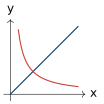
- G6–7 5. Explain how the graph of \(y=2^x\) differs from the graph of \(y=2^{-x}\). [2]
💡Core idea
Define the unknown, translate each relationship into algebra, solve, and interpret the result.
📐Essential rules and method
Rules:
- Every expression must represent the stated quantity and use consistent units
Method:
- Define the variable
- Translate each relationship
- Form the equation
- Solve
- Reject invalid roots
- Answer in context
✏️Worked example — mark-scheme method
- Identify the method. Define the unknown, translate each relationship into algebra, solve, and interpret the result.
- Apply the method and show the mathematical evidence. A rectangle has width \(x\) and length \(2x+3\); its perimeter is 30. Form the equation: \(2x+2(2x+3)=30\), so \(2x+4x+6=30\), giving \(6x=24\) and \(x=4\).
- Check and present the answer. Write what \(x\) represents before forming the equation. Check that every value has been used, signs and units are correct, and the final answer is in the form requested by the question.
⚡Exam hack
Write what \(x\) represents before forming the equation.
Questions (5)
- G8–9 1. The perimeter of a rectangle is 68 cm. Its length is 4 cm more than three times its width. Find the dimensions of the rectangle. [4]
- G6–7 2. Three consecutive integers sum to 141. Find the three integers. [3]
- G8–9 3. A rectangle has length \((2x+3)\) cm and width \((x-1)\) cm. Given that its area is \(52\text{ cm}^2\), form and solve an equation to find \(x\). [4]
- G6–7 4. The angles of a quadrilateral are \(x^{\circ}\), \((x+15)^{\circ}\), \((2x-10)^{\circ}\) and \((x+25)^{\circ}\). Find the size of the largest angle. [3]
- G8–9 5. Twice a number added to 7 gives the same result as 5 less than three times the number. Find the number. [3]
💡Core idea
Find values satisfying both equations using elimination, substitution or graphical intersection.
📐Essential rules and method
Rules:
- A solution satisfies both equations
- Elimination requires equal coefficients
- Substitution replaces one variable consistently
Method:
- Match coefficients
- Add/subtract
- Solve one variable
- Substitute back
- Check both equations
✏️Worked example — mark-scheme method
- Identify the method. Find values satisfying both equations using elimination, substitution or graphical intersection.
- Apply the method and show the mathematical evidence. Solve \(x+y=7\) and \(x-y=1\): adding the equations eliminates \(y\), giving \(2x=8\), so \(x=4\). Substitute into the first equation: \(4+y=7\), so \(y=3\). Check: \(4-3=1\). ✓
- Check and present the answer. Choose elimination when coefficients can be matched easily; substitute back into the simpler equation. Check that every value has been used, signs and units are correct, and the final answer is in the form requested by the question.
⚡Exam hack
Choose elimination when coefficients can be matched easily; substitute back into the simpler equation.
Questions (8)
- G6–7 1. Solve \(3x+4y=23\) and \(2x-y=1\). [3]
- G6–7 2. Solve \(5x-2y=16\) and \(3x+y=17\). [3]
- G8–9 3. Solve \(x+y=7\) and \(x^2+y^2=25\). [4]
- G8–9 4. Solve \(y=x+3\) and \(y=x^2-4x+9\). [4]
- G8–9 5. Solve algebraically: \(2x^2-y^2=7\) and \(x+y=5\). [5]
- G8–9 6. A shop sells adult and child tickets. 3 adult tickets and 2 child tickets cost £39. 2 adult tickets and 5 child tickets cost £44. Find the cost of one adult ticket and one child ticket. [4]
- G8–9 7. Solve the simultaneous equations \(y=2x-1\) and \(y=-x+5\) graphically, sketching both lines on the same axes and stating the point of intersection. [3]
- G8–9 8. Solve \(x^2+y^2=20\) and \(y=x+2\). [4]
💡Core idea
Solve by factorising, completing the square or using the quadratic formula.
📐Essential rules and method
Rules:
- First write \(ax^2+bx+c=0\)
- Zero-product gives each factor equal to zero
- Formula \(x=(-b\pm\sqrt{b^2-4ac})/(2a)\)
Method:
- Choose factorising
- Completing the square or formula
- Find both roots
- Substitute to check
✏️Worked example — mark-scheme method
- Identify the method. Solve by factorising, completing the square or using the quadratic formula.
- Apply the method and show the mathematical evidence. Solve \(x^2+3x-10=0\): find factors of \(-10\) that sum to 3, namely 5 and \(-2\), so \((x+5)(x-2)=0\). Then \(x+5=0\) or \(x-2=0\), giving \(x=-5\) or \(x=2\).
- Check and present the answer. Set the equation equal to zero before choosing a method. Check that every value has been used, signs and units are correct, and the final answer is in the form requested by the question.
⚡Exam hack
Set the equation equal to zero before choosing a method.
Questions (3)
- G6–7 1. Solve \(x^2-7x+10=0\). [3]
- G6–7 2. Solve \(3x^2+2x-8=0\). [3]
- G6–7 3. Solve \(2x^2-5x-1=0\), giving your solutions correct to 3 significant figures. [3]
💡Core idea
A quadratic graph is a parabola; roots, intercept and turning point describe its key features.
📐Essential rules and method
Rules:
- Roots occur where \(y=0\)
- The \(y\)-intercept occurs at \(x=0\)
- The axis of symmetry passes through the turning point
Method:
- Find intercepts
- Locate the turning point or symmetry
- Plot sufficient points
- Draw a smooth parabola
✏️Worked example — mark-scheme method
- Identify the method. A quadratic graph is a parabola; roots, intercept and turning point describe its key features.
- Apply the method and show the mathematical evidence. For \(y=(x-2)^2-5\): the turning point is \((2,-5)\) directly from completed-square form. The \(y\)-intercept is at \(x=0\): \(y=(0-2)^2-5=4-5=-1\), giving \((0,-1)\).
- Check and present the answer. Use symmetry: the turning point lies midway between two roots. Check that every value has been used, signs and units are correct, and the final answer is in the form requested by the question.
⚡Exam hack
Use symmetry: the turning point lies midway between two roots.
Questions (10)
- G8–9 1. Complete a table of values and draw the graph of \(y=x^2-4x+1\) for values of \(x\) from \(-1\) to \(5\), then use it to estimate the roots. [5]
- G8–9 2. Find the coordinates of the turning point of \(y=x^2+6x+5\) by completing the square. [3]
-
G6–7
3.
Sketch \(y=-(x-2)(x+4)\), marking the coordinates of the points where the curve crosses the axes. [3]
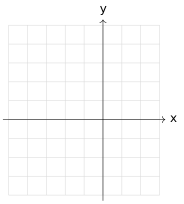
- G6–7 4. Find the turning point of \(y=2x^2-8x+3\). [3]
- G8–9 5. Write \(y=x^2-10x+7\) in the form \((x-a)^2-b\), and hence state the coordinates of the minimum point. [3]
-
G8–9
6.
A ball’s height, in metres, \(t\) seconds after being thrown is \(h=15t-5t^2\). Sketch the graph and find the maximum height reached. [4]
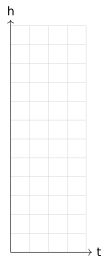
- G6–7 7. The curve \(y=x^2+px+q\) has a minimum point at \((3,-4)\). Find the values of \(p\) and \(q\). [3]
- G6–7 8. Find the coordinates of the points where \(y=x^2-2x-8\) crosses the \(x\)-axis. [3]
- G6–7 9. Sketch the graph of \(y=x^2-6x+9\), stating the coordinates of the point where the curve touches the \(x\)-axis. [3]
- G8–9 10. The curve \(C\) has equation \(y=2x^2-12x+7\). Find the coordinates of the turning point on \(C\). [3]
💡Core idea
Treat a function as a machine; composition applies one function and then another, while an inverse reverses it.
📐Essential rules and method
Rules:
- Composition is read right-to-left
- An inverse undoes the original function
- \(f^{-1}\) is not \(1/f\)
Method:
- Substitute with brackets
- Simplify
- For an inverse set \(y=f(x)\)
- Rearrange for \(x\)
- Swap notation
✏️Worked example — mark-scheme method
- Identify the method. Treat a function as a machine; composition applies one function and then another, while an inverse reverses it.
- Apply the method and show the mathematical evidence. \(f(x)=2x+1\), \(g(x)=x^2\). Find \(fg(3)\): work right to left, first \(g(3)=3^2=9\), then \(f(9)=2(9)+1=19\), so \(fg(3)=19\).
- Check and present the answer. Read composition from right to left and use brackets around the substituted expression. Check that every value has been used, signs and units are correct, and the final answer is in the form requested by the question.
⚡Exam hack
Read composition from right to left and use brackets around the substituted expression.
Questions (5)
- G6–7 1. \(f(x)=3x-2\), \(g(x)=x^2+4\). Find \(fg(2)\). [2]
- G6–7 2. \(f(x)=\dfrac{2x+5}{3}\). Find \(f^{-1}(x)\). [2]
- G6–7 3. \(g(x)=4-x\), \(h(x)=2x^2\). Find \(gh(3)\). [2]
- G6–7 4. \(f(x)=5x-1\). Solve \(f(x)=f^{-1}(x)\). [3]
- G6–7 5. \(f(x)=x^2-1\), \(g(x)=2x+3\). Find \(fg(x)\) in its simplest form. [3]
💡Core idea
Know the shapes, periods and key values of sine, cosine and tangent graphs.
📐Essential rules and method
Rules:
- Sine and cosine have period \(360^\circ\)
- Tangent has period \(180^\circ\) with asymptotes at \(90^\circ+180^\circ n\)
Method:
- Mark key angles and values
- Include asymptotes
- Apply transformations
- Draw a smooth periodic curve
✏️Worked example — mark-scheme method
- Identify the method. Know the shapes, periods and key values of sine, cosine and tangent graphs.
- Apply the method and show the mathematical evidence. To sketch \(y=\sin x\) for \(0^\circ\le x\le360^\circ\): plot key points \((0^\circ,0)\), \((90^\circ,1)\), \((180^\circ,0)\), \((270^\circ,-1)\), \((360^\circ,0)\), then join with a smooth periodic curve.
- Check and present the answer. Mark key points and asymptotes before drawing a smooth curve. Check that every value has been used, signs and units are correct, and the final answer is in the form requested by the question.
⚡Exam hack
Mark key points and asymptotes before drawing a smooth curve.
Questions (3)
-
G6–7
1.
Sketch the graph of \(y=\sin x^{\circ}\) for \(0 \leqslant x \leqslant 360\), marking any points where the graph meets the axes. [3]
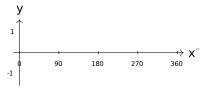
- G6–7 2. Using a graph of \(y=\cos x^{\circ}\), write down all solutions of \(\cos x^{\circ}=0.3\) for \(0 \leqslant x \leqslant 720\). [2]
- G6–7 3. The graph of \(y=\tan x^{\circ}\) is reflected in the \(x\)-axis. Write down an equation of the reflected graph. [1]
💡Core idea
Identify constant first differences for linear sequences and constant second differences for quadratic sequences.
📐Essential rules and method
Rules:
- Linear sequences have constant first difference
- Quadratic sequences have constant second difference
- Geometric sequences use a constant ratio
Method:
- Build a difference table
- Select the rule form
- Determine coefficients
- Verify several terms
✏️Worked example — mark-scheme method
- Identify the method. Identify constant first differences for linear sequences and constant second differences for quadratic sequences.
- Apply the method and show the mathematical evidence. For \(5,9,13,17,\ldots\): the first difference is constant at 4, so the \(n\)th term has the form \(4n+c\). Since the 1st term is 5, \(4(1)+c=5\), so \(c=1\): \(n\)th term \(=4n+1\).
- Check and present the answer. Substitute \(n=1\) into your rule to check the first term immediately. Check that every value has been used, signs and units are correct, and the final answer is in the form requested by the question.
⚡Exam hack
Substitute \(n=1\) into your rule to check the first term immediately.
Questions (13)
- G6–7 1. Find the \(n\)th term of the sequence \(5, 9, 13, 17, \ldots\) [2]
- G6–7 2. The first three terms of a geometric sequence are 3, 6, 12. Find the 7th term. [2]
- G6–7 3. Find the \(n\)th term of the quadratic sequence \(4, 9, 16, 25, 36\). [3]
- G6–7 4. A sequence is defined by \(a_{n+1}=3a_n-2\), with \(a_1=5\). Find \(a_3\). [2]
- G6–7 5. The \(n\)th term of a sequence is \(2n^2-3\). Find the first term greater than 100. [2]
- G6–7 6. Find the \(n\)th term of the quadratic sequence \(-2, 3, 10, 19, 30\). [3]
- G6–7 7. A ball bounces to 80% of its previous height on each bounce. If dropped from 2 m, find the height after the 4th bounce. [3]
- G6–7 8. The first term of an arithmetic sequence is 8 and the common difference is 5. Find the 20th term. [2]
- G8–9 9. Show that 200 is not a term of the sequence with \(n\)th term \(4n+3\). [2]
- G6–7 10. A population grows by 12% each year, starting at 500. Write a recurrence relation for the population and find the population after 3 years. [3]
- G6–7 11. \(x-3\), \(x+1\) and \(2x+2\) are consecutive terms of an arithmetic sequence. Find the value of \(x\). [3]
- G6–7 12. Find the \(n\)th term of the sequence \(2, 5, 10, 17, 26\). [3]
- G8–9 13. The \(n\)th term of a sequence is \(an^2+bn\). Given the 2nd term is 6 and the 4th term is 28, find \(a\) and \(b\). [4]
💡Core idea
Represent general integers algebraically, simplify, and finish with a statement that proves the claim.
📐Essential rules and method
Rules:
- Consecutive integers are \(n,n+1,\ldots\)
- Even integers are \(2n\)
- Odd integers are \(2n+1\)
Method:
- Represent a general case
- Simplify exactly
- Factor into the required form
- Finish with a sentence linking the algebra to the claim
✏️Worked example — mark-scheme method
- Identify the method. Represent general integers algebraically, simplify, and finish with a statement that proves the claim.
- Apply the method and show the mathematical evidence. Prove the sum of three consecutive integers is a multiple of 3. Let the integers be \(n,\,n+1,\,n+2\). Sum \(=n+(n+1)+(n+2)=3n+3=3(n+1)\), which is a multiple of 3 since \(n+1\) is an integer.
- Check and present the answer. Do not test examples only; use \(n\) so the argument covers every valid integer. Check that every value has been used, signs and units are correct, and the final answer is in the form requested by the question.
⚡Exam hack
Do not test examples only; use \(n\) so the argument covers every valid integer.
Questions (4)
- G8–9 1. Prove algebraically that the sum of any three consecutive even numbers is always a multiple of 6. [3]
- G8–9 2. Prove that \((n+3)^2-(n-3)^2\) is always a multiple of 12, for any integer \(n\). [3]
- G8–9 3. Prove algebraically that the difference between the squares of any two consecutive integers is equal to the sum of the two integers. [3]
- G8–9 4. Prove that the product of two consecutive odd numbers is always odd. [2]
💡Core idea
Solve like an equation, but reverse the inequality when multiplying or dividing by a negative number.
📐Essential rules and method
Rules:
- Perform the same operation on both sides
- Reverse the inequality when multiplying or dividing by a negative
Method:
- Simplify
- Isolate the variable
- Record any sign reversal
- Represent the solution correctly on a line or graph
✏️Worked example — mark-scheme method
- Identify the method. Solve like an equation, but reverse the inequality when multiplying or dividing by a negative number.
- Apply the method and show the mathematical evidence. Solve \(-2x<6\): divide both sides by \(-2\), remembering to reverse the inequality, to get \(x>-3\). Represent on a number line with an open circle at \(-3\) and an arrow to the right.
- Check and present the answer. Use an open circle for \(<\) or \(>\) and a filled circle for \(\le\) or \(\ge\). Check that every value has been used, signs and units are correct, and the final answer is in the form requested by the question.
⚡Exam hack
Use an open circle for \(<\) or \(>\) and a filled circle for \(\le\) or \(\ge\).
Questions (10)
- G6–7 1. Solve \(4x-7 \leqslant 2x+9\), illustrating your answer on a number line. [2]
- G6–7 2. Find the integer values of \(n\) satisfying \(-5 < 3n-2 \leqslant 10\). [3]
- G6–7 3. Solve the inequality \(3(x-1) > 2x+4\). [2]
- G8–9 4. On a grid, shade the region satisfying \(x \geqslant 0\), \(y \geqslant 1\), \(x+y \leqslant 6\). Label the region \(R\). [4]
- G6–7 5. Solve algebraically: \(x^2-5x+6 < 0\). [3]
- G6–7 6. Solve \(2x^2-7x-4 \geqslant 0\). [3]
- G8–9 7. Find the set of values of \(x\) for which \(x^2-9>0\) and \(2x+1<7\). [4]
- G6–7 8. Write down the inequality shown on a number line with a filled circle at \(-3\) and an unfilled circle at \(2\). [1]
- G6–7 9. Solve the inequality \((x-4)(x+2) \leqslant 0\). [3]
- G6–7 10. Find all integer solutions to \(-4 \leqslant 2x < 10\). [2]
💡Core idea
On distance–time graphs gradient is speed; on speed–time graphs area is distance and gradient is acceleration.
📐Essential rules and method
Rules:
- Distance–time gradient is speed
- Speed–time gradient is acceleration
- Area under a speed–time graph is distance
Method:
- Identify gradient or area
- Split compound regions
- Calculate with units
- Interpret horizontal or negative sections
✏️Worked example — mark-scheme method
- Identify the method. On distance–time graphs gradient is speed; on speed–time graphs area is distance and gradient is acceleration.
- Apply the method and show the mathematical evidence. A speed-time graph shows constant speed 12 m/s for 5 s. The distance travelled is the area under the graph: a rectangle of area \(12\times5=60\) m.
- Check and present the answer. Split an area into rectangles and triangles and include units. Check that every value has been used, signs and units are correct, and the final answer is in the form requested by the question.
⚡Exam hack
Split an area into rectangles and triangles and include units.
Questions (11)
-
G8–9
1.
A car accelerates from rest to 20 m/s in 8 seconds, then travels at constant speed for 15 seconds. Use a speed–time graph to find the total distance travelled. [4]
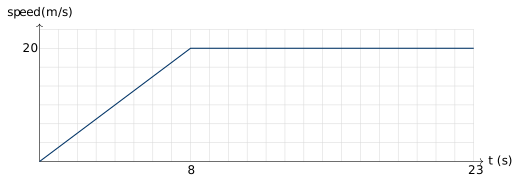
- G8–9 2. Estimate the gradient of a distance–time graph at \(t=10\) seconds and explain what it represents. [3]
- G6–7 3. Estimate the area under a speed–time graph over the first 30 seconds using 3 strips of equal width and given tabulated speeds. [3]
- G6–7 4. Explain what the gradient of a velocity–time graph represents. [1]
-
G8–9
5.
A cyclist’s speed increases uniformly from 0 to 12 m/s over 10 seconds, then decreases uniformly to 0 over the next 5 seconds. Sketch the speed–time graph and find the total distance travelled. [4]
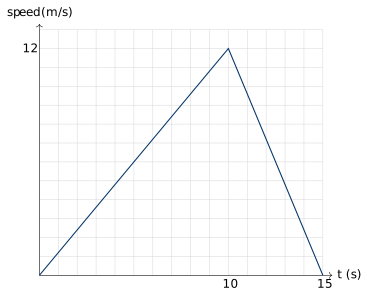
- G6–7 6. Using a distance–time graph, explain why a horizontal section represents the object being stationary. [1]
- G6–7 7. A container is filled with water at a variable rate. Sketch a graph to show how the volume of water changes with time, given a three-stage description of the filling rate. [3]
- G8–9 8. Estimate the distance travelled in the first 20 seconds using the trapezium rule with 4 strips, given speed values at 5-second intervals. [3]
- G8–9 9. Given a description of a journey (accelerate, constant speed, decelerate), calculate the total distance travelled using the areas of a trapezium and a triangle. [4]
- G6–7 10. Explain, with reference to a speed–time graph, why using more strips gives a more accurate estimate of distance travelled. [1]
-
G8–9
11.
A car decelerates uniformly from 24 m/s to rest in 6 seconds. Sketch the graph and calculate the distance travelled during braking. [3]
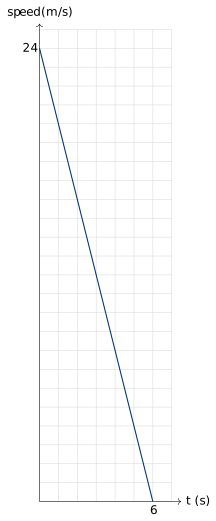
💡Core idea
Substitute carefully using brackets, or rearrange by applying inverse operations to both sides.
📐Essential rules and method
Rules:
- Substitution needs brackets around negative values
- Rearrangement uses inverse operations on both sides
Method:
- Identify the subject
- Clear fractions
- Collect subject terms
- Factorise if necessary
- Divide to isolate it
✏️Worked example — mark-scheme method
- Identify the method. Substitute carefully using brackets, or rearrange by applying inverse operations to both sides.
- Apply the method and show the mathematical evidence. Make \(r\) the subject of \(A=\pi r^2\): divide both sides by \(\pi\) to get \(\dfrac{A}{\pi}=r^2\), then square-root both sides: \(r=\sqrt{\dfrac{A}{\pi}}\) (taking the positive root, since \(r\) is a length).
- Check and present the answer. When the required variable appears twice, collect its terms and factorise it out. Check that every value has been used, signs and units are correct, and the final answer is in the form requested by the question.
⚡Exam hack
When the required variable appears twice, collect its terms and factorise it out.
Questions (5)
- G6–7 1. Given that \(A=\pi r^2\), find the value of \(A\) when \(r=6.5\), giving your answer correct to 3 significant figures. [2]
- G6–7 2. Make \(x\) the subject of \(y=5x-3\). [2]
- G6–7 3. Make \(t\) the subject of \(v=u+at\). [2]
- G6–7 4. Given \(v^2=u^2+2as\), make \(u\) the subject. [3]
- G8–9 5. Make \(x\) the subject of \(y=\dfrac{2x+7}{x-3}\). [4]
💡Core idea
Changes outside \(f(x)\) move a graph vertically; changes inside move it horizontally in the opposite direction.
📐Essential rules and method
Rules:
- \(f(x)+a\) moves up
- \(f(x-a)\) moves right
- \(af(x)\) stretches vertically
- \(f(ax)\) changes horizontal scale
Method:
- Track key points
- Apply the inside change to \(x\) and outside change to \(y\)
- Redraw with unchanged features noted
✏️Worked example — mark-scheme method
- Identify the method. Changes outside \(f(x)\) move a graph vertically; changes inside move it horizontally in the opposite direction.
- Apply the method and show the mathematical evidence. Given \(y=f(x)\) passes through \((3,2)\): on \(y=f(x)+3\) this point becomes \((3,5)\) (shift up 3); on \(y=f(x-3)\) it becomes \((6,2)\) (shift right 3, \(x\)-value only).
- Check and present the answer. Track one distinctive point before trying to redraw the whole graph. Check that every value has been used, signs and units are correct, and the final answer is in the form requested by the question.
⚡Exam hack
Track one distinctive point before trying to redraw the whole graph.
Questions (6)
- G6–7 1. The graph \(y=f(x)\) has a maximum point at \((2,5)\). State the coordinates of the maximum point of \(y=f(x)-3\). [1]
- G6–7 2. Describe the transformation that maps \(y=f(x)\) onto \(y=f(x-4)\). [1]
- G6–7 3. Given a sketch of \(y=f(x)\), sketch \(y=-f(x)\). [2]
- G6–7 4. The graph of \(y=g(x)\) passes through \((0,4)\). State the coordinates of the corresponding point on \(y=g(x+2)\). [1]
- G6–7 5. Describe the single transformation that maps \(y=f(x)\) onto \(y=f(x)+6\). [1]
- G6–7 6. Given that the turning point of \(y=g(x)\) is \((-3,6)\), find the turning point of \(y=g(x-7)\). [2]
💡Core idea
Expanding removes brackets; factorising reverses the process by finding common factors or quadratic pairs.
📐Essential rules and method
Rules:
- Multiply every term in one bracket by every term in the other
- Factorising reverses expansion
- Take out the HCF first
Method:
- Expand systematically or find a product/sum pair
- Collect like terms
- Expand the factorised answer to check it
✏️Worked example — mark-scheme method
- Identify the method. Expanding removes brackets; factorising reverses the process by finding common factors or quadratic pairs.
- Apply the method and show the mathematical evidence. Factorise \(x^2+7x+12\): find two numbers that multiply to 12 and add to 7, namely 3 and 4, so \(x^2+7x+12=(x+3)(x+4)\). Check by expanding: \((x+3)(x+4)=x^2+4x+3x+12=x^2+7x+12\). ✓
- Check and present the answer. Always take out the highest common factor before trying any other pattern. Check that every value has been used, signs and units are correct, and the final answer is in the form requested by the question.
⚡Exam hack
Always take out the highest common factor before trying any other pattern.
Questions (9)
- G6–7 1. Expand and simplify \(4(2x-1)-3(x+5)\). [2]
- G6–7 2. Factorise \(x^2+3x-18\). [2]
- G6–7 3. Expand and simplify \((x+2)(x-5)(x+1)\). [3]
- G6–7 4. Factorise fully \(2x^2-8\). [2]
- G8–9 5. Show that \((x-2)(x+4)(2x-1)\) can be written in the form \(ax^3+bx^2+cx+d\), where \(a,b,c,d\) are integers. [3]
- G6–7 6. Factorise \(6x^2+11x-10\). [3]
- G6–7 7. Expand and simplify \((2x-3)^2\). [2]
- G6–7 8. Factorise fully \(3x^3-12x\). [2]
- G6–7 9. Expand \((x+3)(x-3)(x+1)\) and simplify. [3]
💡Core idea
Apply index laws to coefficients and variables separately, including zero, negative and fractional powers.
📐Essential rules and method
Rules:
- Apply index laws to numerical coefficients and variables separately
- Fractional powers represent roots and negative powers reciprocals
Method:
- Simplify brackets first
- Combine like bases
- Rewrite with positive indices if requested
- Check special restrictions
✏️Worked example — mark-scheme method
- Identify the method. Apply index laws to coefficients and variables separately, including zero, negative and fractional powers.
- Apply the method and show the mathematical evidence. Simplify \((2x^3)^2\): apply the power to each factor separately, \((2)^2\times(x^3)^2=4\times x^{3\times2}=4x^6\), keeping the numerical coefficient and variable power distinct throughout.
- Check and present the answer. Simplify the numerical coefficient independently before combining it with the variable powers. Check that every value has been used, signs and units are correct, and the final answer is in the form requested by the question.
⚡Exam hack
Simplify the numerical coefficient independently before combining it with the variable powers.
Questions (6)
- G6–7 1. Simplify \(x^7 \times x^{-3}\). [1]
- G6–7 2. Simplify \((2x^3y^2)^4\). [2]
- G6–7 3. Simplify \((m^5)^2 \div m^4\). [2]
- G6–7 4. Given \((ax^4)^n=8x^{12}\), find the values of \(a\) and \(n\). [3]
- G6–7 5. Simplify \((9x^6y^4)^{1/2}\). [2]
- G8–9 6. Simplify \(12x^3y^5 \div (4x^{-1}y^2)\). [2]
💡Core idea
Use the stated recurrence repeatedly, keeping sufficient calculator accuracy until the requested iteration.
📐Essential rules and method
Rules:
- Rearrange \(f(x)=0\) into \(x=g(x)\) and use \(x_{n+1}=g(x_n)\)
- A sign change brackets a root for continuous functions
Method:
- Verify the rearrangement
- Substitute the starting value repeatedly using full precision
- Record each iterate
- State the requested estimate
✏️Worked example — mark-scheme method
- Identify the method. Use the stated recurrence repeatedly, keeping sufficient calculator accuracy until the requested iteration.
- Apply the method and show the mathematical evidence. For \(x_{n+1}=\sqrt[3]{4x_n+9}\) with \(x_1=2\): \(x_2=\sqrt[3]{4(2)+9}=\sqrt[3]{17}\approx2.5713\); then \(x_3=\sqrt[3]{4(2.5713)+9}=\sqrt[3]{19.285}\approx2.6837\), continuing until the requested iteration.
- Check and present the answer. Store the previous answer in the calculator and copy the iteration exactly. Check that every value has been used, signs and units are correct, and the final answer is in the form requested by the question.
⚡Exam hack
Store the previous answer in the calculator and copy the iteration exactly.
Questions (4)
- G8–9 1. Show that the equation \(x^3-4x-9=0\) has a solution between \(x=2\) and \(x=3\). [2]
- G8–9 2. Show that \(x^3-4x-9=0\) can be rearranged to give \(x=\sqrt[3]{4x+9}\). Starting with \(x_0=2\), use the iteration formula \(x_{n+1}=\sqrt[3]{4x_n+9}\) three times to estimate the solution. [4]
- G8–9 3. Use the iteration formula \(x_{n+1}=\dfrac{3x_n^2-4}{2}\), starting with \(x_0=1\), to find \(x_1\), \(x_2\) and \(x_3\). [3]
- G8–9 4. Show that the equation \(2x^3+x-5=0\) has a root between 1 and 2, and use the iteration \(x_{n+1}=\sqrt[3]{\dfrac{5-x_n}{2}}\), starting at \(x_0=1\), to find an estimate for this root. [4]
⚖️ Ratio & Proportion
💡Core idea
Compare like with like by finding a unit price, equal quantity or equivalent rate.
📐Essential rules and method
Rules:
- Compare like-for-like unit costs or quantities per pound
- Include discounts, delivery and multibuy conditions
Method:
- Convert every option to the same unit rate
- Calculate accurately
- Compare
- Justify the saving rather than naming an option only
✏️Worked example — mark-scheme method
- Identify the method. Compare like with like by finding a unit price, equal quantity or equivalent rate.
- Apply the method and show the mathematical evidence. Two jars of jam: £4.50 for 750 g, or £2.70 for 450 g. Unit price: \(4.50\div750=£0.006\)/g versus \(2.70\div450=£0.006\)/g — equal value, so state that both jars offer identical value per gram.
- Check and present the answer. State the comparison figures and finish with a justified decision. Check that every value has been used, signs and units are correct, and the final answer is in the form requested by the question.
⚡Exam hack
State the comparison figures and finish with a justified decision.
Questions (5)
- G6–7 1. A 500 g box of cereal costs £2.80. A 750 g box costs £3.90. Which box is better value? [3]
- G6–7 2. In France, a 1 kg bag of pasta costs 1.60 euros. In the UK, an 800 g bag costs £1.35. Given £1 = 1.15 euros, work out which is better value. [3]
- G6–7 3. Shop A sells 6 items for £15. Shop B sells 10 items for £23. Which shop offers better value per item? [2]
- G6–7 4. A 2 litre bottle of juice costs £3.60. A 1.5 litre bottle costs £2.70. Determine which is better value per litre. [2]
- G8–9 5. Petrol costs £1.48 per litre in the UK and $1.65 per litre in the USA. Given £1 = $1.27, work out which country has cheaper petrol. [3]
💡Core idea
Simplify ratios, use total parts to share quantities, and keep corresponding terms in the same order.
📐Essential rules and method
Rules:
- Equivalent ratios multiply/divide every part equally
- A share uses amount \(\div\) total parts
Method:
- Align quantities
- Simplify or total the parts
- Find one part
- Scale
- Check shares sum to the original
✏️Worked example — mark-scheme method
- Identify the method. Simplify ratios, use total parts to share quantities, and keep corresponding terms in the same order.
- Apply the method and show the mathematical evidence. Share £60 in the ratio \(2:3\): total parts \(=2+3=5\), so one part \(=60\div5=£12\). The shares are \(2\times12=£24\) and \(3\times12=£36\), which sum to £60. ✓
- Check and present the answer. Add the ratio parts before finding the value of one part. Check that every value has been used, signs and units are correct, and the final answer is in the form requested by the question.
⚡Exam hack
Add the ratio parts before finding the value of one part.
Questions (23)
- G6–7 1. Divide £780 in the ratio \(5:7\). [2]
- G8–9 2. A recipe requires flour, sugar and eggs in the ratio \(8:5:1\) (by weight). If 480 g of flour is used, find the required amounts of sugar and eggs. [3]
- G6–7 3. The ratio of adults to children on a coach trip is \(3:8\). There are 24 adults. How many children are there? [2]
- G8–9 4. A map has a scale of \(1:40\,000\). Two landmarks are 6.5 cm apart on the map. Find the real distance between them, in km. [3]
- G8–9 5. £900 is shared between Ali, Ben and Cara in the ratio \(3:4:2\). Work out how much more Ben receives than Cara. [3]
- G6–7 6. A solution of squash is made from concentrate and water in the ratio \(1:6\). How much concentrate is needed to make 3.5 litres of solution? [2]
- G6–7 7. The ratio of red to blue to yellow counters is \(3:4:5\). There are 60 counters. Find the number of red counters. [2]
- G6–7 8. A photo is enlarged so the ratio of old to new width is \(4:9\). If the original width is 12 cm, find the new width. [2]
- G6–7 9. Paint is mixed blue:yellow \(=2:7\) to make green paint. How much yellow paint is needed to make 45 litres of green paint? [2]
- G8–9 10. The ratio \(a:b\) is \(3:5\) and \(b:c\) is \(2:3\). Find \(a:b:c\). [3]
- G6–7 11. In a school, the ratio of boys to girls is \(6:7\). If there are 91 girls, find the total number of students. [2]
- G6–7 12. £360 is shared in the ratio \(2:3:4\). Find the largest share. [2]
- G8–9 13. Two numbers are in the ratio \(4:9\). Their sum is 156. Find the two numbers. [3]
- G6–7 14. A fruit drink is made from orange, mango and pineapple juice in the ratio \(5:2:3\). How much orange juice is in 2 litres of the drink? [2]
- G8–9 15. The ratio of Sam’s savings to Tom’s savings is \(7:4\). After Sam spends £30, the ratio becomes \(5:4\). Find Sam’s original savings. [4]
- G6–7 16. A sample of 40 fish is caught from a lake, tagged, and released. Later, 60 fish are caught and 5 are found to be tagged. Estimate the total fish population. [3]
- G6–7 17. A recipe for 6 people uses 450 g of rice. How much rice is needed for 10 people? [2]
- G6–7 18. Divide £5000 in the ratio \(1:2:2\). [2]
- G6–7 19. The ratio of the areas of two similar shapes is \(4:25\). Find the ratio of their corresponding lengths. [2]
- G8–9 20. In a bag, the ratio of red to green marbles is \(5:3\). If 8 more green marbles are added, the ratio becomes \(5:4\). Find the original number of red marbles. [4]
- G8–9 21. Concrete is made from cement, sand and gravel in the ratio \(1:2:4\). How much sand and how much gravel are needed for 84 kg of concrete? [3]
- G8–9 22. Two integers are in the ratio \(3:7\). If both are increased by 8, the new ratio is \(1:2\). Find the original integers. [4]
- G6–7 23. A necklace is made from gold and silver beads in the ratio \(2:9\). If there are 55 beads in total, find the number of gold beads. [2]
💡Core idea
Use formulas such as speed \(=d/t\), density \(=m/V\) and pressure \(=F/A\) with consistent units.
📐Essential rules and method
Rules:
- Speed \(=d/t\), density \(=m/V\), pressure \(=F/A\)
- Compound units must be consistent
Method:
- Write the formula triangle or equation
- Convert units
- Substitute
- Rearrange
- Attach the correct compound unit
✏️Worked example — mark-scheme method
- Identify the method. Use formulas such as speed \(=d/t\), density \(=m/V\) and pressure \(=F/A\) with consistent units.
- Apply the method and show the mathematical evidence. A car travels 150 km in 2.5 hours. Using speed \(=\) distance \(\div\) time: speed \(=150\div2.5=60\) km/h. The units (km and hours) are consistent, so no conversion is needed.
- Check and present the answer. Write the formula and convert units before substituting. Check that every value has been used, signs and units are correct, and the final answer is in the form requested by the question.
⚡Exam hack
Write the formula and convert units before substituting.
Questions (19)
- G6–7 1. A car travels 210 miles in 3.5 hours. Find its average speed. [2]
- G6–7 2. A metal block has a mass of 850 g and a volume of \(100\text{ cm}^3\). Find its density. [2]
- G6–7 3. A force of 320 N acts on an area of \(0.8\text{ m}^2\). Find the pressure. [2]
- G6–7 4. A cyclist rides at 18 km/h for 2 hours 15 minutes. Find the distance travelled. [2]
- G6–7 5. Convert a speed of 90 km/h to m/s. [2]
- G6–7 6. A tank is filled with water at a rate of 15 litres per minute. Find how long it takes to fill a 600 litre tank. [2]
- G6–7 7. Liquid A has density \(1.4\text{ g/cm}^3\) and liquid B has density \(0.9\text{ g/cm}^3\). \(60\text{ cm}^3\) of A is mixed with \(40\text{ cm}^3\) of B. Find the density of the mixture. [3]
- G6–7 8. A runner completes a marathon (26.2 miles) in 3 hours 45 minutes. Find the average speed in mph. [3]
- G6–7 9. Convert \(5000\text{ cm}^3\) to litres. [1]
- G6–7 10. A gas exerts a pressure of 200\,000 Pa on an area of \(0.05\text{ m}^2\). Find the force exerted. [2]
- G6–7 11. Two pumps fill a pool at rates of 12 litres/min and 18 litres/min. Working together, how long would they take to fill a 3000 litre pool? [3]
- G6–7 12. A cube of metal has side 4 cm and mass 320 g. Find its density. [2]
- G6–7 13. A plane travels 2400 miles in 5 hours. Find its average speed in mph, then convert to km/h given 1 mile \(=1.6\) km. [3]
- G8–9 14. Water flows into a cylindrical tank of radius 20 cm at 4 litres per minute. Find how long it takes to raise the water level by 15 cm. [4]
- G6–7 15. Convert a density of \(2.5\text{ g/cm}^3\) to kg/m\(^3\). [2]
- G6–7 16. A journey of 45 miles takes 50 minutes. Find the average speed in mph. [2]
- G6–7 17. It takes 8 taps 6 hours to fill a reservoir. How long would it take 5 taps working at the same rate? [3]
- G6–7 18. A force of 450 N is exerted over an area of \(0.25\text{ m}^2\). A second surface experiences the same force over an area of \(0.6\text{ m}^2\). Compare the two pressures. [3]
- G8–9 19. Estimate the number of heartbeats in a lifetime, given a heart rate of approximately 72 beats per minute and a lifespan of 80 years. [3]
💡Core idea
Direct proportion uses \(y=kx^n\); inverse proportion uses \(y=k/x^n\).
📐Essential rules and method
Rules:
- Direct: \(y=kx^n\)
- Inverse: \(y=k/x^n\)
- The constant \(k\) does not change
Method:
- Translate the proportion
- Substitute a known pair to find \(k\)
- Write the full formula
- Use it for the unknown
✏️Worked example — mark-scheme method
- Identify the method. Direct proportion uses \(y=kx^n\); inverse proportion uses \(y=k/x^n\).
- Apply the method and show the mathematical evidence. \(y\propto x^2\) and \(y=20\) when \(x=2\): substitute to find \(k\), \(20=k(2)^2=4k\), so \(k=5\), giving the formula \(y=5x^2\). This formula can now be used for any value of \(x\).
- Check and present the answer. Use the given pair first to find \(k\) before answering the actual question. Check that every value has been used, signs and units are correct, and the final answer is in the form requested by the question.
⚡Exam hack
Use the given pair first to find \(k\) before answering the actual question.
Questions (11)
- G6–7 1. \(y\) is directly proportional to \(x\). When \(x=8\), \(y=20\). Find \(y\) when \(x=14\). [2]
- G6–7 2. \(p\) is inversely proportional to \(q\). When \(q=4\), \(p=15\). Find \(p\) when \(q=10\). [2]
- G8–9 3. \(y\) is directly proportional to \(x^2\). When \(x=3\), \(y=27\). Find \(y\) when \(x=5\). [3]
- G6–7 4. It takes 8 workers 12 days to complete a job. How many days would 6 workers take, at the same rate? [2]
- G8–9 5. \(y\) is inversely proportional to \(x^2\). When \(x=2\), \(y=9\). Find \(y\) when \(x=6\). [3]
- G6–7 6. The cost of a taxi journey is directly proportional to the distance travelled. A 12-mile journey costs £21. Find the cost of a 20-mile journey. [2]
- G8–9 7. \(x\) is directly proportional to the square of \(y\). \(y\) is directly proportional to the cube of \(z\). Given \(z=2\) when \(x=64\), find a formula for \(x\) in terms of \(z\). [4]
- G6–7 8. It takes 5 pipes 18 hours to fill a tank. How long would it take 3 pipes, working at the same rate? [3]
- G6–7 9. \(y\) is inversely proportional to \(x\). When \(x=5\), \(y=8\). Find \(x\) when \(y=20\). [2]
- G6–7 10. A table of values shows \(y\) increasing as \(x^2\) increases but not in proportion to \(x\). Using two rows of the table, explain why the relationship is not direct proportion between \(y\) and \(x\). [2]
- G8–9 11. \(f\) is inversely proportional to \(d^2\). Given \(f=4\) when \(d=5\), find an equation for \(f\) in terms of \(d\), then find the positive value of \(d\) when \(f=25\). [4]
• Geometry & Measures
💡Core idea
Use angle facts, parallel-line rules and polygon sums: interior sum \(=(n-2)180^\circ\).
📐Essential rules and method
Rules:
- Triangle sum \(180^\circ\)
- Quadrilateral sum \(360^\circ\)
- Polygon interior sum \((n-2)180^\circ\)
- Exterior angles total \(360^\circ\)
Method:
- Mark equal/parallel-angle facts
- Select the relevant total
- Form an equation
- Verify the angle is plausible
✏️Worked example — mark-scheme method
- Identify the method. Use angle facts, parallel-line rules and polygon sums: interior sum \(=(n-2)180^\circ\).
- Apply the method and show the mathematical evidence. A regular hexagon has 6 sides. Interior angle sum \(=(6-2)\times180^\circ=720^\circ\). Since all interior angles in a regular polygon are equal, each interior angle \(=720^\circ\div6=120^\circ\).
- Check and present the answer. Write angle reasons such as alternate, corresponding or co-interior, not just numbers. Check that every value has been used, signs and units are correct, and the final answer is in the form requested by the question.
⚡Exam hack
Write angle reasons such as alternate, corresponding or co-interior, not just numbers.
Questions (5)
- G6–7 1. The exterior angle of a regular polygon is \(18^{\circ}\). Find the number of sides. [2]
- G6–7 2. Find the sum of the interior angles of a regular decagon (10 sides). [2]
- G6–7 3. Two parallel lines are cut by a transversal, giving one angle of \(124^{\circ}\). Find the alternate angle. [1]
- G6–7 4. A regular polygon has interior angles of \(150^{\circ}\). Find the number of sides. [2]
-
G6–7
5.
The angles of a pentagon are \(x^{\circ}\), \((x+10)^{\circ}\), \((x+20)^{\circ}\), \((2x)^{\circ}\) and \((2x-10)^{\circ}\). Find the value of \(x\). [3]
(Diagram not accurately drawn.)
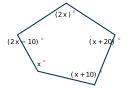
💡Core idea
Describe transformations fully: translation vector, reflection line, rotation centre/angle/direction, or enlargement centre/scale factor.
📐Essential rules and method
Rules:
- State transformation type and all defining data: vector, centre/angle/direction, mirror line, or centre/scale factor
Method:
- Transform key vertices
- Count from the centre or line
- Preserve orientation where appropriate
- Label the image
✏️Worked example — mark-scheme method
- Identify the method. Describe transformations fully: translation vector, reflection line, rotation centre/angle/direction, or enlargement centre/scale factor.
- Apply the method and show the mathematical evidence. Translate a point \((4,1)\) by the vector \(\binom{3}{-2}\): add the vector components to the coordinates, \((4+3,\,1+(-2))=(7,-1)\), so the image point is \((7,-1)\).
- Check and present the answer. One missing detail can lose the mark, so use the full transformation vocabulary. Check that every value has been used, signs and units are correct, and the final answer is in the form requested by the question.
⚡Exam hack
One missing detail can lose the mark, so use the full transformation vocabulary.
Questions (10)
-
G6–7
1.
Describe fully the single transformation that maps shape \(S\) onto shape \(T\) on a coordinate grid (a reflection in a given line). [2]
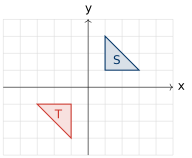
- G6–7 2. Enlarge a given triangle by scale factor 2, centre \((1,1)\). [2]
- G8–9 3. Enlarge a given triangle by scale factor \(-2\), with a given centre of enlargement. [3]
- G6–7 4. Describe the combined effect of a reflection in the \(x\)-axis followed by a reflection in the line \(y=x\). [3]
-
G6–7
5.
Triangle \(P\) with vertices \((2,3)\), \((4,3)\), \((2,6)\) is rotated \(90^{\circ}\) clockwise about the origin to give triangle \(Q\). Find the coordinates of \(Q\). [3]
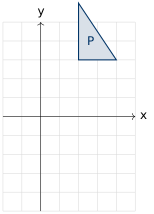
- G6–7 6. A shape is translated by the vector \(\begin{pmatrix}5\\-3\end{pmatrix}\). A point on the original shape is at \((-2,4)\). Find the coordinates of the image point. [2]
- G6–7 7. Describe fully the single transformation equivalent to two successive reflections in the parallel lines \(x=1\) and \(x=5\). [3]
- G6–7 8. Enlarge a given shape by scale factor \(\tfrac{1}{2}\), centre \((0,0)\). [2]
- G8–9 9. A shape undergoes a rotation of \(180^{\circ}\) about \((1,0)\) followed by a translation by the vector \(\begin{pmatrix}-2\\0\end{pmatrix}\). Find the coordinates of the invariant point. [3]
- G8–9 10. Describe fully the single transformation equivalent to a reflection in \(y=x\) followed by a reflection in the \(x\)-axis. [3]
💡Core idea
Choose the correct area, surface-area or volume formula and keep units squared or cubed.
📐Essential rules and method
Rules:
- Area uses square units, volume cubic units
- Prism volume \(=\) cross-sectional area \(\times\) length
- Circle measures use \(\pi\)
Method:
- Mark dimensions
- Choose the correct formula
- Split composite shapes
- Retain exact values until the end
- Round with units
✏️Worked example — mark-scheme method
- Identify the method. Choose the correct area, surface-area or volume formula and keep units squared or cubed.
- Apply the method and show the mathematical evidence. A cylinder has radius 3 cm and height 5 cm. Using \(V=\pi r^2h\): \(V=\pi\times3^2\times5=\pi\times9\times5=45\pi\approx141\) cm\(^3\) (3 s.f.).
- Check and present the answer. For compound shapes, sketch the pieces and mark whether you add or subtract them. Check that every value has been used, signs and units are correct, and the final answer is in the form requested by the question.
⚡Exam hack
For compound shapes, sketch the pieces and mark whether you add or subtract them.
Questions (41)
-
G6–7
1.
A cylinder has radius 5 cm and height 12 cm. Find its volume. [2]
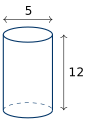
- G6–7 2. A sphere has radius 7 cm. Find its volume. [2]
-
G6–7
3.
A cone has radius 4 cm and slant height 9 cm. Find its curved surface area. [2]
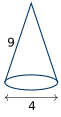
- G6–7 4. Find the volume of a cuboid measuring \(8\text{ cm} \times 5\text{ cm} \times 3\text{ cm}\). [1]
-
G6–7
5.
A sector has radius 8 cm and angle \(100^{\circ}\). Find its area. [2]
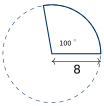
- G6–7 6. A sector has radius 6 cm and angle \(75^{\circ}\). Find its arc length. [2]
-
G6–7
7.
Find the area of a trapezium with parallel sides 7 cm and 12 cm and height 6 cm. [2]
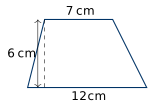
- G8–9 8. A hemisphere has radius 4.5 cm. Find its total surface area. [3]
- G6–7 9. Find the volume of a triangular prism with cross-sectional area \(24\text{ cm}^2\) and length 15 cm. [2]
-
G8–9
10.
A composite shape is made of a rectangle 10 cm by 6 cm with a semicircle of diameter 6 cm attached to one side. Find the total area. [3]
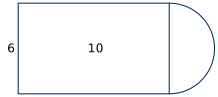
- G8–9 11. A cylindrical tank has radius 30 cm and height 80 cm. Find its capacity in litres. [3]
- G6–7 12. A cone has base radius 6 cm and height 8 cm. Find its volume. [2]
- G6–7 13. Find the surface area of a cuboid measuring \(7\text{ cm}\times4\text{ cm}\times3\text{ cm}\). [3]
-
G6–7
14.
A regular hexagon has side length 8 cm. Find its area. [3]

-
G8–9
15.
A solid is made from a cone joined to a hemisphere of the same radius. The cone has radius 5 cm and height 12 cm. Find the total volume. [4]
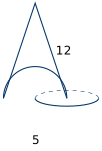
- G6–7 16. Find the area of a circle with circumference 62.8 cm, correct to 3 significant figures. [3]
- G8–9 17. Find the perimeter of a sector with radius 9 cm and angle \(80^{\circ}\). [3]
- G6–7 18. A cube has volume \(343\text{ cm}^3\). Find the length of one edge. [2]
-
G6–7
19.
A pyramid has a square base of side 10 cm and height 12 cm. Find its volume. [2]
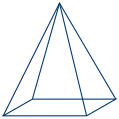
-
G8–9
20.
Find the volume of a frustum formed by removing a cone of height 4 cm from a similar cone of height 10 cm and base radius 8 cm. [4]
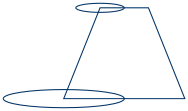
- G8–9 21. Two similar solids have volumes \(64\text{ cm}^3\) and \(216\text{ cm}^3\). Find the ratio of their surface areas. [3]
- G8–9 22. A cylinder has volume \(942\text{ cm}^3\) and radius 5 cm. Find its height (take \(\pi\approx3.14\)). [3]
- G8–9 23. A garden is a rectangle 12 m by 8 m with a semicircular flowerbed of diameter 8 m removed from one end. Find the remaining area. [3]
- G8–9 24. Find the total surface area of a cylinder with radius 3 cm and height 10 cm. [3]
- G8–9 25. A sphere has surface area \(314\text{ cm}^2\). Find its radius, correct to 3 significant figures. [3]
- G6–7 26. A prism has an L-shaped cross-section made from two rectangles measuring \(6\text{ cm}\times4\text{ cm}\) and \(3\text{ cm}\times2\text{ cm}\), and length 10 cm. Find the volume of the prism. [3]
- G6–7 27. Find the area of an equilateral triangle with side length 10 cm. [3]
- G8–9 28. A cone has volume \(100\pi\text{ cm}^3\) and height 12 cm. Find its radius. [3]
- G6–7 29. Find the length of an arc of a circle with radius 10 cm subtending an angle of \(45^{\circ}\) at the centre. [2]
- G8–9 30. A composite solid is made from a cuboid \(6\text{ cm}\times6\text{ cm}\times10\text{ cm}\) with a hemisphere of radius 3 cm removed from the top. Find the remaining volume. [4]
- G6–7 31. Two similar cylinders have heights 4 cm and 10 cm. If the volume of the smaller is \(50\text{ cm}^3\), find the volume of the larger. [3]
-
G8–9
32.
A square of side 8 cm has a quarter circle of radius 8 cm removed from one corner. Find the remaining area. [3]

- G6–7 33. Find the volume of a sphere with diameter 18 cm. [2]
- G6–7 34. A trapezium-cross-section prism has parallel sides 5 cm and 9 cm, height 4 cm, and length 20 cm. Find its volume. [3]
- G6–7 35. A cuboid has a square base of side \(x\) cm and height \(2x\) cm. Given that its volume is \(250\text{ cm}^3\), find \(x\). [3]
- G8–9 36. Find the curved surface area of a cone with radius 6 cm and height 8 cm. [3]
- G8–9 37. Two right-angled triangles share a hypotenuse of length 13 cm. Given the other sides are 5 cm and 12 cm for one triangle and 12 cm and an unknown side for the other, find the perimeter of the combined shape. [4]
- G8–9 38. A sector has area \(45\pi\text{ cm}^2\) and angle \(90^{\circ}\). Find its radius. [3]
- G8–9 39. Find the total volume of a cuboid with dimensions in the ratio \(2:3:4\), given its total volume is \(648\text{ cm}^3\). [4]
- G8–9 40. A cylindrical candle has radius 3 cm and height 15 cm. It is melted and recast into spheres of radius 1.5 cm. Find the maximum number of spheres that can be made. [4]
- G8–9 41. Find the volume of a cuboid whose total surface area is \(148\text{ cm}^2\), given its base is \(6\text{ cm}\times4\text{ cm}\). [4]
💡Core idea
A circle with centre \((a,b)\) and radius \(r\) has equation \((x-a)^2+(y-b)^2=r^2\).
📐Essential rules and method
Rules:
- \((x-a)^2+(y-b)^2=r^2\) has centre \((a,b)\) and radius \(r\)
- A tangent is perpendicular to the radius
Method:
- Read centre/radius
- Test points by substitution
- Find the radius gradient
- Use the negative reciprocal
- Form the tangent equation
✏️Worked example — mark-scheme method
- Identify the method. A circle with centre \((a,b)\) and radius \(r\) has equation \((x-a)^2+(y-b)^2=r^2\).
- Apply the method and show the mathematical evidence. \(x^2+y^2=25\) compared with \((x-a)^2+(y-b)^2=r^2\): here \(a=0\), \(b=0\) and \(r^2=25\), so the centre is \((0,0)\) and the radius is \(r=\sqrt{25}=5\).
- Check and present the answer. Read the centre signs oppositely from the brackets. Check that every value has been used, signs and units are correct, and the final answer is in the form requested by the question.
⚡Exam hack
Read the centre signs oppositely from the brackets.
Questions (4)
-
G8–9
1.
A circle has equation \(x^2+y^2=20\). The point \((2,4)\) lies on the circle. Find the equation of the tangent to the circle at that point. [4]
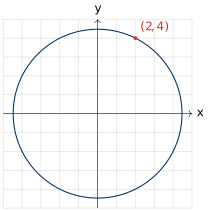
-
G8–9
2.
Find the coordinates of the points where the line \(y=2x-1\) meets the circle \(x^2+y^2=17\). [4]
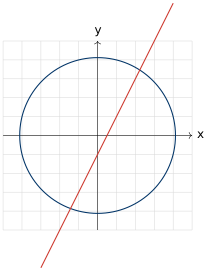
- G6–7 3. Write down the coordinates of the centre and the radius of the circle \((x+3)^2+(y-2)^2=49\). [1]
- G8–9 4. A circle has equation \(x^2+y^2=25\). Show that the point \((3,-4)\) lies on the circle, and find the equation of the tangent at that point. [4]
💡Core idea
Recognise the relevant theorem, calculate the angle, and give the theorem as the reason.
📐Essential rules and method
Rules:
- Centre angle is twice circumference angle
- Same-segment angles match
- Cyclic opposite angles total \(180^\circ\)
- Radius is perpendicular to tangent
Method:
- Mark known radii and angles
- Name each theorem used
- Form an angle equation
- Solve in a logical chain
✏️Worked example — mark-scheme method
- Identify the method. Recognise the relevant theorem, calculate the angle, and give the theorem as the reason.
- Apply the method and show the mathematical evidence. \(A\), \(B\), \(C\) lie on a circle centre \(O\); angle \(AOC=118^\circ\) (at the centre). Since the angle at the centre is twice the angle at the circumference on the same arc, angle \(ABC=118^\circ\div2=59^\circ\).
- Check and present the answer. Mark equal radii to expose isosceles triangles before using a theorem. Check that every value has been used, signs and units are correct, and the final answer is in the form requested by the question.
⚡Exam hack
Mark equal radii to expose isosceles triangles before using a theorem.
Questions (10)
-
G6–7
1.
\(A\), \(B\), \(C\) are points on a circle with centre \(O\). Angle \(AOC=132^{\circ}\). Find angle \(ABC\), giving a reason. [2]
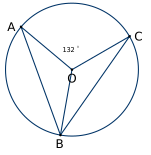
-
G8–9
2.
\(PQ\) is a tangent to a circle at \(P\). The angle between \(PQ\) and chord \(PR\) is \(58^{\circ}\). Find the angle in the alternate segment. [2]
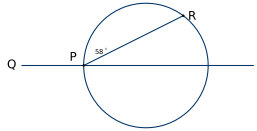
-
G8–9
3.
\(ABCD\) is a cyclic quadrilateral with angle \(A=98^{\circ}\). Find angle \(C\). [2]
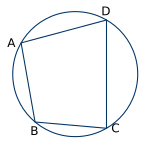
-
G6–7
4.
Two tangents \(PA\) and \(PB\) are drawn to a circle from an external point \(P\). Angle \(APB=44^{\circ}\). Find angle \(PAB\). [3]
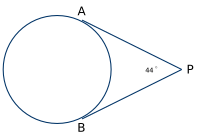
- G6–7 5. \(AB\) is a diameter of a circle and \(C\) is a point on the circumference. State the size of angle \(ACB\), giving a reason. [1]
-
G8–9
6.
\(A,B,C,D\) lie on a circle. Chords \(AC\) and \(BD\) intersect at \(X\) inside the circle. Prove that triangle \(ABX\) is similar to triangle \(DCX\). [3]
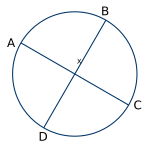
- G6–7 7. A tangent and a chord meet at point \(P\) on a circle, forming a \(65^{\circ}\) angle. Find the angle subtended by the chord at the centre. [2]
- G6–7 8. In a circle, chord \(AB\) subtends an angle of \(80^{\circ}\) at the centre. Find the angle subtended by \(AB\) at a point on the major arc. [2]
- G8–9 9. Prove that the angle in a semicircle is always \(90^{\circ}\), using the fact that the angle at the centre is twice the angle at the circumference. [3]
- G8–9 10. \(A,B,C\) are points on a circle with centre \(O\). Angle \(OAB=35^{\circ}\). Find angle \(AOB\) and hence angle \(ACB\). [3]
💡Core idea
Use Pythagoras in right triangles, SOHCAHTOA for right-triangle ratios, and sine/cosine rules for non-right triangles.
📐Essential rules and method
Rules:
- Right triangles use SOHCAHTOA
- Non-right triangles use sine rule, cosine rule or \(\frac12ab\sin C\)
Method:
- Label opposite/adjacent/hypotenuse
- Choose a formula from known data
- Substitute before rearranging
- Check calculator degree mode
✏️Worked example — mark-scheme method
- Identify the method. Use Pythagoras in right triangles, SOHCAHTOA for right-triangle ratios, and sine/cosine rules for non-right triangles.
- Apply the method and show the mathematical evidence. A right triangle has opposite side 6 and hypotenuse 10. Using \(\sin\theta=\dfrac{\text{opp}}{\text{hyp}}\): \(\sin\theta=\dfrac{6}{10}=0.6\), so \(\theta=\sin^{-1}(0.6)\approx36.9^\circ\) (3 s.f.).
- Check and present the answer. Label opposite, adjacent and hypotenuse relative to the angle before choosing a ratio. Check that every value has been used, signs and units are correct, and the final answer is in the form requested by the question.
⚡Exam hack
Label opposite, adjacent and hypotenuse relative to the angle before choosing a ratio.
Questions (20)
- G6–7 1. In a right-angled triangle, the opposite side is 6 cm and the hypotenuse is 10 cm. Find the angle. [2]
-
G6–7
2.
In triangle \(ABC\), angle \(A=90^{\circ}\), \(AB=9\) cm, angle \(B=38^{\circ}\). Find \(BC\). [2]
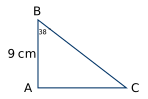
-
G8–9
3.
In triangle \(PQR\), \(PQ=8\) cm, \(QR=11\) cm, angle \(PQR=52^{\circ}\). Find \(PR\) using the cosine rule. [3]
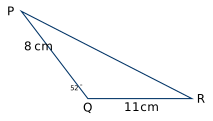
- G8–9 4. In triangle \(XYZ\), \(XY=7\) cm, angle \(X=48^{\circ}\), angle \(Y=63^{\circ}\). Find \(YZ\) using the sine rule. [3]
- G6–7 5. Find the area of a triangle with sides 9 cm and 12 cm and an included angle of \(55^{\circ}\). [3]
-
G6–7
6.
In triangle \(ABC\), \(AB=10\) cm, \(BC=14\) cm, \(CA=18\) cm. Find the largest angle. [3]
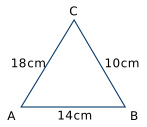
- G6–7 7. A ladder 6 m long leans against a wall, reaching 5.2 m up the wall. Find the angle the ladder makes with the ground. [2]
- G6–7 8. From a point on the ground, the angle of elevation to the top of a 40 m tower is \(32^{\circ}\). Find the distance from the point to the base of the tower. [2]
- G6–7 9. In a right-angled triangle, the adjacent side is 8 cm and the opposite side is 6 cm. Find the hypotenuse and the angle between the hypotenuse and the adjacent side. [3]
- G8–9 10. Two right-angled triangles share a side. Triangle 1 has legs 5 cm and 12 cm; find its hypotenuse, then use this length as a side of triangle 2 to find a further length (given one further angle). [4]
- G6–7 11. In triangle \(DEF\), \(DE=15\) cm, \(DF=9\) cm, angle \(D=64^{\circ}\). Find \(EF\). [3]
- G6–7 12. Find the area of an isosceles triangle with two sides of 8 cm and an included angle of \(40^{\circ}\). [3]
-
G8–9
13.
A ship sails from port \(A\) to port \(B\), a distance of 45 km on a bearing of \(060^{\circ}\). Find how far north and how far east \(B\) is from \(A\). [3]
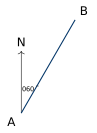
- G8–9 14. In triangle \(ABC\), angle \(A=52^{\circ}\), angle \(B=61^{\circ}\), \(BC=10\) cm. Find \(AC\) using the sine rule. [3]
- G6–7 15. A right-angled triangle has hypotenuse 20 cm and one angle of \(35^{\circ}\). Find both of the other sides. [3]
- G6–7 16. Two towers are 120 m apart. From the base of one, the angle of elevation to the top of the other is \(25^{\circ}\). Find the height of the second tower. [2]
- G8–9 17. In triangle \(PQR\), \(PQ=6\) cm, \(PR=9\) cm, angle \(QPR=110^{\circ}\). Find \(QR\) using the cosine rule. [3]
- G6–7 18. Find the perimeter of a right-angled triangle where one angle is \(42^{\circ}\) and the hypotenuse is 15 cm. [3]
- G6–7 19. A vertical flagpole casts a shadow of 12 m when the angle of elevation of the sun is \(38^{\circ}\). Find the height of the flagpole. [2]
- G8–9 20. In a non-right-angled triangle, two sides are 11 cm and 14 cm with an included angle of \(72^{\circ}\). Find the length of the third side and then the area of the triangle. [4]
💡Core idea
Find a useful right triangle inside the solid, often using Pythagoras on a face before trigonometry.
📐Essential rules and method
Rules:
- Three-dimensional problems reduce to connected right triangles
- Locate a face or space diagonal using Pythagoras first
Method:
- Sketch and label the hidden triangle
- Calculate an intermediate length
- Apply trigonometry and round only at the end
✏️Worked example — mark-scheme method
- Identify the method. Find a useful right triangle inside the solid, often using Pythagoras on a face before trigonometry.
- Apply the method and show the mathematical evidence. A cuboid has a rectangular base \(3\times4\). Its diagonal on that face, by Pythagoras, is \(\sqrt{3^2+4^2}=\sqrt{25}=5\). This length can now be used as a side of a new right triangle running up into the solid.
- Check and present the answer. Redraw the required triangle in two dimensions and label every known length. Check that every value has been used, signs and units are correct, and the final answer is in the form requested by the question.
⚡Exam hack
Redraw the required triangle in two dimensions and label every known length.
Questions (4)
-
G8–9
1.
A cuboid measures \(6\text{ cm}\times8\text{ cm}\times10\text{ cm}\). Find the length of the space diagonal and the angle it makes with the base. [4]
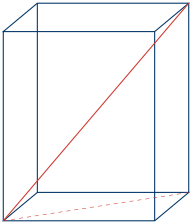
-
G8–9
2.
\(VABCD\) is a right pyramid with a square base of side 10 cm and height 15 cm. Find the angle between edge \(VA\) and the base. [4]
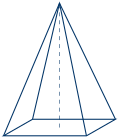
- G8–9 3. In cuboid \(ABCDEFGH\), find the angle between the diagonal \(AG\) and the face \(ABCD\), given \(AB=8\) cm, \(BC=5\) cm and \(CG=6\) cm. [4]
- G8–9 4. A triangular prism has a horizontal rectangular base. Find the angle between a sloped edge to the apex ridge and the base, given the relevant lengths. [4]
💡Core idea
Describe directed movement using vector addition and scalar multiples; use alternate routes to form equations.
📐Essential rules and method
Rules:
- A route vector is the sum of directed segments
- Reversing a vector changes its sign
- Parallel vectors are scalar multiples
Method:
- Choose a common start/end route
- Express each segment in base vectors
- Simplify coefficients
- State the geometric conclusion
✏️Worked example — mark-scheme method
- Identify the method. Describe directed movement using vector addition and scalar multiples; use alternate routes to form equations.
- Apply the method and show the mathematical evidence. \(OABC\) is a parallelogram, \(\overrightarrow{OA}=\mathbf{a}\), \(\overrightarrow{OC}=\mathbf{c}\). Since \(\overrightarrow{AB}=\overrightarrow{OC}=\mathbf{c}\) (opposite sides equal), \(\overrightarrow{OB}=\overrightarrow{OA}+\overrightarrow{AB}=\mathbf{a}+\mathbf{c}\).
- Check and present the answer. Start every route at the named first point and follow arrow directions. Check that every value has been used, signs and units are correct, and the final answer is in the form requested by the question.
⚡Exam hack
Start every route at the named first point and follow arrow directions.
Questions (9)
- G6–7 1. Given \(\mathbf{a}=\begin{pmatrix}4\\-1\end{pmatrix}\) and \(\mathbf{b}=\begin{pmatrix}-2\\5\end{pmatrix}\), find \(3\mathbf{a}-2\mathbf{b}\). [2]
-
G6–7
2.
\(OABC\) is a parallelogram with \(\overrightarrow{OA}=\mathbf{a}\) and \(\overrightarrow{OC}=\mathbf{c}\). Find \(\overrightarrow{OB}\) in terms of \(\mathbf{a}\) and \(\mathbf{c}\). [2]
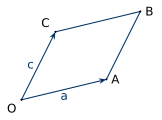
- G6–7 3. \(M\) is the midpoint of \(AB\), where \(\overrightarrow{OA}=\mathbf{a}\) and \(\overrightarrow{OB}=\mathbf{b}\). Find \(\overrightarrow{OM}\) in terms of \(\mathbf{a}\) and \(\mathbf{b}\). [2]
- G6–7 4. Given that \(2\mathbf{a}+\mathbf{b}=\begin{pmatrix}9\\4\end{pmatrix}\) and \(\mathbf{a}-\mathbf{b}=\begin{pmatrix}0\\-1\end{pmatrix}\), find \(\mathbf{a}\) and \(\mathbf{b}\) as column vectors. [3]
-
G8–9
5.
In triangle \(OAB\), \(\overrightarrow{OA}=\mathbf{a}\), \(\overrightarrow{OB}=\mathbf{b}\). \(P\) is on \(AB\) such that \(AP:PB=2:3\). Find \(\overrightarrow{OP}\) in terms of \(\mathbf{a}\) and \(\mathbf{b}\). [3]
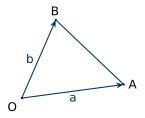
-
G8–9
6.
\(OABC\) is a trapezium with \(\overrightarrow{OA}=\mathbf{a}\), \(\overrightarrow{OC}=3\mathbf{a}\), \(\overrightarrow{AB}=\mathbf{b}\). \(D\) is on \(OB\) such that \(OD:DB=1:2\). Find \(\overrightarrow{OD}\) in terms of \(\mathbf{a}\) and \(\mathbf{b}\). [4]
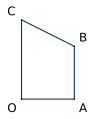
- G8–9 7. Prove, using vectors, that the diagonals of a parallelogram bisect each other. [4]
- G6–7 8. Given \(\mathbf{a}=\begin{pmatrix}3\\2\end{pmatrix}\) and \(\mathbf{b}=\begin{pmatrix}-1\\4\end{pmatrix}\), find the vector \(2\mathbf{a}+3\mathbf{b}\) and its magnitude. [3]
- G8–9 9. \(E,F,G,H\) are the midpoints of the sides of quadrilateral \(ABCD\). Using vectors, prove that \(EFGH\) is a parallelogram. [4]
💡Core idea
Bearings are measured clockwise from north and written using three digits.
📐Essential rules and method
Rules:
- Bearings are measured clockwise from north and written with three figures
- Alternate/corresponding north-line angles are useful
Method:
- Draw north lines
- Mark the clockwise bearing
- Find internal angles
- Use scale drawing
- Sine rule or cosine rule as appropriate
✏️Worked example — mark-scheme method
- Identify the method. Bearings are measured clockwise from north and written using three digits.
- Apply the method and show the mathematical evidence. A ship sails from a port on a bearing of \(048^\circ\) for 60 km, then on a bearing of \(155^\circ\) for 40 km. Draw a north line at each turning point, mark the given bearings as clockwise angles from north, and use the interior angle between legs to find the final bearing from the port.
- Check and present the answer. Draw a north line at every relevant point and use parallel-line angle facts. Check that every value has been used, signs and units are correct, and the final answer is in the form requested by the question.
⚡Exam hack
Draw a north line at every relevant point and use parallel-line angle facts.
Questions (4)
- G6–7 1. The bearing of point \(B\) from point \(A\) is \(072^{\circ}\). Find the bearing of \(A\) from \(B\). [2]
-
G8–9
2.
A ship sails from a port on a bearing of \(048^{\circ}\) for 60 km, then on a bearing of \(155^{\circ}\) for 40 km. Find the bearing of the ship’s final position from the port. [4]
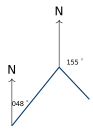
- G8–9 3. Two coastguard stations \(A\) and \(B\) are 24 km apart, with \(B\) due east of \(A\). A boat \(C\) is on a bearing of \(048^{\circ}\) from \(A\) and a bearing of \(115^{\circ}\) from \(B\). Work out the distance \(AC\), giving your answer to 3 significant figures. [4]
- G8–9 4. A plane flies from airport \(P\) on a bearing of \(065^{\circ}\) for 180 km to point \(Q\), then on a bearing of \(140^{\circ}\) for 220 km to point \(R\). Work out the direct distance from \(P\) to \(R\), giving your answer to 3 significant figures. [4]
💡Core idea
Similar shapes have equal corresponding angles and proportional lengths; areas scale by \(k^2\) and volumes by \(k^3\).
📐Essential rules and method
Rules:
- Similar lengths scale by \(k\), areas by \(k^2\), volumes by \(k^3\)
- Congruent shapes have scale factor 1
Method:
- Match corresponding sides
- Find the linear scale factor
- Apply the correct power
- Preserve the direction of enlargement
✏️Worked example — mark-scheme method
- Identify the method. Similar shapes have equal corresponding angles and proportional lengths; areas scale by \(k^2\) and volumes by \(k^3\).
- Apply the method and show the mathematical evidence. Two similar shapes have a linear scale factor of 3. Since area scales by (linear factor)\(^2\), the area scale factor is \(3^2=9\): a shape of area 5 cm\(^2\) maps to an image of area \(5\times9=45\) cm\(^2\).
- Check and present the answer. Write the linear scale factor first, then square or cube it only when needed. Check that every value has been used, signs and units are correct, and the final answer is in the form requested by the question.
⚡Exam hack
Write the linear scale factor first, then square or cube it only when needed.
Questions (11)
- G6–7 1. Two similar triangles have corresponding sides 6 cm and 15 cm. If the area of the smaller triangle is \(20\text{ cm}^2\), find the area of the larger. [3]
-
G8–9
2.
Prove that triangle \(ABC\) is congruent to triangle \(DEF\), given \(AB=DE\), angle \(B=\) angle \(E\) and \(BC=EF\). [2]
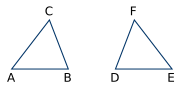
- G6–7 3. Two similar cones have heights 8 cm and 12 cm. If the volume of the smaller is \(180\text{ cm}^3\), find the volume of the larger. [3]
-
G6–7
4.
Triangle \(ABC\) is similar to triangle \(XYZ\). \(AB=8\) cm, \(XY=20\) cm. If \(BC=11\) cm, find \(YZ\). [2]
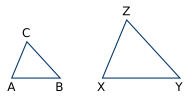
- G8–9 5. Two similar cylinders have surface areas \(40\text{ cm}^2\) and \(90\text{ cm}^2\). Find the ratio of their heights. [3]
- G8–9 6. Prove that a line drawn parallel to one side of a triangle creates a smaller triangle similar to the original. [3]
- G6–7 7. State the congruence condition (SSS, SAS, ASA or RHS) that applies to two right-angled triangles that share a hypotenuse and one other equal side. [1]
- G8–9 8. Two similar solids have volumes \(27\text{ cm}^3\) and \(125\text{ cm}^3\). Find the ratio of their surface areas. [3]
- G8–9 9. \(AB\) is parallel to \(CD\). Lines \(AC\) and \(BD\) meet at \(O\). Prove that triangle \(OAB\) is similar to triangle \(OCD\). [3]
- G6–7 10. A photograph measuring 15 cm by 10 cm is enlarged, keeping the same proportions, to make a poster 60 cm wide. Find the height of the poster. [2]
- G8–9 11. Two similar solids made from the same material have masses 40 g and 135 g. Find the ratio of their surface areas. [3]
💡Core idea
Plans show the view from above; elevations show front or side views with hidden depth removed.
📐Essential rules and method
Rules:
- A plan is viewed from above
- Front/side elevations preserve width or height but not depth
Method:
- Identify the viewing direction
- Project visible edges to a grid
- Use exact dimensions
- Include hidden structure only when required
✏️Worked example — mark-scheme method
- Identify the method. Plans show the view from above; elevations show front or side views with hidden depth removed.
- Apply the method and show the mathematical evidence. A \(3\times2\times1\) cuboid is viewed from above (plan) and from the front (front elevation). The plan shows the \(3\times2\) face; the front elevation shows the \(3\times1\) face, since depth is not visible from the front.
- Check and present the answer. Count grid units and identify the viewing direction before drawing. Check that every value has been used, signs and units are correct, and the final answer is in the form requested by the question.
⚡Exam hack
Count grid units and identify the viewing direction before drawing.
Questions (4)
- G6–7 1. A solid is a cuboid with a triangular prism removed from one edge. Sketch its plan view, given a description of the solid. [2]
- G6–7 2. Given the plan and front elevation of a solid, sketch its side elevation. [3]
- G6–7 3. The plan, front elevation and side elevation of a solid are all congruent squares of side 4 cm. Name the solid and explain your reasoning. [2]
-
G8–9
4.
A solid consists of a cylinder of radius 3 cm and height 8 cm standing on a square base of side 8 cm and height 2 cm. Sketch the front elevation of the solid, marking all lengths. [3]
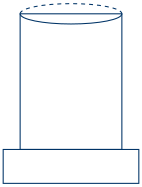
💡Core idea
Use compass-and-straightedge arcs for bisectors and loci, leaving construction marks visible.
📐Essential rules and method
Rules:
- A perpendicular bisector gives points equidistant from two points
- An angle bisector gives points equidistant from two lines
Method:
- Keep compass radius fixed for paired arcs
- Draw construction arcs clearly
- Join intersections accurately
- Shade the correct locus
✏️Worked example — mark-scheme method
- Identify the method. Use compass-and-straightedge arcs for bisectors and loci, leaving construction marks visible.
- Apply the method and show the mathematical evidence. To bisect angle \(ABC\): place the compass point at \(B\) and draw an arc crossing both arms; from each crossing point draw equal-radius arcs that intersect; join \(B\) to this intersection point — this line is the bisector.
- Check and present the answer. Do not erase arcs; they are evidence of the required construction. Check that every value has been used, signs and units are correct, and the final answer is in the form requested by the question.
⚡Exam hack
Do not erase arcs; they are evidence of the required construction.
Questions (4)
-
G6–7
1.
Using a ruler and compasses only, construct the bisector of a given angle \(ABC\). You must show all construction lines. [2]
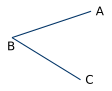
- G8–9 2. A goat is tethered inside a rectangular field \(ABCD\) by a rope attached at corner \(A\). The rope has length equal to side \(AB\). On a scale drawing of the field, construct and shade the region the goat can reach. [3]
- G8–9 3. A radio transmitter at point \(T\) has a range of 6 km. Using a scale of 1 cm to 1 km, construct and shade the region that is within range of the transmitter. [2]
- G6–7 4. A new path is to be built so that every point on it is equidistant from two straight roads that meet at point \(O\) at an angle of \(70^{\circ}\). Using ruler and compasses only, construct the path. [2]
🎲 Probability
💡Core idea
Place intersections first, then fill exclusive regions and the outside of the universal set.
📐Essential rules and method
Rules:
- Intersection means both, union means either, complement means not
- Fill the intersection first
Method:
- Place overlap values
- Complete exclusive regions
- Calculate the outside region
- Divide by the universal total for probabilities
✏️Worked example — mark-scheme method
- Identify the method. Place intersections first, then fill exclusive regions and the outside of the universal set.
- Apply the method and show the mathematical evidence. \(P(\text{maths})=0.6\), \(P(\text{science})=0.5\), \(P(\text{both})=0.3\). Using \(P(A\cup B)=P(A)+P(B)-P(A\cap B)\): \(P(\text{maths or science})=0.6+0.5-0.3=0.8\).
- Check and present the answer. “Or” means union; “and” means intersection; “not” means complement. Check that every value has been used, signs and units are correct, and the final answer is in the form requested by the question.
⚡Exam hack
“Or” means union; “and” means intersection; “not” means complement.
Questions (7)
- G6–7 1. \(\mathcal{E}=\{1,2,\ldots,20\}\), \(A=\{\text{multiples of }4\}\), \(B=\{\text{multiples of }5\}\). List the elements of \(A\cap B\). [2]
-
G6–7
2.
In a survey of 60 people, 34 like tea, 28 like coffee and 12 like both. Draw a Venn diagram and find how many people like neither. [3]
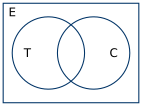
- G6–7 3. \(A=\{\text{factors of }24\}\), \(B=\{\text{factors of }36\}\). List the elements of \(A\cap B\). [2]
- G6–7 4. In a class of 32 students, 20 study Biology, 18 study Chemistry, and 5 study neither. Find the number of students who study both subjects. [3]
- G8–9 5. A Venn diagram has regions labelled in terms of \(x\), with set sizes given in the question. Form and solve an equation to find \(x\). [3]
- G6–7 6. A survey of 50 people found that 30 own a car, 22 own a bike and 8 own neither. Find the probability that a randomly chosen person owns both a car and a bike. [3]
- G6–7 7. \(\mathcal{E}=\{\text{all students in a school}\}\), \(A=\{\text{students who play football}\}\), \(B=\{\text{students who play rugby}\}\). Given \(|A|=45\), \(|B|=30\), \(|A\cap B|=15\) and \(|\mathcal{E}|=120\), find the number of students who play neither sport. [3]
💡Core idea
Use the product rule for successive choices and adjust when repetition is forbidden.
📐Essential rules and method
Rules:
- Add mutually exclusive alternatives
- Multiply successive choices
- Reduce later choices when repetition is forbidden
Method:
- Draw slots or a tree
- Write the number of choices at each stage
- Multiply and adjust restrictions
✏️Worked example — mark-scheme method
- Identify the method. Use the product rule for successive choices and adjust when repetition is forbidden.
- Apply the method and show the mathematical evidence. A meal deal has 5 sandwich choices, 3 drink choices and 2 snack choices, with one from each category. The number of different meal deals is \(5\times3\times2=30\).
- Check and present the answer. Write the number of choices at each stage before multiplying. Check that every value has been used, signs and units are correct, and the final answer is in the form requested by the question.
⚡Exam hack
Write the number of choices at each stage before multiplying.
Questions (8)
- G6–7 1. A restaurant has 5 starters, 7 mains and 4 desserts. How many different three-course meals are possible? [1]
- G6–7 2. A padlock has 4 dials, each numbered 0–9, with digits allowed to repeat. How many different codes are possible? [1]
- G6–7 3. In how many ways can 3 books be chosen from a shelf of 10 different books, if the order does not matter? [2]
- G6–7 4. A school has 20 teachers. Two are chosen at random to form a committee. How many different committees are possible? [2]
- G6–7 5. A team of 5 is chosen from 5 forwards and 6 backs, selecting 2 forwards and 3 backs. How many different teams are possible? [3]
- G6–7 6. How many different 5-digit codes can be made using the digits 1–9, if no digit is repeated? [2]
- G6–7 7. Eight teams play in a league where each team plays every other team twice. Find the total number of matches played. [2]
- G8–9 8. A meal choice consists of a starter and a main, or a main and a dessert. Given 6 starters, 8 mains and 5 desserts, find the total number of possible meal choices. [3]
💡Core idea
Use sample spaces, trees or two-way tables; conditional probability restricts the sample to known outcomes.
📐Essential rules and method
Rules:
- Branch probabilities multiply along a route and mutually exclusive routes add
- Conditional probabilities use the reduced sample space
Method:
- Complete missing branches to total 1
- Multiply route probabilities
- Add required routes
- Interpret without replacement carefully
✏️Worked example — mark-scheme method
- Identify the method. Use sample spaces, trees or two-way tables; conditional probability restricts the sample to known outcomes.
- Apply the method and show the mathematical evidence. A bag has 5 red and 3 blue counters; two are drawn without replacement. \(P(\text{both red})=P(\text{1st red})\times P(\text{2nd red}\mid\text{1st red})=\dfrac{5}{8}\times\dfrac{4}{7}=\dfrac{20}{56}=\dfrac{5}{14}\).
- Check and present the answer. On a tree, multiply along branches and add mutually exclusive final routes. Check that every value has been used, signs and units are correct, and the final answer is in the form requested by the question.
⚡Exam hack
On a tree, multiply along branches and add mutually exclusive final routes.
Questions (21)
- G8–9 1. A bag has 7 red and 5 blue counters. Two counters are drawn without replacement. Find the probability that both are red. [3]
- G6–7 2. A biased coin has \(P(\text{heads})=0.35\). It is flipped twice. Find the probability of getting exactly one head. [3]
- G8–9 3. The probability that it rains on a given day is 0.25. Find the probability it rains on at least one of the next 3 days. [3]
- G6–7 4. Events \(A\) and \(B\) are independent, with \(P(A)=0.5\) and \(P(B)=0.3\). Find \(P(A \text{ or } B)\). [2]
- G8–9 5. A box has 4 green and 6 yellow balls. Two are drawn without replacement. Find the probability they are different colours. [3]
- G6–7 6. A spinner has 5 equal sections numbered 1–5. It is spun twice. Find the probability the two scores sum to more than 8. [3]
-
G8–9
7.
Complete a probability tree diagram for two attempts at a test, where \(P(\text{pass})=0.7\) on each attempt, and find \(P(\text{pass at least once})\). [4]
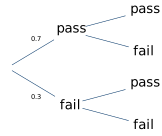
- G8–9 8. A bag contains only red, blue and green counters in the ratio \(2:3:5\). Two counters are drawn without replacement. Find the probability both are green. [3]
- G6–7 9. In a game, the probability of winning is 0.4. A player plays 3 times. Find the probability of winning exactly twice. [3]
- G6–7 10. Given \(P(A)=0.6\), \(P(B|A)=0.3\), \(P(B|\text{not }A)=0.5\), find \(P(B)\). [3]
- G8–9 11. A bag has only red and blue counters. The probability of picking two reds without replacement is 0.4. Given there are 10 counters in total, find the number of red counters. [4]
- G6–7 12. Two fair dice are rolled. Find the probability that the product of the two scores is even. [3]
- G8–9 13. A weather model states: if it rains one day, \(P(\text{rain next day})=0.7\); if dry, \(P(\text{rain next day})=0.4\). Given a 60% chance of rain on Monday, find \(P(\text{rain on Wednesday})\). [4]
- G8–9 14. Three cards are drawn without replacement from a set of 10 numbered cards (5 even, 5 odd). Find the probability all three cards drawn are even. [3]
- G8–9 15. A biased dice has \(P(6)=0.3\) and all other outcomes equally likely. Find \(P(\text{not }6)\) and hence the probability of at least one 6 in 2 rolls. [3]
- G8–9 16. A box of 12 chocolates has 5 dark and 7 milk. Two are chosen at random. Find the probability at least one is dark. [3]
- G8–9 17. Given a probability tree for two independent events with \(P(A)=0.45\), find \(P(\text{exactly one of the two events occurs})\). [3]
- G8–9 18. A game show has 3 doors, one hiding a prize. A contestant picks a door; the host then reveals a different, non-prize door, and the contestant may switch. Find the probability of winning if the contestant always switches. [4]
- G6–7 19. Two friends each roll a fair die. Find the probability that their scores differ by exactly 2. [3]
- G6–7 20. A card is drawn from a standard deck, replaced, and another card drawn. Find the probability that both cards are the same suit. [3]
- G6–7 21. A survey found that 65% of people own a dog and, of dog owners, 40% also own a cat. Find the probability that a randomly chosen person owns both a dog and a cat. [2]
💡Core idea
Relative frequency estimates probability from observed data and becomes more stable with more trials.
📐Essential rules and method
Rules:
- Relative frequency \(=\) observed successes/trials
- Estimated frequency \(=\) relative frequency \(\times\) future trials
Method:
- Use the largest reliable sample
- Calculate the proportion
- Scale to the new number of trials
- Describe it as an estimate
✏️Worked example — mark-scheme method
- Identify the method. Relative frequency estimates probability from observed data and becomes more stable with more trials.
- Apply the method and show the mathematical evidence. A biased dice is rolled 60 times, landing on 6 fifteen times. Relative frequency \(=15\div60=0.25\). To estimate the count in 500 rolls: \(0.25\times500=125\) sixes expected.
- Check and present the answer. Use the estimate to predict a count by multiplying by the new number of trials. Check that every value has been used, signs and units are correct, and the final answer is in the form requested by the question.
⚡Exam hack
Use the estimate to predict a count by multiplying by the new number of trials.
Questions (4)
- G6–7 1. A drawing pin is dropped 150 times and lands point-up 87 times. Work out the relative frequency of landing point-up, giving your answer to 3 significant figures. [2]
- G6–7 2. A factory tests 240 components and finds 18 are faulty. Estimate how many faulty components there would be in a batch of 4500. [2]
- G6–7 3. A biased dice is rolled and the results recorded after 20, 100 and 500 rolls, giving relative frequencies for a six of 0.30, 0.24 and 0.21 respectively. \ (a) Which estimate is likely to be most reliable, and why? [1] \ (b) Use the most reliable estimate to predict the number of sixes in 750 rolls. [2]
- G6–7 4. A café records that 34 out of 80 customers order a hot drink. Based on this, estimate how many of the next 300 customers will order a hot drink. [2]
📊 Statistics
💡Core idea
Describe correlation by direction and strength; use a line of best fit only within a sensible data range.
📐Essential rules and method
Rules:
- Correlation describes association, not causation
- Interpolation is within the data range and extrapolation is outside it
Method:
- Describe direction/strength
- Draw a balanced line of best fit
- Estimate from the line
- Comment on reliability
✏️Worked example — mark-scheme method
- Identify the method. Describe correlation by direction and strength; use a line of best fit only within a sensible data range.
- Apply the method and show the mathematical evidence. A scatter graph of hours revised against test score shows points rising left to right, close to a straight line. This shows strong positive correlation: as revision time increases, test score tends to increase.
- Check and present the answer. Mention interpolation or extrapolation when judging reliability. Check that every value has been used, signs and units are correct, and the final answer is in the form requested by the question.
⚡Exam hack
Mention interpolation or extrapolation when judging reliability.
Questions (6)
- G6–7 1. A scatter graph plots hours of revision against exam score. Describe the type of correlation you would expect. [1]
-
G6–7
2.
Given a scatter graph with a line of best fit, use it to estimate the score for 5 hours of revision. [2]
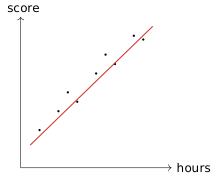
- G6–7 3. Explain why it may not be appropriate to use a line of best fit to predict values far outside the range of the data. [1]
- G6–7 4. A scatter graph of car engine size against fuel consumption (mpg) shows negative correlation. Explain what this means in context. [1]
- G6–7 5. A scatter graph dataset includes one point far from the general trend. Identify this as an outlier and comment on how it might affect a line of best fit. [2]
- G6–7 6. Two variables show no correlation on a scatter graph. Explain what this tells us about the relationship between them. [1]
💡Core idea
Estimate a grouped mean using class midpoints: \(\bar{x}\approx\sum fx/\sum f\).
📐Essential rules and method
Rules:
- Estimated mean \(=\sum(f\times\text{midpoint})/\sum f\)
- Modal class has greatest frequency density when widths differ
Method:
- Find midpoints
- Multiply by frequencies
- Total both columns
- Divide
- Label the result as an estimate
✏️Worked example — mark-scheme method
- Identify the method. Estimate a grouped mean using class midpoints: \(\bar{x}\approx\sum fx/\sum f\).
- Apply the method and show the mathematical evidence. A class \(10\)–\(20\) has midpoint 15 and frequency 4, contributing \(15\times4=60\) to the \(\sum fx\) column. Repeat for every class, then divide the total of the \(fx\) column by the total frequency to estimate the mean.
- Check and present the answer. Add a midpoint and \(fx\) column before calculating totals. Check that every value has been used, signs and units are correct, and the final answer is in the form requested by the question.
⚡Exam hack
Add a midpoint and \(fx\) column before calculating totals.
Questions (6)
- G6–7 1. The table shows the ages of 60 people in a survey, grouped into class intervals. Find an estimate for the mean age. [3]
- G6–7 2. A grouped frequency table shows the heights of some plants. State the modal class. [1]
- G6–7 3. Estimate the median from a grouped frequency table of delivery times. [2]
- G6–7 4. Given a grouped frequency table of exam scores, state which class interval contains the median. [1]
- G6–7 5. The mean of 30 numbers is 18. Given that 10 of them have a mean of 22, find the mean of the remaining 20 numbers. [3]
- G6–7 6. A group of 25 boys has mean height 165 cm and a group of 15 girls has mean height 158 cm. Find the mean height of all 40 students. [3]
💡Core idea
Choose scales and representations that match the data, and label axes, units and categories clearly.
📐Essential rules and method
Rules:
- Pie-chart angle \(=\) frequency/total \(\times360^\circ\)
- Frequency polygons use class midpoints
- Diagrams need labelled scales
Method:
- Identify variable type
- Choose a suitable display
- Calculate plotting values
- Label axes/units
- Avoid misleading scales
✏️Worked example — mark-scheme method
- Identify the method. Choose scales and representations that match the data, and label axes, units and categories clearly.
- Apply the method and show the mathematical evidence. A frequency table has class \(10\)–\(20\) with frequency 8. The class midpoint is \((10+20)\div2=15\), so the point \((15,8)\) is plotted on the frequency polygon and joined to adjacent midpoints with straight lines.
- Check and present the answer. Calculate every class midpoint before placing any points. Check that every value has been used, signs and units are correct, and the final answer is in the form requested by the question.
⚡Exam hack
Calculate every class midpoint before placing any points.
Questions (5)
-
G6–7
1.
Draw a frequency polygon for a given grouped frequency table of race times. [3]
- G6–7 2. Compare two data sets shown on a back-to-back stem-and-leaf diagram, commenting on the median and range of each. [3]
-
G6–7
3.
Draw a stem-and-leaf diagram for a given list of 15 data values, including a key. [3]
- G8–9 4. A charity’s income of £84,000 is spent as follows: staffing £37,800, projects £29,400, admin £10,920, other £5,880. Work out the angle for each sector of a pie chart showing this data, giving each angle to the nearest degree. [3]
- G8–9 5. A survey of 90 people gives commuting times summarised in a grouped frequency table with class widths of 10, 15 and 20 minutes. Explain why a histogram, rather than a bar chart, should be used to display this data, and state how frequency density is calculated. [2]
💡Core idea
Histogram bar area represents frequency; frequency density \(=\) frequency divided by class width.
📐Essential rules and method
Rules:
- Frequency density \(=\) frequency/class width
- Histogram area represents frequency
Method:
- Calculate class widths and densities
- Draw bars with continuous boundaries
- Use area ratios to recover missing frequencies
✏️Worked example — mark-scheme method
- Identify the method. Histogram bar area represents frequency; frequency density \(=\) frequency divided by class width.
- Apply the method and show the mathematical evidence. A class of width 5 has frequency 30. Frequency density \(=\) frequency \(\div\) class width \(=30\div5=6\), so the bar for this class is drawn with height 6 on the frequency density axis.
- Check and present the answer. Never read frequency directly from height unless all class widths are equal. Check that every value has been used, signs and units are correct, and the final answer is in the form requested by the question.
⚡Exam hack
Never read frequency directly from height unless all class widths are equal.
Questions (7)
- G8–9 1. A histogram has a bar of frequency density 4.2 over the class \(20 < x \leqslant 25\). Find the frequency for this class. [2]
-
G8–9
2.
Given an incomplete histogram and a frequency table, find the missing frequency density and complete the histogram. [3]
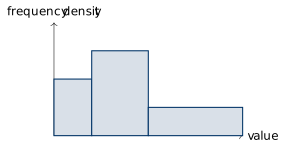
- G6–7 3. A histogram shows exam scores. Find an estimate for the number of students scoring above 70, using the areas of the bars. [3]
- G6–7 4. Estimate the median from a histogram with unequal class widths. [3]
- G6–7 5. Given a histogram, find the total frequency represented by all the bars. [2]
- G6–7 6. Explain why a bar chart would not be suitable for continuous data with unequal class widths, and why a histogram is used instead. [1]
- G8–9 7. A histogram has a class \(0 < x \leqslant 10\) with frequency 12 and frequency density 1.2. A second class \(10 < x \leqslant 30\) has frequency 18. Find its frequency density. [2]
💡Core idea
Use median and quartiles for position, and range or IQR for spread; compare both centre and variability.
📐Essential rules and method
Rules:
- Mean \(=\sum x/n\)
- Range \(=\) max\(-\)min
- IQR \(=Q_3-Q_1\)
- Cumulative frequency locates medians and quartiles
Method:
- Order or accumulate data
- Identify positions
- Calculate the requested measure
- Compare centre and spread separately
✏️Worked example — mark-scheme method
- Identify the method. Use median and quartiles for position, and range or IQR for spread; compare both centre and variability.
- Apply the method and show the mathematical evidence. A data set has lower quartile \(Q_1=12\) and upper quartile \(Q_3=29\). The interquartile range is \(\mathrm{IQR}=Q_3-Q_1=29-12=17\), which measures the spread of the middle 50% of the data.
- Check and present the answer. When comparing distributions, make one statement about average and one about spread in context. Check that every value has been used, signs and units are correct, and the final answer is in the form requested by the question.
⚡Exam hack
When comparing distributions, make one statement about average and one about spread in context.
Questions (12)
- G6–7 1. Find the median and interquartile range of the data set: \(12, 18, 7, 25, 9, 31, 14\). [3]
-
G6–7
2.
A box plot shows minimum 5, lower quartile 12, median 20, upper quartile 28, maximum 40. Describe the skew of the distribution. [1]

-
G8–9
3.
Draw a cumulative frequency table and graph from a grouped frequency table of ages, then estimate the median. [4]
- G6–7 4. Use a cumulative frequency graph to estimate the interquartile range of a data set. [2]
- G6–7 5. Compare two box plots, given their summary statistics, commenting on which data set has the higher median and which has more spread. [2]
- G6–7 6. The lower quartile of a data set is 15 and the upper quartile is 34. Find the interquartile range. [1]
- G6–7 7. Use a cumulative frequency graph to estimate the number of values above a given threshold. [2]
- G8–9 8. Given the five-number summary of two data sets, draw box plots for both and compare them. [3]
- G6–7 9. Find the range and interquartile range of the values: \(44, 29, 51, 38, 60, 33, 47\). [3]
- G6–7 10. A cumulative frequency table with 100 data points is used to estimate the 90th percentile. [2]
- G6–7 11. Explain why the interquartile range is often preferred over the range as a measure of spread. [1]
- G8–9 12. Given a cumulative frequency graph, estimate the median and the number of values below a given point. [3]